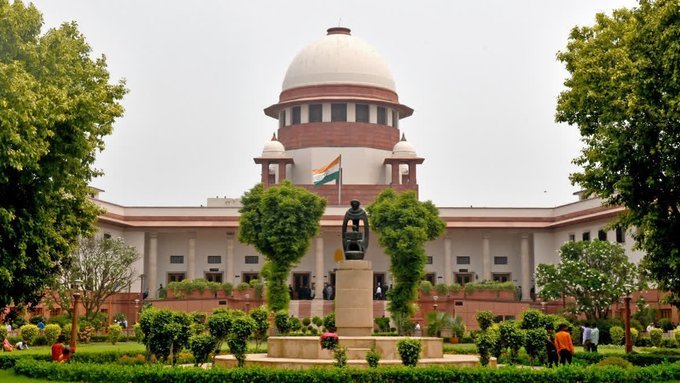
NEW DELHI: The Supreme Court on Wednesday took suo motu cognizance of a Patna High Court judgment that held that allegations of attempting to remove a woman’s salwar and physically molesting her by pressing her chest did not, in the circumstances of the case, constitute an offence of attempt to rape.
A three-judge Bench headed by Chief Justice of India Surya Kant and comprising Justice Joymalya Bagchi and Justice V. Mohana took note of the judgment and observed that some of the High Court’s observations were “offending”.
“There are some offending observations,” Chief Justice Surya Kant told Bihar Advocate General S.D. Sanjay during the hearing.
The CJI also made it clear that the Supreme Court would have to hear the accused before setting aside the High Court judgment. He directed the Bihar Advocate General to ensure that the accused was served through the local police.
The suo motu proceedings have been registered as “In Re: Order dated 09.07.2026 passed by the High Court of Judicature at Patna in Criminal Appeal (SJ) No. 775/2013 and ancillary issues”, under SMW (Crl.) No. 5/2026.
What the Patna High Court held
The Patna High Court judgment arose from an appeal by Himanshu Kumar Pathak against his conviction by a Sessions Court, which had sentenced him to three years’ rigorous imprisonment.
According to the prosecution case recorded in the judgment, the woman had accompanied her father to the appellant’s photography studio. The prosecution alleged that the appellant asked her father to wait outside while photographs were being viewed on a computer, bolted the studio door from inside, attempted to remove the woman’s salwar and physically molested her by pressing her chest.
The woman raised an alarm, following which her father forced open the door and the appellant allegedly fled.
The High Court, however, drew a distinction between the alleged acts and the legal threshold for an attempt to commit rape.
Justice Purnendu Singh held that the allegations established the use of criminal force against the woman and that the ingredients of Section 354 IPC, concerning assault or criminal force to a woman with intent to outrage, or knowledge that her modesty would be outraged, were made out.
But the court concluded that the prosecution evidence did not establish an attempt to commit rape under Section 376 read with Section 511 IPC.
The judgment said that, even if the prosecution case was accepted in its entirety, the alleged acts did not “unequivocally establish” the commission of an offence under Section 376(1) read with Section 511. The court therefore treated the conduct as falling, at most, within Section 354 IPC.
The High Court also referred to the absence of evidence of penetration and what it described as the absence of an overt act unequivocally constituting an attempt to rape. It accordingly set aside the conviction under Sections 376/511 IPC and acquitted the appellant of those charges.
Supreme Court had already intervened in similar Allahabad HC case
The Patna case came before the Supreme Court against the backdrop of another controversial ruling by the Allahabad High Court involving allegations against a minor girl.
In March 2025, the Allahabad High Court had held that allegations that two accused persons grabbed the breasts of a minor, broke the string of her pyjama and attempted to drag her towards a culvert amounted to acts falling short of an attempt to rape. The High Court treated the conduct as preparation rather than an attempt and modified the proceedings to lesser offences under the IPC and the POCSO Act.
The Supreme Court subsequently took suo motu cognizance of that judgment.
On February 10, 2026, a three-judge Bench headed by CJI Surya Kant set aside the Allahabad High Court judgment and restored the original summons issued by the POCSO court. The Supreme Court held that the allegations, if accepted at the relevant stage, went beyond mere preparation and disclosed a prima facie attempt to commit rape.
The Supreme Court emphasised the established distinction between preparation and attempt, observing that an attempt begins after preparation has been completed and that the conduct alleged in that case indicated execution of the criminal intent rather than merely preparatory acts.
READ: ECI Clarification Leaves Joshi-Sandhu Questions Unanswered
Supreme Court called for greater judicial sensitivity
The Allahabad case also led the Supreme Court to address a broader issue: the manner in which courts deal with sexual-offence cases.
The Court directed the National Judicial Academy, Bhopal, to constitute a five-member committee of experts to prepare a comprehensive report on developing guidelines aimed at inculcating sensitivity and compassion in judicial processes involving sexual offences and other vulnerable cases.
The Court said that the justice system should foster an environment of compassion and empathy and that judicial decisions should reflect humanity and understanding while maintaining the requirements of law.
The Supreme Court subsequently approved guidelines concerning judicial sensitivity in sexual-offence cases and directed courts to follow the prescribed approach.
Patna ruling flagged before Supreme Court in July
The Patna High Court judgment had already been brought to the Supreme Court’s attention in July, when Senior Advocate Shobha Gupta flagged it before the same Bench during the proceedings arising from the Allahabad case.
Senior Advocate H.S. Phoolka also raised the issue, pointing out that the Patna ruling had come despite the Supreme Court having already intervened in the Allahabad matter involving the distinction between preparation and attempt.
The lawyers argued that the reasoning and observations in the two cases raised similar concerns.
The Supreme Court has now formally registered a separate suo motu proceeding concerning the Patna judgment.
What the Supreme Court will examine
The Supreme Court’s intervention does not, at this stage, amount to a final finding that the Patna High Court’s legal conclusion was incorrect. The Bench indicated that the accused must first be heard before the judgment can be set aside.
The proceedings are therefore expected to examine both the legal reasoning adopted by the Patna High Court in distinguishing preparation from attempt and the nature of observations made in the judgment.
The case also places the Patna ruling in the context of the Supreme Court’s February 2026 judgment, in which it had already clarified the legal distinction between preparation and attempt in sexual-offence cases and called for a more sensitive judicial approach in such matters.
The Supreme Court’s latest proceedings will determine whether the Patna High Court judgment can stand in its present form.