The Supreme Court has already issued notice on a challenge to Section 16. The latest disclosures underline the importance of clarifying where institutional independence ends and legal accountability begins.
BY PC Bureau
New Delhi/September 23: The latest disclosures about serious differences within the Election Commission have added urgency to a constitutional question already pending before the Supreme Court: how far should the legal protection available to the Chief Election Commissioner and Election Commissioners extend?
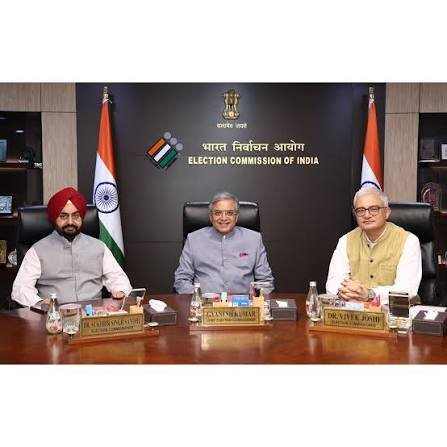
An investigation by The Indian Express has reported that Election Commissioners Sukhbir Singh Sandhu and Vivek Joshi formally objected at least 14 times over 10 months to decisions and orders of the poll panel, including on voter registration, deletion and restoration of names, appeals and the management of the electoral-roll database. Some of their objections were copied to Chief Election Commissioner Gyanesh Kumar.
The disclosures do not by themselves establish criminal wrongdoing by Gyanesh Kumar or either of the other Election Commissioners. But they raise an important institutional question because the disagreements reportedly concern the core functions of the Election Commission — the preparation and maintenance of electoral rolls and the procedures through which citizens are added to or removed from them.
One dispute concerned Form 6, the statutory application used by first-time voters to register. According to The Indian Express, the form on the ECINet portal was changed to ask applicants whether their own, or their parents’ or grandparents’ names appeared in the electoral roll of the last Special Intensive Revision. Joshi reportedly objected that such a change could not be made without amending the relevant statutory rules. Sandhu subsequently described the change as “unauthorised and illegal” and called for its removal.
Another concern involved what the two Election Commissioners described as the gradual centralisation of the electoral-roll database. They questioned whether statutory officers at the state and constituency levels were retaining the access required to perform their functions. The issue became serious enough for the two Commissioners to separately approach Cabinet Secretary T.V. Somanathan over changes affecting the Election Commission’s IT and administrative structure.
The significance of these objections goes beyond the personalities involved. Article 324 establishes the Election Commission as a constitutional body, while the 2023 law provides that its business should, as far as possible, be transacted unanimously and that differences between the CEC and ECs are to be resolved by majority. The reported objections therefore raise questions about how decisions were being taken and communicated within the Commission itself.
This makes the pending challenge to Section 16 of the 2023 Election Commissioners Act particularly significant.
Section 16 provides legal protection to a current or former CEC or Election Commissioner against civil or criminal proceedings for an act, thing or word done or spoken while acting, or purporting to act, in the discharge of official duty. The provision has been challenged before the Supreme Court by Lok Prahari.
In January 2026, the Supreme Court issued notice to the Centre and the Election Commission on the challenge but did not stay the operation of Section 16.
That distinction is important. The present legal position cannot be described as allowing prosecution of Gyanesh Kumar for official acts covered by Section 16. The provision remains in force unless and until the Supreme Court strikes it down, limits its scope or Parliament changes the law.
At the same time, the latest disclosures make an early judicial determination of the provision’s constitutional limits more consequential.
A cracker of a story by @RitikaChopra__
Days after two Elections Commissioners wrote (July 29) to Cabinet Secretary over the functioning of the Commission, two Deputy Election Commissioners moved out of the ECI.
Gyanesh Bharti on Aug 10 (Andaman CS) and Sanjay Kumar on Aug 28. https://t.co/9qOO5z7uEM pic.twitter.com/SF0VB2H8r3— Arvind Gunasekar (@arvindgunasekar) September 23, 2026
The issue before the Court is not whether an Election Commissioner should be exposed to criminal cases merely because another Commissioner disagrees with a decision. Such a standard could itself undermine the independence of the institution. Nor do internal disagreements automatically amount to evidence of an offence.
The harder question is what happens when an Election Commissioner formally alleges that a particular administrative step was unauthorised or contrary to statutory requirements, while the law simultaneously provides broad protection against civil and criminal proceedings arising from official acts.
READ: Gyanesh Kumar’s ECI Fiefdom: Two Members Cry Foul 14 Times in 10 Months
That question cannot be resolved simply by assuming either guilt or innocence. It requires the Court to define the boundary between legitimate institutional independence and legal accountability.
There is a strong constitutional rationale for protecting Election Commissioners from politically motivated litigation. The Commission must be able to conduct elections without the constant threat that every controversial decision will result in personal criminal or civil proceedings against its members.
But accountability is equally important for a constitutional institution exercising powers that directly affect citizens’ voting rights. The existence of statutory immunity makes the precise scope of that immunity especially important.
The Supreme Court therefore has an opportunity to settle a question that extends beyond the present controversy. It can determine whether Section 16 is constitutionally valid in its present form and, if so, how its protection should be interpreted. If the provision is constitutionally permissible, the Court can clarify what kinds of conduct fall within the protection of official duty and what, if anything, lies outside it.
The latest disclosures should not be treated as a finding against Gyanesh Kumar. They should instead be viewed as highlighting why the pending legal question cannot remain unresolved indefinitely.
The Supreme Court need not prejudge the CEC, the two Election Commissioners or the allegations reflected in their internal correspondence. But an early ruling on Section 16 would provide clarity to the Election Commission, Parliament, future Commissioners and, most importantly, citizens whose electoral rights depend on the credibility of the institution.
The fundamental question is straightforward: how can the law protect the independence of the Election Commission without allowing institutional immunity to become a barrier to accountability?
That question now deserves an authoritative constitutional answer.