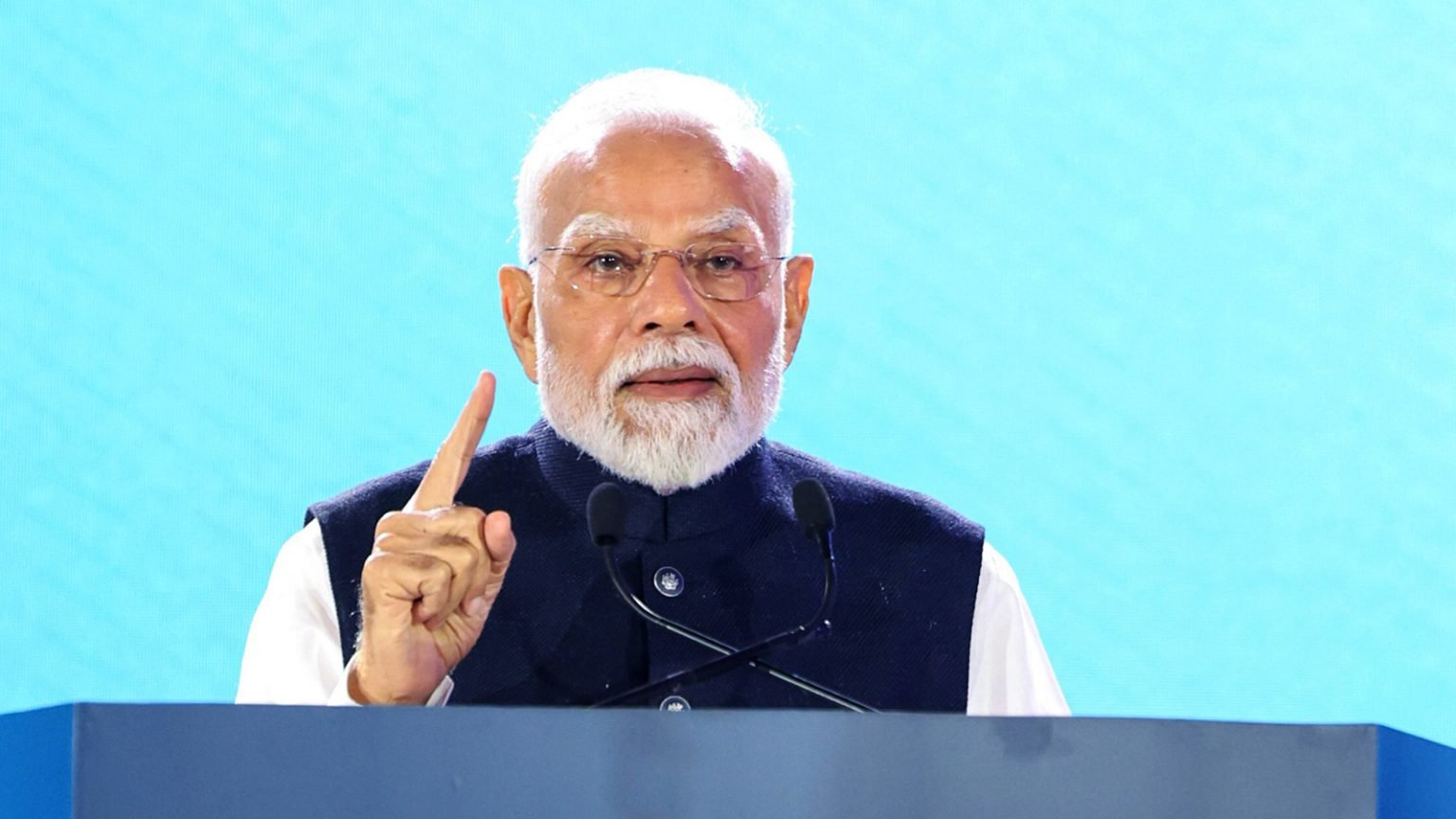
Addressing the Bloomberg New Economy Forum in New Delhi, Prime Minister Modi said growth should benefit the world rather than come at the expense of others.
BY PC Bureau
New Delhi: Prime Minister Narendra Modi on Tuesday presented India as a dependable partner in an increasingly uncertain world, calling on nations to harness technology, innovation and economic growth to expand opportunities and improve lives.
Addressing the Bloomberg New Economy Forum in New Delhi, being hosted in India for the first time, Modi put forward the theme of “Power to Empower”, arguing that the value of power lies not in who controls it but in how it is used to benefit society.
“The real question is not who possesses power. Rather, the question is how that power is being used,” he said, asking whether advances in technology and knowledge would remain concentrated in a few hands or create opportunities for millions.
Modi said the global economy was navigating a succession of disruptions, from the COVID-19 pandemic and regional conflicts to uncertainty over trade, critical minerals and energy supplies. Supply chains, payment networks and technology were increasingly becoming instruments of geopolitical pressure, he observed. At the same time, artificial intelligence was reshaping industries, while ageing populations were creating fresh economic challenges.
Against this backdrop, he said, countries needed reliable partners that could maintain supplies, honour commitments and stand by them during crises.
“We do not grow at anyone’s cost. We grow with the world, and for the world,” Modi said.
Economic growth and reforms
Citing India’s economic indicators, Modi said the country recorded 7.8% growth in the April–June quarter. He contrasted the current account deficit of 0.61% of GDP last year with levels exceeding 4% more than a decade ago, and noted that foreign exchange reserves had crossed $700 billion.
He also described the banking sector as being in its strongest position in decades and cited sovereign rating upgrades as evidence of growing economic confidence.
Modi said the government’s reform agenda was driven by a clear policy direction. He pointed to the Goods and Services Tax (GST), which created a unified national market, insolvency legislation, the consolidation of 29 labour laws into four labour codes, and the removal of criminal penalties for hundreds of minor business-related offences.
“For us, reforms are not a compulsion. Reforms are our conviction,” he said.
Digital technology and entrepreneurship
Modi presented affordable mobile data and expanding digital connectivity as examples of technology making economic opportunities more accessible. Students in smaller towns can access online education, village shopkeepers can reach customers beyond their immediate markets, and young people can acquire new skills through digital courses, he said.
He invited international delegates to examine India’s digital payments ecosystem, where street vendors and large automobile showrooms use the same underlying infrastructure despite the difference in their scale of operations.
India is also sharing its experience with Digital Public Infrastructure with countries in the Global South and other partners, Modi said, enabling them to develop systems suited to their own requirements. He cited the open-source CoWIN platform, developed during the pandemic, as another example of technology supporting large-scale public services.
Turning to entrepreneurship, he said India now had more than 2.5 lakh startups, compared with only a few hundred before 2014. Nearly half are based in smaller cities and towns, while more than 45% have at least one woman director or partner. This expansion, he argued, was bringing new talent and ideas into the innovation economy.
Technology-led welfare delivery
Modi said digital systems had also transformed welfare delivery through the JAM Trinity—Jan Dhan bank accounts, Aadhaar and mobile connectivity—and Direct Benefit Transfers. By sending benefits directly to recipients’ bank accounts, these mechanisms had reduced opportunities for corruption and made government assistance more accessible, he said.
He added that 25 crore people had moved out of poverty over the past decade, arguing that the purpose of government power should be to enable citizens to become self-reliant rather than dependent.
India’s domestic capabilities, he said, could also serve international needs. During the pandemic, the country supplied vaccines to more than 100 nations. Referring to the AI Impact Summit hosted in India earlier this year, he said discussions had explored applications capable of benefiting both humans and animals.
“When the world needs affordable medicines, one out of every five generic medicines comes from India,” Modi said.
He also highlighted the presence of more than 2,000 Global Capability Centres in India, which provide services to companies worldwide, alongside the contribution of Indian digital solutions and skilled professionals to the global economy.
READ: 13 Held in Manipur Valley Districts for Sharing Porn Videos on Telegram
Renewable energy and global cooperation
On climate action, Modi said India had achieved its target of sourcing 40% of installed electricity capacity from non-fossil-fuel sources in November 2021, nine years ahead of the 2030 deadline. He described India as the first G20 country to reach the milestone.
Renewable energy capacity, he said, had expanded from approximately 75 gigawatts in 2014 to around 300 gigawatts. Programmes such as PM Surya Ghar and PM-KUSUM were helping households and farmers adopt solar power, with the schemes delivering more than 30 gigawatts of capacity and estimated to prevent over three crore tonnes of carbon emissions annually.
VIDEO | Delhi: “India is the mother of democracy,” says Prime Minister Narendra Modi at the Bloomberg New Economy Forum.
(Source: PM Modi’s YT)
(Full video available on PTI Videos – https://t.co/d8jp61yd2p) https://t.co/sE41rrZFND
— Press Trust of India (@PTI_News) October 13, 2026
Solar energy, he argued, could advance both environmental protection and economic empowerment by enabling households and farmers to participate in the clean-energy transition.
Modi also cited the International Solar Alliance, the Coalition for Disaster Resilient Infrastructure, the Big Cat Alliance, the Global Biofuel Alliance, the India–Middle East–Europe Economic Corridor and Mission LiFE as initiatives aimed at addressing challenges through international cooperation.
He linked these efforts to the broader principles of “One Sun, One World, One Grid”, “One Earth, One Family, One Future” and “One Earth, One Health”, presenting them as expressions of a shared approach to global development.
India’s diversity and democratic traditions
Describing India as the “Mother of Democracy”, Modi drew attention to the country’s linguistic and media diversity. He cited more than 100 languages, nearly 80,000 registered newspapers and publications, over 1,000 satellite television channels, and more than 50 crore users each on YouTube and Instagram.
Welcoming participants to New Delhi, he thanked Bloomberg for bringing the forum to India and acknowledged the organisation’s longstanding engagement with the country.
In his concluding remarks, Modi invoked a Vedic message calling on people to move forward together, engage in dialogue and develop mutual understanding. He urged delegates to use their resources and capabilities not merely for their own advancement but to create opportunities for others and help address the challenges facing the world.