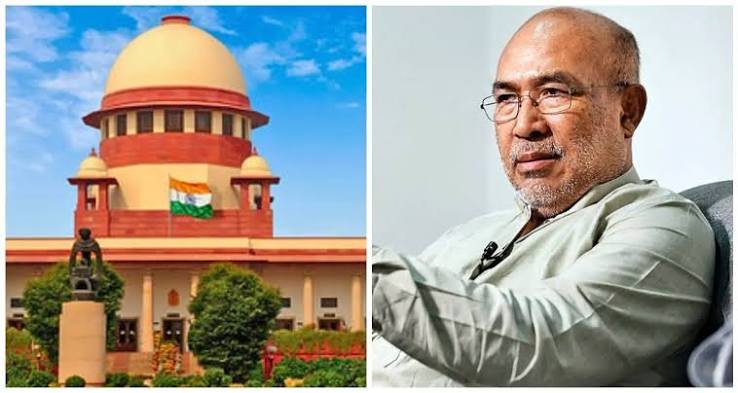
The Supreme Court directed that the latest NFSU forensic report on the alleged Biren Singh audio clips be shared with the Kuki Organisation for Human Rights in a sealed cover, while ordering that the report remain confidential.
BY PC Bureau
August 7, 2026: A dispute over conflicting forensic reports took centre stage before the Supreme Court on Thursday as Advocate Prashant Bhushan contested the National Forensic Sciences University’s conclusion that the alleged Biren Singh audio clips had been altered. Citing a Truth Labs report that identified the former Manipur Chief Minister’s voice with over 93% certainty, Bhushan alleged “complete mala fides,” while the Court directed that the latest NFSU report be supplied to the parties in a sealed cover without being made public.
A Bench of Justice Sanjay Kumar and Justice Sanjeev Sachdeva was hearing a petition filed by the Kuki Organisation for Human Rights (KOHR), which seeks an investigation into the alleged audio recordings. The Bench directed that the latest NFSU report be shared with the petitioner but stressed that its confidentiality must be maintained.
The report was produced before the Court in a sealed cover by Additional Solicitor General Aishwarya Bhati, appearing for the Union. She informed the Bench that the NFSU had concluded that the examined audio clips, including the first-generation copy submitted by the whistleblower, had been altered. As a result, the agency was unable to authenticate the recordings or conduct a reliable comparison with Biren Singh’s admitted voice samples.
Bhati submitted that repeated forensic attempts had failed because the recordings had been manipulated. In these circumstances, she urged the Court to dismiss the writ petition, arguing that no reliable forensic verification was possible.
Bhushan, however, disputed the conclusions and maintained that the findings were contrary to the earlier analysis conducted by Truth Labs. He also informed the Court that he intended to share the NFSU report with Truth Labs for its opinion.
Recording the submissions, the Bench directed that the coloured copies of the NFSU report be furnished to the parties in sealed covers. “Confidentiality of the report should be maintained to the extent of not making it public or placing it in public,” the Court ordered.
READ: Viral ‘Moving Well’ in Gujarat Sparks Superstition
The case has witnessed multiple rounds of forensic examination after earlier reports failed to conclusively establish the authenticity of the recordings. In February last year, the Supreme Court directed that the report of the Central Forensic Science Laboratory (CFSL), Guwahati, be produced before it in a sealed cover. Finding the report unsatisfactory, the Court subsequently ordered a fresh forensic examination.
In August, the Court entrusted the exercise to the NFSU after the CFSL reported that it could not reach any clear findings. Later, in January this year, the Bench directed the NFSU to examine the entire 48-minute recording and compare it with Biren Singh’s admitted voice samples.
During the proceedings, it emerged that the NFSU was unable to complete the comparison because the audio appeared to have been modified. The Court then asked Bhushan to ascertain whether the whistleblower would be willing to produce the original, unmodified recording. Bhushan informed the Court that doing so could expose the whistleblower’s identity but said he would explore the possibility.
Subsequently, the Court was informed that the whistleblower had submitted an audio recording running for more than two hours and 26 minutes. The Bench then directed the State to provide Biren Singh’s admitted voice samples for comparison. On April 30, it further ordered that the first-generation copy of the recording be sent to the NFSU for forensic examination.
The latest report has now concluded that the recordings examined had been altered, rendering forensic authentication and voice comparison impossible. The matter remains pending before the Supreme Court.