Trends suggest Vijay’s TVK has cut into the traditional vote bases of both the Dravida Munnetra Kazhagam and the All India Anna Dravida Munnetra Kazhagam, with strong support among youth and first-time voters.
By PC Bureau
May 4, 2026: As counting trends from Tamil Nadu on May 4, 2026 continue to settle, one storyline stands out with unusual clarity: the remarkable debut of actor-turned-politician Vijay and his party Tamilaga Vettri Kazhagam.
Early projections suggest TVK has not merely entered the electoral arena—it has disrupted it, emerging as a significant force in its first election and reshaping the contours of a political landscape long dominated by the Dravidian majors.
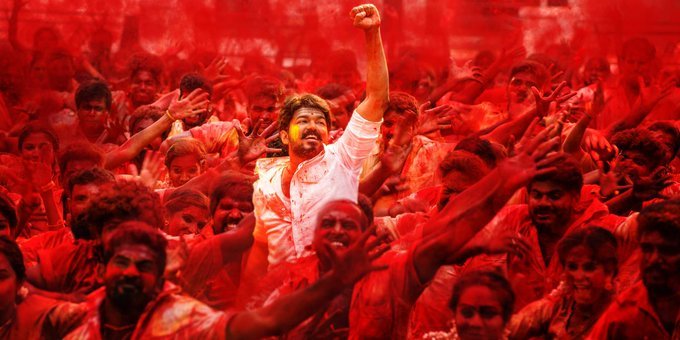
Vijay’s political rise has been built on a foundation that few new entrants possess: decades of mass cinematic appeal. For years, he has been one of Tamil cinema’s most bankable stars, commanding massive opening crowds, strong fan networks, and a loyal youth following.
But what distinguishes his transition is not just fame—it is persona.
On screen, Vijay has often been cast as the idealised protector figure: a morally upright, socially conscious hero standing against corruption and injustice. Over time, this screen identity has blended with his public image, creating a perception of authenticity and emotional relatability that has carried into his political messaging.
TVK’s campaign has leveraged this carefully, positioning itself as a vehicle for change rather than continuity. Large rallies, strong youth participation, and high visibility on social media platforms have amplified the sense of momentum around the party.
Tamil Nadu’s Long Relationship Between Cinema and Politics
Vijay’s emergence is not an anomaly in Tamil Nadu—it is part of a long political tradition.
The state has repeatedly seen cinema shape its political leadership and electoral outcomes. The most prominent example remains M. G. Ramachandran, whose transition from film hero to Chief Minister redefined mass politics in the state. His screen image of a benevolent protector translated directly into political authority.
They said cinema fame won’t work in politics
Vijay came without money politics, without alliances, without fake identity And now in his very first election, he is winning
This is not just a political entry
This is history in the making
Thalapathy Vijay, the STAR of Tamil Nadu… pic.twitter.com/igZQqeyO0u— Prayag (@theprayagtiwari) May 4, 2026
Similarly, J. Jayalalithaa built her political legitimacy on a strong cinematic foundation, eventually evolving into one of the most powerful political figures in Tamil Nadu’s history.
This pattern established a unique political culture where cinematic charisma often becomes a legitimate pathway to political power.
Vijay’s TVK, in many ways, is the latest expression of this tradition—though under very different technological and demographic conditions.
Breaking the Dravidian Binary
For decades, Tamil Nadu politics has been defined by a stable two-party dominance between the Dravida Munnetra Kazhagam and the All India Anna Dravida Munnetra Kazhagam.
This Dravidian duopoly has survived multiple waves of anti-incumbency, leadership changes, and electoral realignments. Even when new players have entered the field, none have fundamentally altered the structure.
READ: BJP Breakthrough in Bengal, Vijay’s TVK Shakes Tamil Nadu
TVK’s performance in 2026 now challenges that equilibrium.
Early counting trends suggest that Vijay’s party is not only cutting into vote shares of both DMK and AIADMK but, in several constituencies, leading outright. This marks a shift from being a “third force” to a potential “first wave disruptor.”
Youth Vote and Emotional Mobilisation
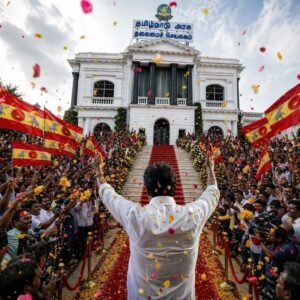
A key factor behind TVK’s rise appears to be its appeal among younger voters and first-time electors.
In many constituencies, early reports suggest higher-than-expected youth turnout aligning with TVK. Political analysts attribute this to a combination of anti-incumbency sentiment, aspiration-driven politics, and the emotional connection built through Vijay’s long cinematic career.
Unlike traditional parties, TVK has not relied heavily on deep organisational networks. Instead, it has leaned on mass mobilisation events, digital outreach, and personality-driven engagement.
This strategy appears to have worked—at least in terms of visibility and initial vote conversion.
What This Means for DMK and AIADMK
For the Dravidian majors, the emergence of TVK is both a warning and a structural challenge.
The Dravida Munnetra Kazhagam, currently in power, appears to have retained significant support in traditional strongholds but is facing erosion in urban and youth-centric constituencies where TVK has surged.
The All India Anna Dravida Munnetra Kazhagam, meanwhile, continues to struggle with organisational rebuilding and vote consolidation, leaving space for TVK to capture disaffected voters.
If TVK sustains even part of its early performance, it could force both parties to rethink their long-term strategies—especially their engagement with younger demographics and digital political mobilisation.
A Structural Shift or a One-Time Surge?
The key question now is whether Vijay’s political debut represents a structural shift or a personality-driven surge.
On one hand, Tamil Nadu’s history suggests that cinematic charisma can translate into durable political power if supported by organisation, ideology, and sustained mobilisation—as seen in the cases of MGR and Jayalalithaa.
On the other hand, several earlier attempts by film personalities have failed to sustain momentum beyond initial enthusiasm.
TVK’s future will depend on whether it can transition from a personality-centric movement into an institutional political force.
A New Variable in Tamil Nadu Politics
Regardless of final seat outcomes, the 2026 election has already altered Tamil Nadu’s political conversation.
Vijay and Tamilaga Vettri Kazhagam have introduced a new variable into a long-stable political system—one built on mass appeal, emotional resonance, and cinematic identity.
For the Dravidian parties, the message is clear: the political field is no longer strictly bipolar. For the electorate, it signals the return of a familiar Tamil Nadu phenomenon—where cinema once again steps into politics not as a spectator, but as a contender.
Whether this moment becomes a turning point or a passing surge will depend on what comes after the counting ends.