BY PC Bureau
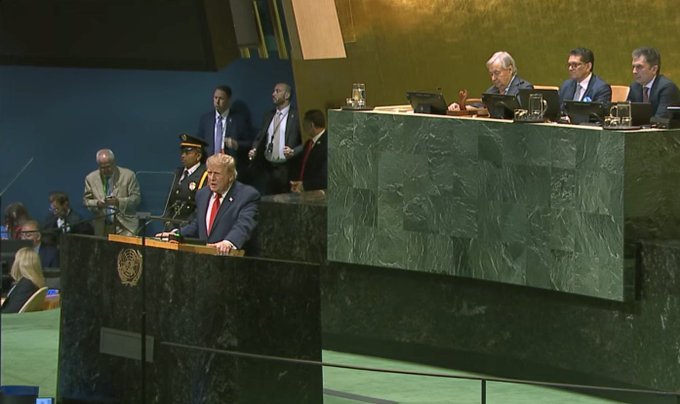
September 22: US President Donald Trump used his address to the 81st United Nations General Assembly on Tuesday to defend the US military campaign against Iran, claim credit for ending the Gaza war, warn of threats in the Western Hemisphere and reject what he described as attempts to impose a system of global governance on the United States.
Speaking at UN headquarters in New York, Trump portrayed American military power and diplomacy as the principal forces behind what he described as recent gains in international security. His address came as the US-Iran conflict entered its seventh month and as world leaders gathered for a General Assembly dominated by wars in the Middle East, Ukraine and growing questions over the future role of the UN.
Iran occupied much of Trump’s speech. He described Tehran as a major sponsor of terrorism and repeated his pledge that Iran would not be allowed to acquire a nuclear weapon. Trump said he had initially sought negotiations and offered economic cooperation in return for an end to Iran’s nuclear programme, but claimed Tehran rejected the offer.
He then defended the US military operations against Iran, including Operation Midnight Hammer, the US strikes on Iranian nuclear facilities, and Operation Epic Fury, the broader campaign launched against Iran in 2026. The White House has described Epic Fury as a campaign intended to destroy Iran’s missile and naval capabilities, disrupt its support for armed proxies and prevent it from acquiring a nuclear weapon.
Trump claimed the US campaign had severely damaged Iran’s nuclear infrastructure and military capabilities and said the Iranian economy had been devastated. He also made a series of sweeping claims about Iranian casualties, inflation and military losses that were presented as part of his case for continuing pressure on Tehran. Such claims should be treated as statements by the US president rather than independently verified figures.
Trump also linked Iran to the October 7, 2023, Hamas attack on Israel and accused the Iranian leadership of supporting terrorism across the region. He called on other countries to increase economic pressure on Tehran, particularly over its nuclear programme, attacks on shipping and support for armed groups.
At the same time, Trump left the door open to negotiations. He said Iran faced a choice between reaching a deal with Washington and continuing on its present course, while predicting that an agreement could eventually be reached.
The US-Iran confrontation has become one of the defining issues of this year’s UN gathering. Iran has indicated that it is prepared to discuss a possible diplomatic path, while the Trump administration has continued to insist that Tehran must meet its demands on the nuclear programme.
READ: Bihar’s Moral Policing: Main Accused Shot in Leg in Police Encounter
Gaza and the claim of a peace breakthrough
Trump also presented Gaza as evidence of what he described as the effectiveness of his diplomatic approach.
He contrasted the situation at the previous UN gathering, when the Gaza war was still raging and hostages remained in captivity, with what he portrayed as the current situation following US diplomatic efforts. Trump said his administration had helped end the war, save thousands of lives and secure the return of hostages.
Before the speech, US Ambassador to the UN Mike Waltz had said Trump would discuss progress on a 20-point Gaza peace plan and the proposed international mechanism for reconstruction and stabilisation.
Trump’s presentation of Gaza as a major diplomatic success was part of a broader argument: that the United States could achieve results through a combination of military strength and direct negotiations rather than through multilateral institutions alone.
That approach put him at odds with the wider message from UN Secretary-General António Guterres, who warned in his opening address that global divisions had deepened and called for renewed international cooperation. Guterres condemned the October 7 attack while also describing the destruction and loss of life in Gaza as unprecedented in his experience.
Trump goes to the UN. Regurgitates a half ass version of the SOTU. Dumb. https://t.co/rACJkG5mDb
— Gus (@Gus_802) September 22, 2026
‘America First’ at the UN
Trump’s message extended beyond the Middle East.
He warned that the United States would not allow threats to take root in the Western Hemisphere and said Washington would use military force when necessary to protect American interests. He singled out drug cartels, comparing them with terrorist organisations and accusing them of murder, trafficking and other crimes.
He also attacked what he described as efforts to undermine US sovereignty through international institutions. Trump rejected the idea of a global government or global taxation and argued that national governments should retain control over their own political and economic decisions.
The remarks reflected the broader “America First” approach that has characterised Trump’s foreign policy: cooperation where it serves US interests, but resistance to international arrangements that Washington believes constrain American sovereignty.
A speech built around strength
Trump’s UN address therefore combined three messages: military strength against Iran, diplomatic claims over Gaza and a rejection of what he sees as excessive authority for international institutions.
The speech came at a moment when the UN itself is facing pressure over its ability to respond to multiple wars. The General Assembly’s 81st session is being held from September 22 to September 28, with the high-level debate bringing world leaders together in New York.
For Trump, however, the central argument was less about strengthening the existing multilateral order than demonstrating what he considers the results of American power.
He presented the Iran campaign, his Gaza diplomacy and US actions elsewhere as evidence that Washington can shape international events through military capability, economic pressure and direct negotiations.
The response from other governments is likely to focus on the gap between those claims and the continuing conflicts that brought world leaders to New York in the first place.