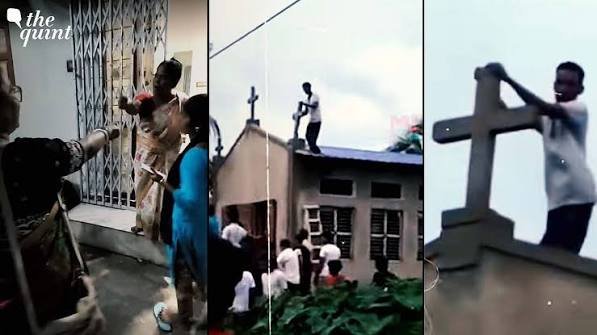
From disrupted house prayers to allegations of assault and intimidation, Christian organisations say a disturbing pattern has emerged in Bengal since the change of government. Hindu groups, however, allege that some prayer meetings are linked to inducement-based conversions.
BY PC Bureau
The trouble began, the family says, at home.
For three days in mid-September, the house of Putul Manna and her husband, Kanchan Manna, in Ghoraberia Dakshin Bhatora village in Howrah’s Amta area, became the centre of a confrontation over something that should ordinarily have been deeply private: prayer.
The Mannas say they had been holding Christian prayers at their home when a large group entered the premises on September 16 and demanded that they abandon Christianity and accept Sanatan Hinduism. What followed, according to their complaint and subsequent accounts, was not a single confrontation but a series of escalating encounters. The family says they were abused and assaulted in front of their two minor sons, while threats were made to drive them from their home if they refused to give up their faith.
The following day, the family alleges, another group returned. Household belongings were thrown outside, Kanchan was beaten and Putul was dragged by her hair. The complaint also alleges that the couple were pressured to sign a document concerning their children. Putul later told The Times of India that the family had considered leaving but questioned why her children should be forced out of their ancestral home.
The allegations have not been adjudicated by a court. Police have registered a complaint and begun an investigation. But the case has acquired significance far beyond one village because it comes amid a growing dispute in West Bengal over Christian prayer meetings, allegations of religious conversion and the increasingly confrontational response of groups opposed to them.
For Christian organisations, the Howrah episode is evidence of something larger: a climate in which ordinary house prayers can trigger accusations of forced conversion and, in some cases, physical confrontation. The Bangiya Christiya Pariseba, a Christian forum that says it represents more than 1.3 million Catholics and Protestants in the state, says it has documented 26 incidents over roughly three months and that 11 resulted in FIRs. It has submitted the list to Chief Minister Suvendu Adhikari, asking the government to intervene.
READ:
Saffronization at its Peak in West Bengal
A Christian woman was brutally beaten by a BJP’s saffron-clad mob on the fake, hateful lie of “forced conversion” in West Bengal.
This is state-backed thuggery. Under BJP rule, mobs storm homes, drag women by their hair, assault… pic.twitter.com/wbsa8N98mP
— Roshini Sen (@RoshiniSen_in) September 22, 2026
The number is significant, but it comes from the organisation itself and has not been independently audited as a statewide database. What is harder to dispute is that a series of confrontations has been reported since May from different parts of Bengal. Prayer meetings have been disrupted, worshippers have alleged assaults, property has been damaged and, in some cases, Christians have themselves faced police action following accusations of unlawful conversion.
One such confrontation took place in Uluberia, also in Howrah, on August 23. A Sunday prayer meeting was under way in a rented house when a group arrived and accused those present of conversion activities. Pastor Mithun Hazra alleged that men and women were beaten and furniture was damaged. Police confirmed an FIR and said an investigation was under way.
📍Dharmatala, Kolkata, West Bengal
On September 11, members of Hindu Sanghati reportedly disrupted a Christian prayer meeting, assaulted attendees and vandalised the gathering, alleging religious conversion through promises of healing and financial benefits. pic.twitter.com/HAatndnfju
— Voice of Indian Minorities 🇮🇳 (@VOIM_Matters) September 22, 2026
Similar episodes have been reported in Medinipur, Bankura and elsewhere. Christian groups describe the incidents as intimidation of a religious minority. Hindu organisations involved in some of the confrontations tell a different story. They argue that prayer meetings are sometimes being used as a cover for converting Hindus through money or other inducements, and say their objections should not automatically be dismissed as communal hostility.
That competing narrative is now colliding with a new political reality in Bengal.
The BJP came to power in the state in May, ending the Trinamool Congress’s long tenure, and the new government has made opposition to what it describes as forced or inducement-based conversion part of its broader political agenda. Adhikari has announced plans for a stringent anti-conversion law and a Uniform Civil Code, linking the proposed measures to concerns over demographic change, infiltration and religious conversion.
Christian organisations see a danger in this atmosphere. Their concern is that an allegation of conversion could become enough to legitimise intervention by private groups before the police or courts have established whether any offence has actually occurred.
Hindu organisations and BJP voices reject that interpretation. They argue that genuine complaints about unlawful conversion deserve investigation and that not every objection to a prayer meeting should be portrayed as an attack on Christianity. BJP leaders have also disputed the description of the incidents as a systematic campaign against Christians.
That leaves Bengal with a dispute in which the facts of individual cases matter enormously. A prayer meeting is not, by itself, evidence of conversion. An allegation of conversion is not, by itself, proof that a crime occurred. And an allegation of conversion cannot provide a legal justification for a private group to assault or intimidate worshippers. Equally, claims of unlawful inducement cannot be dismissed without investigation simply because they arise in a politically charged environment.
READ: The Trafficking Trail: Where Are the Missing Imphal Girls?
The Howrah family’s account brings that larger argument down to the level of one home, two children and a couple who say they were told to choose between their faith and their place in their own house.
For the Mannas, the question is not about the wording of a proposed law or the politics of demographic change. It is whether they can pray in their own home without being threatened.
For the Christian organisations now pressing the government, the question is whether the Howrah incident is an isolated confrontation or part of a pattern spreading across Bengal.
And for the government and police, the challenge is more fundamental: to determine, case by case, whether allegations of unlawful conversion are supported by evidence—and to ensure that whatever the answer, the enforcement of the law remains with the state rather than the street.