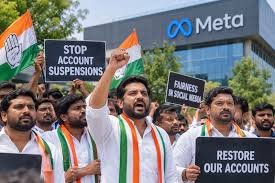
The sharp rise in Meta content restrictions comes amid tighter IT Rules, including a three-hour takedown deadline and expanded use of automated filters, raising concerns over online censorship and freedom of expression.
BY PC Bureau
NEW DELHI/ November 22: Meta restricted access to more than 5.4 million pieces of content in India during the first half of 2026, a dramatic increase from approximately 70,000 during the entire previous year, according to the company’s transparency disclosures. The surge has intensified concerns over online censorship, government-mandated content removal and the impact of India’s tightened information technology rules on freedom of expression.
The figures cover content restricted under Indian law on Meta platforms, primarily Facebook and Instagram. The company’s January-June 2026 disclosure puts the total at 5,438,958 items, including 2,822,404 on Facebook and 2,616,554 on Instagram. More than 20,000 additional items were restricted on Threads, according to the separate platform disclosure.
The scale of the restrictions is striking. The first-half figure is nearly 78 times the approximately 70,000 restrictions recorded during all of 2025. It also represents an average of around 30,000 items a day during the six-month reporting period.
Meta attributed the restrictions to its obligations under Indian law, including compliance with requests from government and law-enforcement agencies. Its disclosure refers to requests and reports from the Ministry of Electronics and Information Technology (MeitY), the Ministry of Information and Broadcasting, the Indian Cyber Crime Coordination Centre and state law-enforcement agencies. It also includes restrictions carried out through automated systems.
🇺🇸🇮🇳 Meta has restricted more than 5.4 MILLION posts and accounts in India during the first half of 2026, compared with just 70,000 in 2025.
The massive surge follows new government rules introduced in February, requiring platforms like Facebook and Instagram to remove content deemed unlawful within just THREE HOURS of receiving an official notice.
Previously, companies had 36 hours to comply.
The restrictions have reportedly affected opposition politicians, journalists and activists, including accounts criticizing Modi’s government and the ruling BJP.
The crackdown has sparked protests, with Youth Congress activists demonstrating outside Meta’s Hyderabad office on Friday, accusing the company of helping silence political opposition.
The Indian government insists the restrictions are necessary to enforce existing laws and protect public safety and ‘national security.’
Source: Reuters / Writer: Mhedi
— Mario Nawfal (@MarioNawfal) November 22, 2026
The company said the large majority of the restrictions involved instances in which it was required to proactively block content, including identical copies of material previously restricted under Indian legal requirements. Meta said it was continuing to test and refine its implementation of the system.
The disclosures have become particularly contentious because the increase coincided with amendments to India’s Information Technology Rules, which came into effect on February 20, 2026.
Three-Hour Deadline and Automated Restrictions
The amended rules reduced the time available to social media platforms to remove or disable access to content identified as unlawful through an authorised government or law-enforcement notice from 36 hours to just three hours.
The changes also strengthened the requirement for major platforms to deploy automated tools to identify and restrict content that is exactly identical to material previously taken down under a valid court order or government direction.
This distinction is important. The three-hour deadline applies to specified takedown notices, while the automated mechanism under Rule 4(4) is intended to identify identical copies of content already removed. Together, the provisions have expanded the pressure on platforms to act quickly and at scale.
The amendments have drawn criticism from digital-rights advocates and legal experts, who argue that the compressed compliance window leaves little time to examine the legality and context of individual requests. They also warn that automated systems could restrict legitimate material, including journalism and political commentary, if previously blocked content is reproduced or discussed in a different context.
Meta’s disclosure identifies several areas in which restrictions have been imposed under local legal requirements. These include online gaming, synthetically generated content depicting prominent figures, material considered threatening to India’s sovereignty and integrity, gender-based harassment and content promoting enmity between groups.
📊 Key Highlights Box
Main drivers: Amended IT Rules (3-hour takedown deadline from 20 Feb 2026) + proactive restrictions of identical copies at scale.
Categories cited: Online gaming, synthetic content of prominent figures, threats to sovereignty, gender-based harassment, promoting enmity between groups.
Source: Meta Transparency Report (India)
Youth Congress Protests at Meta Offices
The controversy escalated on November 20, when Indian Youth Congress workers staged protests at Meta-linked offices in Hyderabad, Mumbai and Gurugram, demanding the restoration of Instagram accounts belonging to two of the organisation’s senior office-bearers.
The accounts of Youth Congress national president Uday Bhanu Chib and national in-charge Manish Sharma were reportedly restricted on November 19. The organisation alleged that the action had been taken at the direction of the BJP-led government and accused Meta of suppressing opposition voices.
The allegations have not been substantiated by publicly disclosed government orders or evidence of political instructions to the company.
In Hyderabad, protesters entered the building housing Meta’s offices and clashed with security personnel and police. Videos showed flower pots being damaged during the demonstration. Police detained around 20 protesters, including Telangana Youth Congress president Jakkidi Shivacharan Reddy.
In Mumbai, demonstrators reportedly spray-painted slogans on the walls outside the building housing Meta’s office. In Gurugram, workers carried banners demanding the restoration of the restricted accounts.
The Youth Congress subsequently claimed that the accounts of Chib and Sharma had been restored shortly after the demonstrations. The timing of the restoration was highlighted by the organisation, although Meta has not publicly confirmed that the protests prompted the decision.
The party also issued a seven-day ultimatum, demanding that Meta lift restrictions on accounts belonging to opposition politicians, journalists, activists and content creators. It sought details of the number of Indian accounts restricted following government directions and the number that remain inaccessible.
Manu Jain, who handles the Youth Congress’s social media operations, claimed that thousands of accounts belonging to journalists, creators and influencers critical of the government remained restricted.
Meta declined to comment on the demonstrations. The company has maintained that restrictions in India are imposed to comply with local legal requirements.
The protests drew a sharp response from the BJP. Party spokesperson Pradeep Bhandari accused Congress workers of vandalising private property, while leaders of the Bharat Rashtra Samithi also criticised the disruption, arguing that it damaged Hyderabad’s image as a business destination.
Delhi High Court Issues Notice To Meta
The debate has acquired a significant legal dimension, with the Delhi High Court issuing notice to Meta and the Union government on a petition challenging the company’s automated content-restriction mechanism.
The petition was filed by Live Law Media Private Limited and its director, Sindhu T.P. It challenges the use of automated filters under Rule 4(4) of the IT Rules and seeks scrutiny of government directions that allegedly resulted in restrictions on the platform’s Instagram and Facebook content.
The case concerns three Instagram reels published by LiveLaw reporting proceedings in the Supreme Court. Two were reportedly made inaccessible to users in India within 15 minutes of being uploaded. LiveLaw said it had not received the orders or reasons behind the restrictions and was informed only that access had been disabled pursuant to a legal request.
The publication argued that the automated system risks restricting legitimate journalism without giving publishers adequate notice or an opportunity to challenge the action.
The petition also refers to two MeitY advisories issued on October 8 and 10, 2026, which reportedly asked platforms to give priority to complaints from authorised government agencies and exercise enhanced diligence over certain categories of content.
The Delhi High Court has given the Centre and Meta four weeks to file their responses and listed the matter for further hearing on January 18, 2027.
The case could have wider implications for the way social media platforms implement government takedown directions, particularly when automated systems are used to restrict identical copies of previously blocked material.
READ: Akhilesh Sets Up 4-Member Panel for Seat-Sharing Talks with Congress
Government Cites Public Safety and National Security
The government has defended the tighter regulatory framework as necessary to enforce existing laws and address content that threatens public safety, national security and public order.
Under the amended rules, platforms are required to comply with specified legal directions within the shortened time frame. The government maintains that the measures are intended to ensure faster action against unlawful material rather than suppress legitimate political criticism.
Meta, meanwhile, has said that the large majority of restrictions recorded in its India disclosure were linked to legal obligations, including proactive restrictions on identical copies of previously blocked content.
The central question, however, is how to ensure that compliance with legal directions does not result in the excessive removal of lawful speech. The scale of the restrictions, the complaints from journalists and opposition groups, and the challenge before the Delhi High Court have brought that issue into sharper focus.
With the Youth Congress threatening further protests and the legal challenge moving forward, scrutiny of Meta’s content moderation practices in India is likely to intensify. The company and the government now face growing demands for greater transparency about the legal orders behind the restrictions, the working of automated filters and the safeguards available to users whose content is blocked.