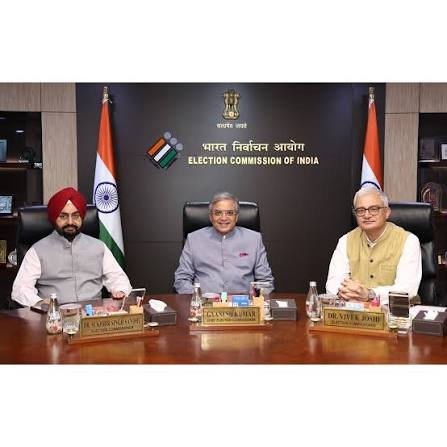
The unprecedented internal dispute has exposed deep differences within the three-member Election Commission, with Sukhbir Singh Sandhu and Vivek Joshi raising objections on key issues linked to the nationwide SIR.
NEW DELHI: An unusual rift has emerged inside the Election Commission of India, with Election Commissioners Sukhbir Singh Sandhu and Vivek Joshi recording formal objections at least 14 times over a 10-month period to decisions and actions taken in the name of the Commission.
According to documents reviewed by The Indian Express, the objections were recorded between November 2025 and August 2026. Four were filed on a single day, while several were copied to Chief Election Commissioner Gyanesh Kumar. The two commissioners questioned decisions relating to new voter registrations, electoral-roll deletions and appeals, the functioning of the Commission’s IT systems and the management of the digital electoral-roll database.
The ECI did not respond to a detailed questionnaire from The Indian Express, while Sandhu and Joshi did not respond to follow-up emails and calls, the newspaper reported.
The dispute unfolded as the Commission was conducting its nationwide Special Intensive Revision (SIR) of electoral rolls. The exercise began in Bihar in June 2025 and was subsequently expanded to other states and Union Territories. The draft rolls across 30 states and UTs reportedly excluded more than 13 crore names.
The significance of the internal objections lies in the constitutional structure of the poll body. The three-member Commission is expected to act unanimously “as far as possible”, while differences are decided by majority. Sandhu and Joshi, according to their recorded notes, questioned whether key decisions were being placed before the full Commission at all.
The two commissioners reportedly did not have a full meeting with the CEC for four months. Their first such meeting in that period took place on September 9, 2026.
Astounding story on the front Page of the Express!
2/3 ECIs objected to Gyanesh Kumar’s moves on various directives of ECI regarding SIR. But govt’s hatchet man Gyanesh Kumar illegally kept issuing directives which has resulted in disenfranchising >13 Cr voters so far!
SC must… pic.twitter.com/4TTiUVBcMI— Prashant Bhushan (@pbhushan1) September 23, 2026
The Form 6 dispute
One of the most significant disagreements concerned Form 6, the statutory application used by people seeking registration as voters.
Form 6 is prescribed under the Registration of Electors Rules, 1960. Those rules cannot simply be altered through an administrative instruction; changes require the prescribed legal process, including consultation with the Commission and notification by the Centre.
The issue arose when the Commission considered linking Form 6 to the SIR process.
In a note dated May 16, Vivek Joshi recorded that the SIR was a special revision under Section 21(3) of the Representation of the People Act, 1950, while the enumeration forms being used in the exercise were non-statutory. He argued that Form 6 and Form 8 could not be altered merely through an SIR order or guideline and said any proposed changes should go through the government and be placed before the full Commission.
Sandhu subsequently concurred with Joshi’s position on May 19.
Despite that, the online version of Form 6 on the ECINet portal was changed. Applicants were asked to select one of three statements: that their own name appeared in the previous SIR roll, that a parent or grandparent appeared in it, or that neither did.
Although the additional section was not explicitly marked mandatory, applicants could not complete the online form without choosing one of the options.
Sandhu objected again on August 13, describing the alteration as “unauthorised/illegal” and calling for the additional question to be removed immediately. He argued that the requirement could create difficulties for eligible first-time voters whose families did not appear in the older electoral roll.
The issue is particularly sensitive because the right to register as a voter is determined by statutory eligibility requirements such as age, citizenship and ordinary residence—not by whether a parent or grandparent appeared in an earlier electoral roll.
A fight over the electoral database
The commissioners’ concerns extended beyond Form 6 to the technology used to maintain electoral rolls.
Under the statutory framework, Electoral Registration Officers, or EROs, are responsible for preparing electoral rolls in their constituencies and deciding claims and objections relating to inclusion and deletion. District and state-level election officials form part of that administrative chain.
According to the objections recorded by Sandhu and Joshi, they became concerned that changes to the Commission’s IT systems were giving central officials greater control over the electoral-roll database.
The concerns developed over several months.
In November 2025, Deputy Election Commissioner Sanjay Kumar, acting on Sandhu’s directions, stressed that statutory functions assigned to EROs, District Election Officers and Chief Electoral Officers had to remain with those officers and that IT systems could not override the statutory framework.
In January 2026, Kumar again instructed the IT division to ensure that the software did not restrict the discretion of EROs while the SIR was under way.
Sandhu later recorded, on April 16, that several new modules and portals had been developed without being shown to him or the Commission and that he had learned about some developments through media reports.
Joshi went further in a May 29 note, raising what he described as the “gradual centralisation of the electoral roll database”. He proposed an independent audit, including involvement of an IIT expert, to establish that only statutory officials had credentials allowing changes to the database.
Sandhu endorsed the audit proposal in July. But on August 14 he recorded that he still did not know what action had been taken.
The same note raised another concern: Sandhu said several CEOs, DEOs and EROs had told him they lacked “proper and complete access” to ERONet. He argued that the Director General of IT, Seema Khanna, had no authority to restrict their statutory access and directed that full access be restored.
The work-allocation dispute
The disagreement then moved into the Commission’s internal administration.
Until late July, Deputy Election Commissioner Sanjay Kumar was overseeing the IT division and routing its files to the three-member Commission. On July 28, Senior Deputy Election Commissioner Maneesh Garg, who had taken additional charge of administration while the regular officer was on leave, issued a work-allocation order removing Kumar from that oversight role.
Sandhu and Joshi objected.
The following day, both commissioners separately wrote to Cabinet Secretary T.V. Somanathan, describing Garg’s order as a “clear violation” of the law governing the Commission and seeking appropriate action.
On July 30, the two commissioners jointly set aside the work-allocation order, describing it as having been issued “without any reason and justification”. They directed that the earlier arrangement continue until the Commission reached consensus.
The note was sent to Garg and copied to CEC Gyanesh Kumar.
READ: Are Christians Under Siege in Bengal? 26 Cases, 11 FIRs
West Bengal: who authorised the appeals?
The internal dispute also surfaced in the contentious SIR process in West Bengal.
After the Supreme Court’s intervention, judicial officers handled a large number of cases involving what the Commission described as “logical discrepancies” in electoral rolls. The Commission subsequently deleted about 27 lakh electors in the state, according to the Indian Express report.
Retired High Court judges were later appointed to hear appeals. The Commission told the court that around 38 lakh appeals were pending, including about 16.10 lakh appeals concerning voters whom judicial officers had included.
Sandhu questioned who had authorised the Commission to file those appeals, who had actually filed them and what process had been followed. He recorded that neither he nor Joshi, nor the then West Bengal Chief Electoral Officer, had been informed of the basis or procedure.
The questions went beyond individual voter cases. They raised the larger issue of who was taking decisions in the Commission’s name and whether those decisions were being placed before all three commissioners.
The Goa problem
A similar problem emerged in Goa.
Following a January 29 Supreme Court order, Electoral Registration Officers examined voters flagged by the software for “logical discrepancies”—including mismatches in names or ages when voters were linked to relatives on older electoral rolls.
The EROs ultimately found 97 voters eligible.
Between February 11 and 17, the Goa Chief Electoral Officer’s office reportedly wrote eight times to Senior Deputy Election Commissioner Gyanesh Bharti, copying IT Director General Seema Khanna, seeking a rollback facility so that the ERO decisions could be entered into the system.
The requests were not acted upon in time. Because the software did not provide a mechanism to record the restorations, the 97 names remained excluded from the final roll.
Why the current dispute stands out
The Election Commission has experienced internal disagreements before.
In 2009, CEC N. Gopalaswami recommended the removal of Election Commissioner Navin Chawla, but the government did not accept the recommendation and Chawla later became CEC.
A decade later, Election Commissioner Ashok Lavasa objected to the treatment of his minority views in decisions concerning the Model Code of Conduct. The Commission subsequently decided that dissenting views could remain on file but would not be incorporated into published orders.
The present dispute is different in one important respect, according to the Indian Express investigation: Sandhu and Joshi are not merely recording disagreements with decisions they lost in a majority vote. Their notes allege that important decisions, administrative orders and even court-related actions were undertaken without their being adequately informed or consulted.
That raises questions about how the three-member Commission is functioning in practice, particularly while the ECI is undertaking one of the largest electoral-roll revision exercises in its history.
All three members were appointed under the 2023 law governing appointments to the Commission. The current ECI officially lists Gyanesh Kumar as CEC and Sandhu and Joshi as Election Commissioners.
What remains unclear is how much of the disagreement has since been resolved.
The three commissioners met together on September 9 after a four-month gap. Whether that meeting addressed the objections recorded over the preceding 10 months—and whether changes were made to the procedures that triggered them—remains the central unanswered question.
For an institution whose authority rests heavily on the appearance and reality of collective decision-making, the documents reveal a conflict that goes beyond any single voter list, software module or administrative order: who decides when the Election Commission acts in the name of the Election Commission?