

From the rights to life and livelihood and health to privacy, environmental protection and dignity, the discussion explored how far Article 21 has evolved and who is responsible for ensuring its implementation.
BY Navin Upadhyay
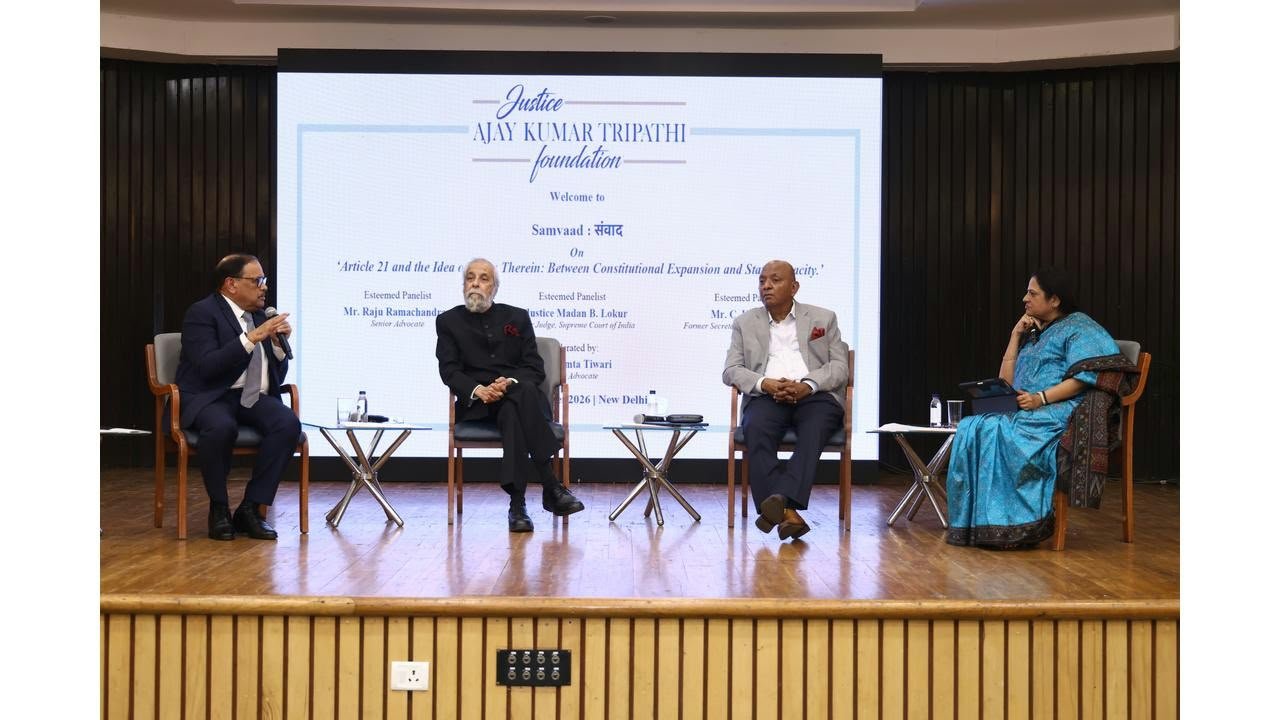
NEW DELHI, November 23: The expanding scope of Article 21 of the Constitution and the challenges of translating judicially recognised rights into reality came under scrutiny at the fifth annual Samvaad organised by the Justice Ajay Kumar Tripathi Foundation at the India International Centre in New Delhi on November 21.
The discussion brought together former Supreme Court judge Justice Madan B. Lokur, senior advocate Raju Ramachandran and former Union government secretary C.K. Mishra to examine a central constitutional question: how far can the judiciary go in expanding the right to life and personal liberty, and what happens when the State lacks the administrative capacity or willingness to implement the rights recognised by the courts?
The session was moderated by senior advocate Mamta Tiwari.
Article 21, which states that no person shall be deprived of life or personal liberty except according to procedure established by law, has evolved considerably through judicial interpretation over the past seven decades. From being understood primarily as protection against unlawful deprivation of life and liberty, it has become the constitutional foundation for a wider range of rights, including the right to livelihood, health, privacy, a clean environment and life with dignity.
More recent judicial interventions have brought issues such as mental health, digital access, menstrual dignity, climate change and pedestrian safety within the broader ambit of the right to life.
The discussion examined whether this evolution should be described as constitutional expansion or constitutional interpretation, and how the judiciary and executive should share responsibility for making these rights meaningful.
Constitutional interpretation or expansion?
Opening the discussion, Tiwari referred to the Constituent Assembly debates on Article 21 and Dr B.R. Ambedkar’s observations on the relationship between the legislature and judiciary. She argued that the provision reflected a fundamental aspect of the Idea of India by extending its protection of life and personal liberty to every person.
Ramachandran questioned the description of Article 21’s evolution as constitutional expansion. He said it was more appropriately understood as constitutional interpretation.
Drawing on the Directive Principles of State Policy in Part IV of the Constitution, he argued that courts had progressively given meaning to the right to life in situations where the State had failed to fulfil its constitutional obligations towards citizens.
He cautioned that courts could not withdraw from their constitutional responsibilities merely because the government was slow to create the conditions necessary to implement recognised rights.
Such a retreat, he argued, would amount to “constitutional abdication”.
The discussion also raised the question of how judicial intervention could be reconciled with separation of powers, which forms part of the basic structure of the constitutional scheme.
State capacity versus willingness
A major point of debate was whether delays in implementing fundamental rights stemmed primarily from limitations in State capacity or from a lack of political and administrative willingness.
Justice Lokur stressed that the right to live with dignity must have practical meaning and cannot remain an abstract constitutional declaration.
Drawing on his judicial experience, he referred to cases involving food security, the welfare of widows in Vrindavan, child protection, manual scavenging and the implementation of social welfare programmes, including the payment of wages under the Mahatma Gandhi National Rural Employment Guarantee Act (MGNREGA).
These cases, he suggested, illustrated the gap between the constitutional recognition of dignity and the everyday conditions faced by vulnerable sections of society.
He emphasised that effective implementation depended not only on institutional capacity but also on the commitment of those responsible for public administration.
Mishra offered a perspective shaped by his experience in government. While acknowledging the State’s obligation to fulfil recognised rights, he drew a distinction between the willingness to act and the practical challenges of building administrative capacity.
He highlighted the complexities of prioritising expenditure, coordinating between ministries and departments, working with state governments and ensuring that the necessary financial resources were available.
The exchange offered an insight into what happens within the government after the Supreme Court recognises a new right.
Responding to a question from Tiwari about the administrative process that follows such a judgment, Mishra outlined the steps involved: interpreting the ruling, assessing its implications, identifying the ministry responsible for implementation, coordinating with other departments and state governments, preparing a compliance framework and arranging the required funds.
He observed that interdepartmental coordination was among the most difficult tasks in government, even though it was often among the easiest to prescribe.
He also pointed out that judicial decisions and government budget cycles do not necessarily operate on the same timetable. Even where there is a commitment to comply with a judgment, implementation may require considerable institutional preparation.
READ: Indian News Websites Suffer Traffic Collapse; News18 Loses 58%, HT 50%
Environmental rights and climate change
Environmental protection provided another important area of discussion, particularly in the context of the constitutional recognition of the right against the adverse effects of climate change.
Referring to persistent air pollution, Justice Lokur questioned whether the continuing failure to implement environmental obligations could always be attributed to a lack of administrative capacity.
Mishra, drawing on his experience in the Ministry of Environment, Forest and Climate Change, highlighted the difficulties of environmental governance. These included uneven implementation capacity, the use of available resources and the need for long-term institutional preparedness.
He argued that environmental protection required sustained commitment rather than seasonal attention. He also stressed the importance of building resilience against future climate impacts.
The exchange underlined a broader theme of the discussion: constitutional recognition establishes obligations, but their fulfilment requires administrative capability, sustained attention and political and institutional priority.
Need for a constructive relationship between institutions
Despite differences over the nature and limits of judicial intervention, the panellists found common ground on the need for a more constructive relationship between the judiciary and the executive.
The discussion moved beyond the conventional perception that judicial intervention and executive administration were necessarily in conflict.
During the concluding round, Tiwari asked the speakers to identify reforms or institutional changes that could narrow the gap between the constitutional promise of Article 21 and its actual implementation.
Justice Lokur recalled his experience on the Supreme Court’s Social Justice Bench, where sustained engagement with government officials and lawyers helped identify practical obstacles and develop workable solutions in cases involving vulnerable communities.
Ramachandran argued that the responsibility of constitutional courts did not end with the recognition of a fundamental right. He highlighted the importance of continuing mandamus, through which courts can monitor the gradual implementation of their directions while remaining mindful of administrative constraints.
Mishra called for a change in institutional thinking. He said the different constitutional institutions should not be viewed as pursuing conflicting objectives simply because their functions were distinct.
Parliament, he argued, should determine the legislative framework, the executive should implement it, and the judiciary should ensure that constitutional obligations are fulfilled.
He emphasised the need for stronger coordination, a common constitutional purpose and collective responsibility.
Rights beyond the courtroom
The audience included former judges of the Supreme Court and various high courts, senior advocates, members of the Bar and academics.
Questions and interventions from the audience widened the discussion to include undertrial prisoners, delays in the justice system, civic education and the relationship between constitutional rights and citizens’ duties.
One participant drew attention to the established right to a speedy trial, arguing that institutions entrusted with protecting fundamental rights must themselves have the capacity to deliver them.
Justice Lokur cautioned against treating courts as the sole protectors of fundamental rights. He highlighted the importance of civic and political processes in ensuring that constitutional guarantees are protected and realised.
Mishra maintained that rights did not become less important merely because their implementation was difficult. At the same time, he argued, the practical demands of implementation could not be wished away through constitutional language alone.
The discussion did not seek to resolve the debate over the limits of judicial interpretation or the causes of implementation failures. Instead, it brought judicial, legal and administrative perspectives into a conversation about the responsibilities of institutions and the gap between recognising rights and delivering them.
At its heart was a question that remains central to India’s constitutional journey: should the right to life be measured by the rights the country is capable of recognising, or by the rights it is capable of making a reality?
The proceedings of Samvaad are available on the Justice Ajay Kumar Tripathi Foundation’s YouTube channel.
About the Foundation: Established in November 2022 in memory of Justice Ajay Kumar Tripathi, former Chief Justice of the Chhattisgarh High Court and Member (Judicial) of the Lokpal of India, the Justice Ajay Kumar Tripathi Foundation is a not-for-profit organisation dedicated to advancing legal thought and public discourse. Its annual Samvaad: Conversations on the Idea of India brings together voices from the judiciary, legal profession, public administration and civic life to discuss constitutional and contemporary issues.