

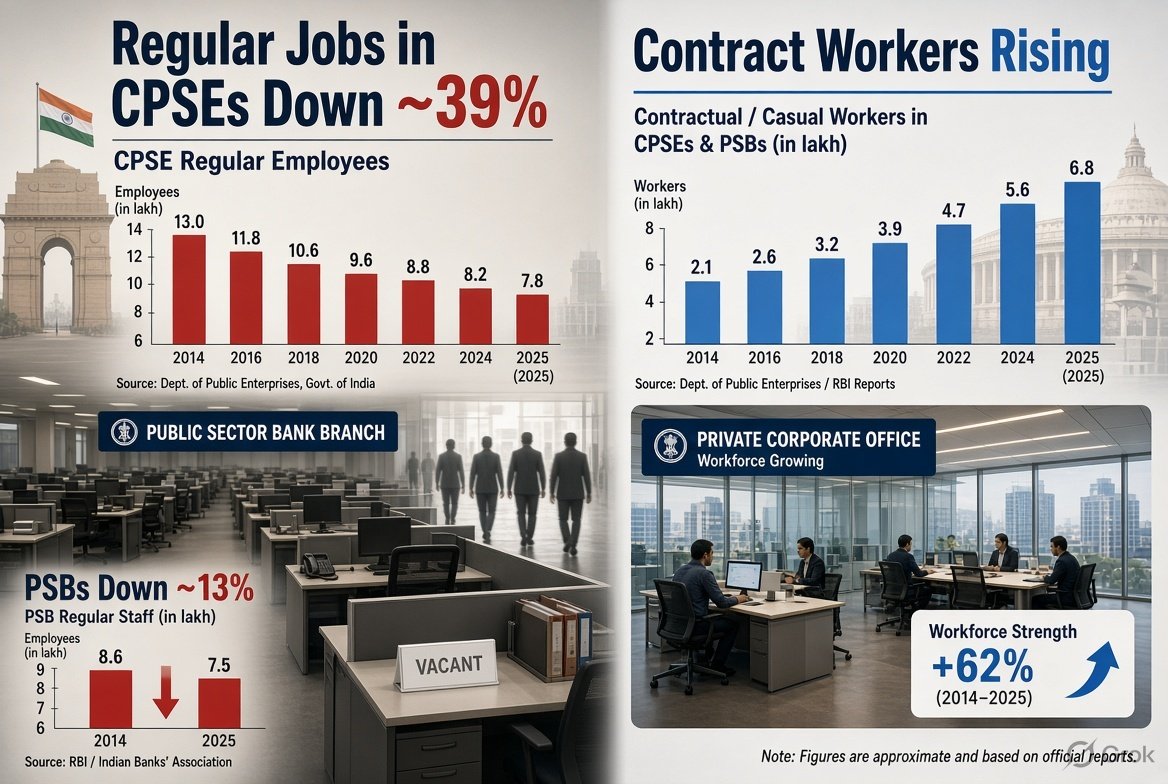
Regular jobs in central public sector enterprises has declined sharply over the past decade, while public sector banks have also recorded a fall in staff strength. The figures invite scrutiny of the government’s own record on job creation.
By Navin Upadhyay
NEW DELHI/ November 23: Prime Minister Narendra Modi has publicly taken India’s corporate sector to task for failing to translate government tax concessions into higher salaries and more jobs. But his criticism also raises an uncomfortable question about the employment record of enterprises directly owned or controlled by his own government: have public sector undertakings (PSUs) and government-owned banks done any better?
Available official data suggests they have not. Over the past decade, regular employment in Central Public Sector Enterprises (CPSEs) has fallen sharply, while the workforce of public sector banks (PSBs) has also declined from its 2014-15 level. The limited recovery in overall PSU employment has increasingly come from contractual and casual workers rather than permanent employees.
The contrast is particularly striking because the Centre has direct ownership and policy control over these institutions, unlike private companies, whose hiring decisions are influenced by market conditions, investment plans and business requirements.
At the centenary convention of the Federation of Indian Chambers of Commerce and Industry (FICCI) in New Delhi on November 19, Modi questioned whether companies had gone for job creation or raised salaries after receiving substantial tax relief.
The Prime Minister pointed out that the basic corporate tax rate had been reduced from 30% to 22% in 2019 and that income up to Rs 12 lakh was exempt from income tax under the new tax regime.
“Have you increased the salaries of your employees? Have you increased the number of employees in your organisations? No,” he asked industry leaders, accusing them of expecting the government to do everything while failing to share the benefits of policy concessions with their employees.
CPSEs: Permanent Job shrinks by nearly 42%
The employment figures for CPSEs present an even more striking picture.
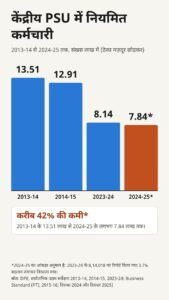
According to the Department of Public Enterprises’ surveys, CPSEs employed approximately 12.91 lakh people, excluding contract workers, in 2014-15. By 2024-25, the number of regular employees had fallen to 7.84 lakh.
This represents a reduction of approximately 5.07 lakh, or nearly 39%, over the decade. The earlier 2013-14 figure was 13.51 lakh, indicating an even larger long-term contraction.
The latest figures show that the trend has continued.
During 2024-25 alone, the number of regular employees in CPSEs fell by 29,752, or 3.66%, from 8.13 lakh to 7.84 lakh.
At the same time, the number of casual, daily-rated and contractual workers increased by 54,124, taking their total to 7.59 lakh.
Consequently, non-regular workers accounted for 49.19% of the total CPSE workforce in 2024-25, compared with 46.41% a year earlier.
The overall workforce actually increased by 1.61% to 15.42 lakh. But this expansion was driven by contractual and casual employment even as regular jobs continued to disappear.
The distinction matters. An increase in total headcount does not necessarily translate into an equivalent expansion of secure, permanent employment, with its associated pay, benefits and job protection.
Public sector banks also lag behind in Job Creation
The record of government-controlled banks is hardly more encouraging.
Reserve Bank of India data shows that public sector banks employed 8.60 lakh people in 2014-15. Their workforce had fallen to 7.49 lakh by March 2025, a net reduction of approximately 1.11 lakh employees, or nearly 13%.
The decline continued for several years, with only a modest recovery in 2024-25.
The contrast with private sector banks is significant. Their employee strength increased from approximately 3.19 lakh in 2014-15 to 8.38 lakh in 2024-25, although the comparison is affected by the reclassification of IDBI Bank as a private sector bank in 2019.
By 2023-24, private sector banks had overtaken public sector banks in total employment.
Public sector banks have undertaken substantial recruitment, particularly to replace employees retiring or leaving service. But gross recruitment figures cannot be equated with net job creation when the overall workforce remains smaller.
Bank consolidation, digitisation, voluntary exits and operational restructuring have contributed to the decline. Nevertheless, the figures raise questions about the public banking sector’s capacity to generate additional employment despite its substantial nationwide presence.
#BREAKING
PM Modi questions corporate India: Tax cuts given, but where are the jobs and salary hikes?
Addressing FICCI, PM Modi reminded business leaders that corporate tax was cut from 30% to 22%, while individuals now pay no income tax on earnings up to ₹12 lakh under the new regime
“You always ask for more. But did you hire more employees? Did you increase their salaries?”
Tough question to India’s biggest businesses!
— Nabila Jamal (@nabilajamal_) November 19, 2026
The contradiction in the government’s position
Modi’s criticism of corporate India raises a larger question about the government’s own employment priorities.
If private companies must demonstrate that tax concessions translate into higher wages and additional jobs, should government-owned enterprises not be judged by the same standards?
The Centre has considerable influence over CPSEs and public sector banks through ownership, board appointments, administrative ministries and policy decisions. Yet the employment data shows that permanent workforce expansion has not been a priority or an outcome in these institutions over the past decade.
There is also a contradiction between celebrating the financial performance and operational efficiency of public enterprises and overlooking the employment implications of a steadily shrinking permanent workforce.
The government may argue that automation, restructuring, improved productivity and the transition to a leaner workforce have made traditional staffing patterns unnecessary. It can also point to recruitment drives and the substantial number of people employed through contractors.
But these arguments do not answer the question of how many additional secure jobs have actually been created.
Who should be held accountable?
Modi’s remarks at FICCI have brought the responsibility of corporate India towards employment and wage growth into the spotlight. His appeal for businesses to share the benefits of economic growth with employees is legitimate.
But accountability cannot be selective.
The government’s own record in the institutions it controls deserves equally close scrutiny. Over roughly a decade, CPSEs have shed several lakh regular jobs, while public sector banks have failed to expand their permanent workforce beyond their mid-2010s levels.
The comparison does not establish that private companies have performed better across the entire economy, nor does it mean that government enterprises must maximise headcount regardless of productivity. But it does expose a weakness in the government’s argument when it demands employment generation from private businesses without adequately addressing the contraction of regular jobs in its own institutions.
If India Inc must answer for the jobs it has failed to create despite tax concessions, the government must also answer for the permanent jobs that have disappeared from the public sector under its watch.
Public Sector Banks (Government-Controlled Banks)
RBI data shows the following approximate total employee strength (end-March, scheduled commercial banks group):
Key trends:
- Net decline of roughly 1.0–1.1 lakh employees from the mid-2010s peak (around FY15–FY17 near 8.5–8.6 lakh) to recent levels. From FY14 levels the drop is smaller but still material after consolidation.
- FY25 saw the first modest net increase in about five years (+~1,600 to ~7.58 lakh in some reports), while private sector banks saw a net decline that year.Business-standardCnbctv18
- Gross recruitment has been substantial: ~1.48 lakh hired in FY2020–25 (mostly to replace retirees/attrition). Recruitment of ~48,570 was underway for FY2025–26. Finance Minister statements have cited cumulative figures such as ~3.94 lakh jobs created across PSBs (including major contributions from SBI, PNB, Canara, BoB, etc.), but these reflect gross additions rather than net expansion of the workforce.XTestbook
- Private sector banks grew sharply (from ~3.2 lakh in FY15 to ~8.4 lakh in FY25), overtaking PSBs in total headcount in recent years. Overall banking sector employment rose strongly, driven by private and small finance banks.
- Drivers of PSB trends: Bank mergers (2017–2020 period reduced the number of PSBs and enabled rationalisation), digitisation reducing clerical needs, slower branch expansion relative to private peers, retirements, and efficiency focus (higher business per employee, e.g., ~₹23–24 crore vs lower in private banks in some years). Officers’ share has risen while clerks/sub-staff declined.ThehindubusinesslineLivemint
PSBs remain large employers (~7.5–7.6 lakh) with ongoing recruitment (SBI has been among the largest recruiters), but net job creation has been negligible or negative over the decade.
Central Public Sector Enterprises (CPSEs/PSUs)
Department of Public Enterprises (Public Enterprises Survey) data shows a clear shift:
- Regular/permanent employees: Declined from ~13.5 lakh as of March 2014 to ~9.2 lakh by March 2022, further to ~8.14 lakh in FY24 (down 3.1% that year), and continued decline (~30,000 fewer in FY25). Some analyses put regular employment near 7.8 lakh in 2024–25.
- Total employment (regular + casual/daily-rated + contract): Roughly 14–17 lakh range historically; recent figures show ~15.18 lakh in FY24 and 15.42 lakh in FY25 (+1.61%). Growth has been driven almost entirely by non-regular workers (e.g., +~54,000 casual/contract in FY25 while regular fell).ThehindubusinesslineBusiness-standard
- Contract/casual share has risen sharply (from ~19% of workforce around 2013 to over 40% in some later years; specific sectors like petroleum/refining & marketing ~82%, transport & logistics ~63%, power generation ~62% in recent data).
- Major job losses in some large entities (e.g., BSNL reported very large reductions; SAIL, MTNL also significant). Offsetting additions occurred in entities such as Indian Oil Corporation (tens of thousands in some analyses).
- Women’s employment share has remained low (~9.5–10%) with a slight recent dip. Skilled workers form a high share (~80%+) of regular staff.
Overall for CPSEs: Net creation of permanent jobs has been negative over the decade (roughly a 40% drop in regular headcount from 2014 levels). Total headcount has been more stable or modestly higher recently only because of contractual hiring. This reflects profitability focus, technology/automation, voluntary retirement schemes, divestment/monetisation efforts, and rationalisation.
Overall Assessment (Last ~10 Years)
- Net permanent job creation by PSUs + PSBs has been limited or negative. PSBs are roughly flat-to-down ~1 lakh from peak; CPSEs regular employment down several lakhs. Combined, these entities have not been major engines of net new permanent jobs.
- Gross hiring continues (especially replacement hiring in banks and some PSU recruitment drives), supporting hundreds of thousands of new entrants over the period, but exits (retirements, VRS, attrition, mergers) largely offset or exceed them.
- Efficiency and productivity have improved (higher business/output per employee in banks; sustained or rising fiscal contributions from CPSEs despite smaller regular workforces).
- Context: Broader Indian economy (RBI KLEMS and other data) has seen substantial overall employment growth (tens of crores of jobs in the 2014–24 period, heavily in private/organised and informal segments), but public sector enterprises and banks have lagged private peers in headcount expansion. Digitisation, consolidation, and a shift toward leaner operations explain much of the pattern.Newsable.asianetnews
Sources and data references
1) Public sector bank employment: RBI – Statistical Tables Relating to Banks in India; RBI – Handbook of Statistics on the Indian Economy.
2) CPSE employment: Department of Public Enterprises – Public Enterprises Survey 2024-25; Public Enterprises Survey 2014-15.
3) Media reports: The Hindu, Business Standard, Asianet
Editorial qualification: The CPSE comparison uses the reported 2014-15 employee count excluding contract workers and the 2024-25 regular-employee count. The categories are broadly comparable but should not be treated as a perfectly identical statistical series. The figures establish a substantial contraction in regular employment, not the disappearance of all jobs in the public sector.