Three presidential tickets will contest the FIDE election: Kazakhstan’s Timur Turlov with India’s Viswanathan Anand, Germany’s Jan Henric Buettner with England’s Malcolm Pein, and Germany’s Wadim Rosenstein with Singapore’s Gordon Tang.
BY Navin Upadhyay
September 24: The world’s chess federations vote on Saturday, September 26, to choose FIDE’s next president, with five-time world champion Viswanathan Anand returning to the ballot as deputy president on the ticket of Kazakhstan’s Timur Turlov.
The election will be held during the FIDE General Assembly in Samarkand, which meets on September 26-27 as part of the 97th FIDE Congress and the 46th Chess Olympiad. Each member federation represented at the General Assembly has one vote, and the elected leadership will serve a four-year term.
FIDE has approved three presidential tickets:
- Timur Turlov (Kazakhstan) — Viswanathan Anand (India)
- Jan Henric Buettner (Germany) — Malcolm Pein (England)
- Wadim Rosenstein (Germany) — Gordon Tang (Singapore)
FIDE’s electoral rules require each presidential ticket to have endorsements from at least five member federations, including at least one from each of FIDE’s four continents, and no more than eight federations in total.
How Anand returned to the ballot
The race changed dramatically in July.
Incumbent president Arkady Dvorkovich, who had been seeking a third term with Turlov as his deputy, was placed on the European Union’s sanctions list on July 23 due to Russia-Ukraine war. Dvorkovich immediately suspended the exercise of his presidential powers and duties. Under the FIDE Charter, Deputy President Anand assumed the responsibilities of interim president.
At the time, Anand had said he would not seek another term as deputy president and would instead remain involved as an adviser.
With Dvorkovich’s withdrawal from the election, Turlov moved from the deputy slot to the presidential position. Anand subsequently reversed his decision and joined Turlov’s ticket as deputy president. FIDE formally confirmed the ticket on July 26.
Anand has therefore gone from serving as FIDE’s elected deputy to acting as its interim president — and now seeking another elected term as deputy.
READ: Ladakh Violence: LG Withdraws Cases Against 20 Accused
Yesterday, I had the opportunity to address the members of AIDEF and share my vision for the future of chess across the Francophone world.
My commitment remains clear: stronger international cooperation, more opportunities for players and federations, and a united voice for the… pic.twitter.com/d8H2MxXxG9
— Jan Henric Buettner (@JanHBuettner) September 23, 2026
Three tickets, three approaches
Turlov-Anand: Turlov, founder and CEO of Nasdaq-listed Freedom Holding Corp. and president of the Kazakhstan Chess Federation, is campaigning on financial sustainability, digital development, chess education and stronger support for national federations. Freedom Holding has been a FIDE partner in development programmes covering tournaments, players, coaches, training centres, education and talent development.
Turlov has also said he would respect international sporting rulings on Russia and has proposed greater Ukrainian representation within FIDE leadership. His campaign has highlighted digital expansion, anti-cheating measures and increased support for smaller federations.
Buettner-Pein: German entrepreneur Jan Henric Buettner, founder of the Freestyle Chess circuit, is running with English International Master and organiser Malcolm Pein. Their campaign has called for structural reform of FIDE, greater transparency and a less president-centric organisation. Buettner’s published manifesto also proposes substantially higher commercial revenues and greater financial distribution to member federations.

Buettner has built Freestyle Chess (Chess960/Fischer Random) as a commercial sports product, combining elite players with branding, spectacle, high production values and substantial prize money. He co-founded the project with Magnus Carlsen after meeting him in Qatar in late 2023 and renamed it “Freestyle Chess” because he considered Fischer Random 960 difficult to market.
The first event, the 2024 G.O.A.T. Challenge, was held at Buettner’s Weissenhaus resort in Germany. The project later raised $12 million from Left Lane Capital to launch a five-event Grand Slam Tour in 2025, with stops including Germany, Paris, New York, Delhi and South Africa.
Buettner’s model combines elite competition with entertainment, dedicated broadcast studios, audience-focused coverage and major prize funds. He has argued that the emphasis should be on attracting viewers and sponsors rather than charging fans.
A dispute with FIDE over the use of the term “World Championship” was eventually settled in 2026, when FIDE and Freestyle Chess agreed to stage the first official FIDE Freestyle Chess World Championship at Weissenhaus.
Running for FIDE president with Malcolm Pein, Buettner presents Freestyle as a model for commercial growth, player-focused investment and modern presentation, while maintaining that classical chess should remain the sport’s premier title.
Rosenstein-Tang
German chess entrepreneur Wadim Rosenstein, founder of WR Chess, is running with Singapore businessman Gordon Tang. Rosenstein has campaigned on governance reform, transparency, conflict-of-interest rules and a stronger commercial structure for FIDE. He has also called for the return of Magnus Carlsen to the classical world championship cycle and adherence to international sporting rulings on Russia and Belarus.
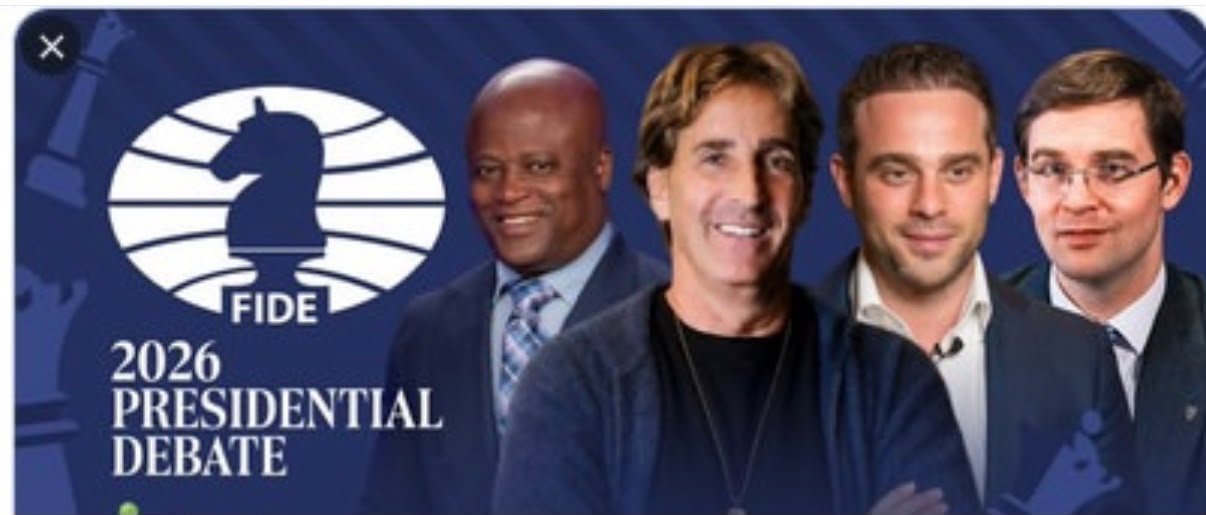
All three candidates took part in the first FIDE presidential debate on September 9, although Rosenstein’s participation was limited after his connection was lost following his opening statement.
The issues facing the next FIDE president
The election comes amid several unresolved issues for world chess.
The Chess Federation of Russia is under temporary FIDE suspension following the federation’s failure to fulfil requirements linked to a Court of Arbitration for Sport ruling. FIDE has stressed that the suspension applies to the federation and does not automatically prevent individual Russian players from competing under applicable FIDE rules.
The next administration will also inherit debates over the future relationship between FIDE and rapidly expanding commercial chess circuits, the distribution of development funds to national federations, digital chess and anti-cheating measures, and the place of Ukraine and Russia within international chess.
The election itself has already generated complaints between the three campaigns, with FIDE’s Electoral Commission handling complaints submitted by all three tickets.
Anand’s second bid
For India, the most visible element of Saturday’s vote is Anand.
The five-time world champion has spent the past two months at the centre of FIDE’s administration, first as Dvorkovich’s deputy and then as interim president following the EU sanctions against Dvorkovich.
Now he is seeking to return to the elected deputy presidency — this time alongside Turlov, rather than Dvorkovich.
For FIDE, Saturday’s vote is therefore about more than replacing an incumbent. The delegates will choose between three different approaches to governance, financing, commercial expansion and the relationship between FIDE and the rapidly changing chess industry.
The General Assembly will continue on Sunday, September 27. But the presidency — and Anand’s future place in FIDE’s elected leadership — will be decided on Saturday in Samarkand.