



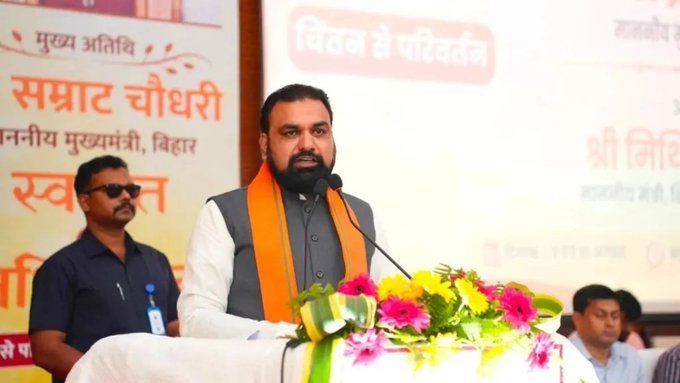
The NDA promised free electricity to millions of households and ₹10,000 transfers to over 18 million women before the Bihar elections. Now, Chief Minister Samrat Choudhary is questioning the cost of power subsidies, raising questions about the fiscal wisdom of the pre-election largesse.
BY Navin Upadhyay
November 5: Millions of voters from Bihar were promised a bonanza before the Assembly elections. Nearly 17 million households were offered free electricity, while more than 18 million women received direct cash transfers of ₹10,000 each. The promises came with considerable fanfare. The National Democratic Alliance (NDA) won decisively.
Now the political celebrations are over, and the financial consequences are coming into focus. Chief Minister Samrat Chaudhary is expressing concern over the cost of its own welfare schemes and appealing to affluent households to voluntarily give up free electricity.
The reversal raises an uncomfortable question: were these schemes designed to deliver lasting economic benefits, or were they electoral inducements whose financial consequences were conveniently left for the post-election period?
The electricity scheme offers a particularly revealing example.
Post-election, Bihar introduced a Time-of-Day (ToD) tariff structure. From April 2026, electricity consumed during peak hours, between 5 pm and 11 pm, became more expensive. For domestic consumers with smart meters, the base energy charge of ₹7.42 per unit, before state subsidy, rises by 10 per cent to ₹8.16 during these hours.
Non-domestic and industrial consumers face a 20 per cent premium.
The timing matters. These are the hours when households switch on lights, fans, coolers and other appliances. In effect, the tariff structure makes electricity more expensive during the period of highest household demand.
“आपको जो फ्री में 125 यूनिट बिजली मिलती है वो सरकार को Donate करना शुरू कीजिए..” Income Tax भरने वाली जनता से CM सम्राट चौधरी की अपील https://t.co/C05MBVxfVm
— Samastipur Town (@samastipurtown) November 1, 2026
The 125-unit free power scheme was announced by then Bihar Chief Minister Nitish Kumar in July 2025. It was expected to benefit around 16.7 million domestic consumers. The announcement generated considerable goodwill ahead of the Assembly elections.
But the government’s tone has changed now.
On November 1, at a youth parliament event in Patna, Samrat Choudhary appealed to affluent and income-tax-paying households to voluntarily surrender the free-electricity benefit.
He said Bihar was spending around ₹23,000 crore annually on power subsidies. The expenditure translated into roughly ₹8,000-10,000 per household, with rich and poor consumers receiving the same entitlement.
Those who could afford to pay their electricity bills, he suggested, should give up the subsidy.
The appeal was revealing. The government had promoted a universal benefit before the elections. It was now publicly questioning its affordability.
There was no accompanying proposal for means-testing, a phased withdrawal or a formal mechanism to identify households that could forgo the benefit. Instead, the government chose to make a voluntary appeal.
The financial commitment, however, remains substantial. Bihar’s 2026-27 Budget has provided more than ₹23,000 crore under the relevant consumer-assistance scheme.
For a state with a limited tax base and substantial dependence on central transfers, this is a recurring liability. The question is not whether poor households need electricity support. They clearly do. It is whether an expensive universal subsidy is the best way to deliver it.
The ₹18,100-crore question
The Mukhyamantri Mahila Rojgar Yojana followed a similar electoral trajectory.
By February 2026, the Bihar government had transferred ₹10,000 each to 18.1 million women, taking the total outlay to ₹18,100 crore.
Most of the transfers were made in five phases between late September and late November 2025, coinciding with the Assembly election campaign.
The government presented the money as seed capital for self-employment. Women could use it to purchase sewing machines, livestock, raw materials or initial stock for small shops.
The scheme also held out the prospect of further assistance of up to ₹2 lakh after beneficiaries established an enterprise and underwent an assessment. But the second stage of assistance, involving support of up to ₹2 lakh, is conditional. Its effectiveness will depend on whether beneficiaries can establish viable enterprises and receive the promised financial and institutional support. So far, no one has reportedly been paid that sum.
The larger manifesto: Where are the promised jobs and development?
The electricity and women’s cash-transfer schemes were only the most visible components of the NDA’s election pitch. Its 69-page joint Sankalp Patra, released on October 31, 2025, contained a far more ambitious development agenda.
Prime minister Narendra Modi, Home Minister Amit Shah, Nitish Kumar, then BJP president JP Nadda, Samrat Choudhary and other alliance leaders presented a vision of a transformed Bihar.
The manifesto promised more than one crore employment opportunities, one crore Lakhpati Didis, seven expressways, major industrial investments, agricultural support, better healthcare and free education from kindergarten to postgraduate level for poor families.
READ: Sonam Wangchuk Hits Back at Ladakh Admin Over School Closure Notice
The manifesto also promised flood-free Bihar initiatives through river-linking and embankment projects within five years. Given the recurring devastation caused by floods, this is among the most consequential commitments. It will require sustained investment and transparent reporting.
The NDA’s Sankalp Patra was not a modest document. It promised jobs, higher incomes, industrialisation, agricultural transformation and major improvements in public services. Yet the most visible action so far has been the distribution of cash and the announcement of free electricity.
The distinction between announcing a scheme, allocating money and delivering measurable results is fundamental. The government cannot claim success merely by pointing to the scale of its announcements.
The fiscal arithmetic of Bihar
The state’s finances make the timing of these promises even more significant.
Bihar’s 2026-27 Budget projects a revenue surplus of just ₹1,143 crore, equivalent to 0.1 per cent of its Gross State Domestic Product (GSDP).
The revised estimates for 2025-26, meanwhile, show a revenue deficit of ₹76,315 crore, or 6.7 per cent of GSDP.
The government has also issued austerity instructions covering official travel, vehicle use and electricity consumption in government offices.
Such measures may signal concern over expenditure, but they cannot address the larger fiscal challenge. The electricity subsidy represents a recurring annual commitment, while the ₹18,100 crore transferred under the women’s employment scheme has already been disbursed.
Neither programme has yet been subjected to a publicly demonstrated restructuring based on verified outcomes and clearly identified beneficiaries.
The opportunity cost is considerable. Money committed to poorly targeted subsidies cannot be spent elsewhere. Bihar needs investment in power infrastructure, irrigation, agriculture, education, healthcare, skills and employment generation.
These are the foundations of long-term economic growth. They cannot be replaced by election-season transfers.





Comments 2