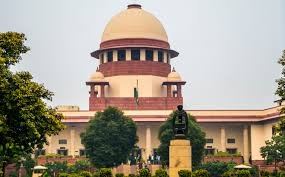
A bench comprising Chief Justice of India Surya Kant and Justice Joymalya Bagchi observed that cases arising out of the violence, which has claimed more than 260 lives and displaced thousands since May 2023, require urgent judicial attention amid continuing instability in the state.
“We are of the view that the ongoing trial needs to be expedited. The status of the ongoing trial must be filed by the next hearing,” the bench observed during the proceedings.
The apex court was hearing a plea filed by the CBI challenging the Gauhati High Court’s decision to grant bail to two accused — Arun Khundongbam alias Nanao and Nameirakpam Kiran Meitei — in a case involving the alleged gang rape and public parading of women during the ethnic violence. While the Supreme Court declined to interfere with the bail granted by the high court, it underlined the need for speedy trial and accountability in all cases linked to the conflict.
READ: KCP Commander Nabbed in Delhi, Massive Arms Haul in Manipur
The CBI had argued that the gravity of the offences warranted cancellation of bail.
During the hearing, the bench also referred to a report submitted by Special Investigation Team (SIT) chief and former Maharashtra Director General of Police Dattatray Padsalgikar, who is overseeing the CBI-led probes into the violence.
According to the report, the law and order situation in Manipur remained “precarious,” with fresh flare-ups reported on April 7 and April 18 this year. The incidents reportedly included violent attacks and bomb explosions, including one that killed two children.
The Supreme Court has been closely monitoring the Manipur situation since the outbreak of ethnic clashes between the Meitei and Kuki-Zo communities on May 3, 2023.
In earlier proceedings, the apex court transferred around 27 sensitive CBI-investigated cases, including those involving sexual violence, to courts in Assam to ensure fair and impartial trials outside the conflict-hit state.
During a hearing in February this year, the court also directed the Manipur government to provide victims and their families with copies of chargesheets filed by the CBI and ordered the State Legal Services Authority to extend free legal aid to affected persons, preferably through lawyers proficient in Manipuri and local languages.
The bench had previously expressed dissatisfaction over delays in rehabilitation efforts, legal aid distribution, and compliance with court directives.
On Wednesday, the Supreme Court also allowed the Manipur government’s request to appoint a new Director General of Police (DGP) from outside the state cadre, amid continuing concerns over policing, neutrality, and security management in the violence-hit state.
The ethnic violence in Manipur, triggered by tensions over reservation demands, land rights, and longstanding ethnic divisions, has resulted in one of the worst humanitarian crises in the Northeast in recent years. Official figures indicate that more than 60,000 people were displaced, many of whom continue to remain in relief camps even three years after the violence began.
The conflict also led to the creation of buffer zones separating communities, while sporadic clashes, arson, and attacks have continued despite heavy deployment of security forces.
The Supreme Court’s continuing intervention includes oversight through committees headed by former Jammu and Kashmir High Court Chief Justice Gita Mittal for humanitarian issues and Dattatray Padsalgikar for criminal investigations and security-related matters.
The latest direction from the apex court underscores the judiciary’s increasing emphasis on accountability, victim support, and speedy justice as investigations and trials in hundreds of violence-related cases continue under the CBI and state SITs.