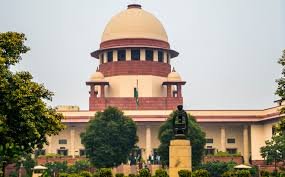
A Bench led by Chief Justice Surya Kant ruled that the Election Commission acted within its constitutional and statutory powers under Article 324 and the Representation of the People Act.
BY PC Bureau
New Delhi, May 27: In a significant ruling with major implications for India’s electoral process, the Supreme Court on Tuesday upheld the Election Commission of India’s authority to conduct Special Intensive Revision (SIR) of electoral rolls, observing that maintaining accurate voter lists is central to preserving the integrity of democracy.
A Bench led by Chief Justice Surya Kant and Justice Joymalya Bagchi dismissed challenges to the Election Commission’s decision to undertake a large-scale revision of electoral rolls in Bihar last year, ruling that the exercise was legally valid and constitutionally permissible.
The Court held that Article 324 of the Constitution, along with provisions of the Representation of the People Act, 1950, empowers the Election Commission to conduct special revisions whenever necessary to ensure the credibility and accuracy of voter rolls.
The Bench observed that free and fair elections depend not only on the act of voting but also on the reliability of electoral databases, which form the foundation of the democratic system.
Explaining its reasoning, the Court stated that the law itself permits the Election Commission to order special revisions “at any time” if circumstances demand such an exercise. The judges noted that the Commission had recorded valid reasons for initiating the SIR, including the absence of a comprehensive intensive revision for over four decades, rapid migration and urbanisation, and the possibility of duplicate or inaccurate entries in electoral records.
READ: ED Raids Properties Linked to Former Kerala CM Vijayan
The Court rejected the contention that the revision process violated the Representation of the People Act or the Registration of Electors Rules, 1960. It also dismissed claims that the exercise treated existing voters as suspected non-citizens or unlawfully shifted the burden of proving citizenship onto them.
Several petitioners, including the Association for Democratic Reforms, activist Yogendra Yadav, and opposition leaders such as Mahua Moitra, Manoj Jha, K. C. Venugopal and Supriya Sule, had argued that the exercise resembled a covert citizenship verification drive similar to the NRC process.
The petitioners contended that questions of citizenship could only be adjudicated under laws governing citizenship and not through electoral revision procedures. They also argued that compelling voters to produce documents effectively created a presumption of ineligibility.
However, the Supreme Court disagreed, holding that the Election Commission had acted within the scope of its constitutional and statutory powers and that the exercise was aimed solely at strengthening the integrity of electoral rolls.
The Court noted that the Special Intensive Revision process has already been completed in Bihar, Kerala, Tamil Nadu, Puducherry and West Bengal, while similar exercises are continuing in states such as Uttar Pradesh, Gujarat and Rajasthan.
The judgment is likely to strengthen the Election Commission’s authority in future voter verification and roll-cleaning exercises, even as debates over citizenship, voter documentation, and electoral inclusion continue to remain politically sensitive issues across the country.