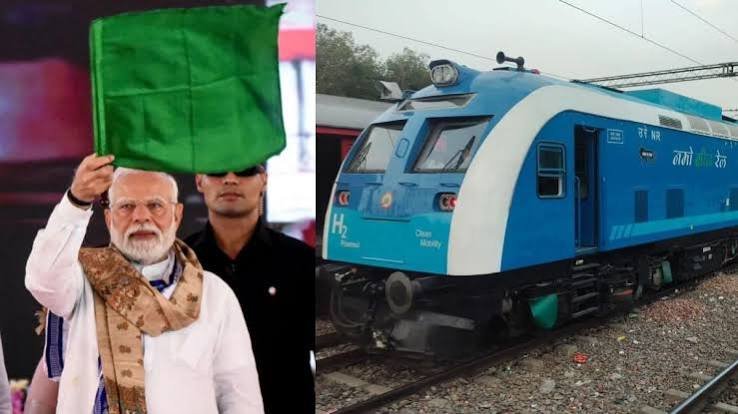
The 10-coach train—the world’s longest hydrogen-powered passenger train—uses indigenous Proton Exchange Membrane (PEM) fuel cell technology and will operate on the Jind-Sonipat route as a pilot project.
BY PC Bureau
New Delhi: Prime Minister Narendra Modi on Friday flagged off India’s first hydrogen-powered passenger train from Jind railway station in Haryana, marking a significant milestone in the country’s transition towards cleaner and sustainable rail transport.
The launch places India among a small group of nations—including Germany, Japan, China and the United States—that have developed or are testing hydrogen fuel cell trains as part of efforts to reduce carbon emissions from railways.
The pilot project will operate on the Jind-Sonipat route under Northern Railway and is expected to provide valuable operational data before the technology is introduced on other non-electrified, remote and heritage railway routes.
The development comes even as Indian Railways has electrified more than 99 per cent of its broad-gauge network over the past decade, substantially reducing dependence on diesel locomotives. Officials say hydrogen-powered trains will complement electrification by providing a zero-emission alternative on routes where installing overhead electric lines is economically or technically challenging.
READ:
Prime Minister @narendramodi flags off India’s first Hydrogen train between Jind and Sonipat at Jind railway station#HydrogenTrain #भारत_की_पहली_हाइड्रोजन_ट्रेन @RailMinIndia
Watch: ⬇️ pic.twitter.com/j1lJCliqRs
— PIB India (@PIB_India) July 17, 2026
World’s Longest Hydrogen Passenger Train
India’s hydrogen train is being billed as the longest hydrogen-powered passenger train in the world.
Unlike hydrogen trains operating in Europe and elsewhere, which typically consist of two or three coaches, the Indian train comprises 10 passenger coaches with a capacity of approximately 2,600 passengers.
Powered by a 3,200-horsepower propulsion system, it is also among the most powerful hydrogen trainsets currently in service globally.
The train has been designed for a maximum speed of 110 kmph, although operational speed on the Jind-Sonipat section will be limited to 75 kmph in accordance with existing track conditions.
Officials said the entire system—including engineering, integration and manufacturing—has been developed using indigenous technology under the “Make in India” initiative.
Route and Timings
The hydrogen-powered train will operate daily between Jind and Sonipat in Haryana.
Train No. 74010
- Departs Jind: 7:40 AM
- Arrives Sonipat: 9:40 AM
Train No. 74009 (Return)
- Departs Sonipat: 10:40 AM
- Arrives Jind: 1:00 PM
The train will halt at Jind City, Pandu Pindara, Lalit Khera, Bhambeva, Ishapur Kheri, Butana, Khandrai, Gohana, Rabhra, Lath, Mohana Haryana and Barwasni.
Primary maintenance will be carried out at Jind.
How the Hydrogen Train Works
The train is powered by Proton Exchange Membrane (PEM) fuel cell technology, one of the most advanced forms of hydrogen propulsion currently used in transportation.
Hydrogen gas stored in high-pressure cylinders onboard the train is supplied to the fuel cell stack. Inside the fuel cell, hydrogen reaches the anode, where a catalyst separates each hydrogen molecule into protons and electrons.
- The protons pass through a special proton exchange membrane.
- The electrons cannot cross the membrane and instead travel through an external electrical circuit, generating electricity.
- At the cathode, the protons and electrons recombine with oxygen drawn from the atmosphere to form water (H₂O).
The electricity produced powers the train’s traction motors, while excess energy is stored in lithium iron phosphate (LiFePO₄) batteries, which assist during acceleration and recover energy during braking.
The only direct emissions are water vapour and heat, making the train a true zero-emission alternative to conventional diesel locomotives.
The train consists of two hydrogen-powered driving cars and eight trailer coaches, with each power car housing hydrogen storage cylinders, PEM fuel cells, battery systems and power electronics.
Hydrogen vs Battery Trains
Although both hydrogen and battery-electric trains produce zero tailpipe emissions, they are designed for different operational requirements.
Hydrogen trains
- Generate electricity onboard using hydrogen fuel cells.
- Offer significantly longer operating range—often between 600 and 1,000 kilometres on a single refuelling.
- Can be refuelled within a few hours.
- Are well suited for long-distance regional routes where electrification is absent.
READ: Trump Revives Election Security Debate, Calls for Sweeping Reforms
Battery-electric trains
- Store electricity directly in rechargeable batteries.
- Usually operate over shorter distances, typically 50 to 150 kilometres before requiring recharging, depending on train design.
- Are highly energy-efficient because electricity is used directly without conversion losses.
- Perform best on routes with partial electrification or dedicated charging infrastructure.
Experts note that while battery trains are generally more energy-efficient, hydrogen trains provide greater operational flexibility on long, unelectrified routes where charging infrastructure is unavailable.
Hydrogen Infrastructure at Jind
Supporting the pilot project is a newly established indigenous hydrogen production, storage and refuelling facility at Jind.
The installation includes:
- hydrogen compression systems,
- standby compressors,
- high-pressure storage,
- automated dispensing equipment,
- hydrogen leak detection systems,
- flame detection mechanisms,
- emergency shutdown facilities.
The facility has received the necessary approvals from the Petroleum and Explosives Safety Organisation (PESO), ensuring compliance with national safety standards for hydrogen handling.
Global Green Rail Movement
Hydrogen-powered rail technology is still in its early stages globally.
Germany became the first country to introduce commercial hydrogen passenger trains in 2022, while Japan, China and the United States continue to test or expand hydrogen-powered rail operations.
With the Jind-Sonipat pilot, India joins this growing international effort to decarbonise rail transport through alternative clean-energy technologies.
Railway officials say operational experience from the pilot will determine the feasibility of deploying hydrogen trains on additional routes across the country, particularly in regions where conventional electrification remains difficult or uneconomical.