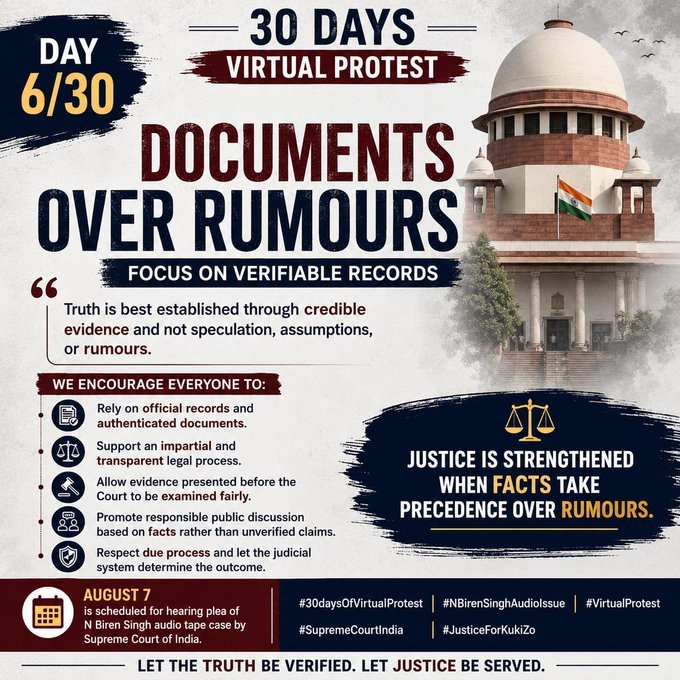
Using hashtags such as #30DaysOfVirtualProtest and #JusticeForKukiZo, campaigners are urging the Supreme Court to order an independent forensic examination, saying “documents over rumours” and “justice delayed is justice denied.”
BY Navin Upadhyay
August 6, 2026: With the Supreme Court set to hear the contentious “Manipur audio tape” case on Friday, Kuki-Zo organisations and supporters have intensified a coordinated online campaign, urging the apex court to order an independent investigation into the recordings allegedly linking former Manipur Chief Minister N. Biren Singh to the 2023 ethnic violence.
The campaign, branded #30DaysOfVirtualProtest, entered its sixth day on Thursday, with hundreds of posts on X carrying hashtags such as #NBirenSinghAudioIssue, #JusticeForKukiZo, #VirtualProtest, #SupremeCourtIndia, #ManipurViolence, and #TruthMustPrevail.
The petition before the Supreme Court was filed by the Kuki Organisation for Human Rights Trust (KOHUR) through senior advocate Prashant Bhushan. It seeks a court-monitored investigation into leaked audio recordings allegedly featuring Biren Singh discussing the origins of the ethnic violence that erupted on May 3, 2023.
The recordings, first made public in August 2024, allegedly contain conversations in which a voice identified by the petitioners as Singh’s refers to launching “operations,” discusses the use of “bombs”, and speaks about protecting those involved in the looting of police armouries during the early days of the conflict.
Earlier, the Manipur government had described the circulated clips as doctored and politically motivated. Singh resigned as Chief Minister in February 2025.
The case has witnessed conflicting forensic assessments. A report by private forensic laboratory Truth Labs concluded there was a high probability—around 93 per cent—that the voice in the recordings matched authenticated samples of Biren Singh. However, examinations conducted by government institutions, including the National Forensic Sciences University (NFSU), have at various stages indicated that portions of the recordings appeared edited or tampered with, making conclusive speaker identification difficult. Dissatisfied with the delays and incomplete submissions, the Supreme Court has repeatedly directed authorities to examine the complete recordings along with admitted voice samples.
Digital Campaign Gains Momentum
The online campaign was launched on August 1 by several Kuki-Zo organisations, civil society groups and activists, who have pledged to sustain daily messaging for 30 days instead of limiting themselves to a single day of online protests.
Each day, participants post graphics, timelines, legal updates and appeals directed at the Supreme Court, constitutional authorities, media organisations and public representatives. The campaign repeatedly stresses themes such as “Documents over rumours,” “Justice delayed is justice denied,” “Let forensic evidence speak,” and “Truth deserves judicial scrutiny.”
One of the campaign’s first posts, shared by @chinkukimizogin, read:
“Today marks the beginning of a 30-day peaceful virtual movement dedicated to constitutional accountability, judicial integrity and the rule of law. Let the evidence be examined. Let due process prevail. Let the truth be established.”
As the August 7 hearing drew closer, campaign messaging became more pointed.
A widely circulated post by @PaulMate6 stated:
“As the Hon’ble Supreme Court hears the plea on 7 August, we reaffirm that verified records—not rumours—must guide justice. Let truth emerge through forensic examination and due process.”
Another viral message declared:
“Documents over rumours. If the evidence exists, test it. If the recordings are genuine, establish it. If they are fabricated, prove it. The country deserves facts—not speculation.”
The account @kukigrand2026 appealed directly to the judiciary:
“Tomorrow is not just another hearing. It is another opportunity for justice to move forward. Let transparency prevail.”
A detailed thread posted by @Kamginthan40473 argued:
“More than three years have passed since the violence began, yet victims are still waiting for truth. Justice cannot remain suspended indefinitely. The Supreme Court must ensure an independent investigation free from political influence.”
The post further demanded prosecution of anyone found culpable, “regardless of political office or position.”
Another widely shared message read:
“Every delay deepens public mistrust. Court-monitored investigation is the only way to restore confidence.”
Several users highlighted the human cost of the conflict.
One post said:
“Over 250 lives lost. Thousands displaced. Hundreds of villages destroyed. Victims deserve answers—not endless procedural delays.”
Another stated:
“Truth has nothing to fear from forensic science. Let experts examine every second of the recording.”
Some participants questioned Biren Singh’s resignation earlier this year, asking why he stepped down if the recordings were entirely fabricated. Others urged supporters to avoid inflammatory language and remain focused on constitutional methods.
Not all commentary remained measured. Supreme Court advocate Vishwajeet Singh (@VishuAdv) posted his personal opinion, writing:
“If I were the prosecutor in this case, I would not demand anything less than the death penalty.”
READ: Ex-Tehelka Editor Tarun Tejpal Held Guilty in 2013 Rape Case
If the 𝗔𝘂𝗱𝗶𝗼 𝗟𝗲𝗮𝗸 𝗧𝗮𝗽𝗲 is not 𝗚𝗲𝗻𝘂𝗶𝗻𝗲, why did 𝗡. 𝗕𝗶𝗿𝗲𝗻 𝗦𝗶𝗻𝗴𝗵 resign after the tape went viral across the 𝗠𝗲𝗱𝗶𝗮?
The Truth Labs concluded that the voice in the Leaked Audio belongs to 𝗡. 𝗕𝗶𝗿𝗲𝗻 𝗦𝗶𝗻𝗴𝗵. His Resignation came after the… pic.twitter.com/lYneiQwSWa
— 𝐂𝐇𝐈𝐊𝐈𝐌-𝐓𝐄-𝐀𝐖𝐆𝐈𝐍 (@chinkukimizogin) August 5, 2026
A Divided Narrative
While Kuki-Zo organisations continue to press for an independent probe, several Meitei groups and supporters have rejected the allegations, maintaining that the recordings are manipulated and politically motivated. They argue that the controversy forms part of a broader campaign surrounding the ethnic conflict and continue to contest the authenticity of the tapes.
The violence that erupted on May 3, 2023, between the Meitei and Kuki-Zo communities claimed more than 250 lives and displaced over 60,000 people. The conflict has also resulted in widespread destruction of homes, religious institutions and public infrastructure, while large numbers of weapons were looted from police armouries during the initial phase of the unrest.
As the Supreme Court prepares to hear the matter on August 7, the coordinated digital mobilisation reflects the determination of Kuki-Zo groups to keep public attention fixed on the case. Although the authenticity of the recordings and the allegations arising from them remain to be judicially determined, campaigners insist that only a transparent, independent and court-supervised investigation can resolve one of the most contentious controversies to emerge from the Manipur conflict.