MEA spokesperson Randhir Jaiswal acknowledged ongoing talks over unsettled border sectors but stopped short of confirming reports that India may swap territory with Myanmar to complete boundary demarcation.
By PC Bureau
New Delhi, August 5, 2026: The Centre has confirmed that discussions are continuing with Myanmar over unresolved sections of the two countries’ shared border, even as reports of a possible land exchange along the Manipur frontier have sparked political and civil society opposition in the northeastern state.
Speaking at the Ministry of External Affairs’ weekly media briefing on Tuesday, MEA spokesperson Randhir Jaiswal said negotiations were underway to settle stretches of the international boundary that remain undemarcated.
“There are certain areas on the border which are yet to be settled. Discussions on those sectors are ongoing,” Jaiswal said when asked about media reports suggesting that India was exploring a territorial adjustment with Myanmar. He, however, neither confirmed nor denied the existence of any proposal involving an exchange of land.
The remarks follow a report published by The Diplomat on July 17 claiming that New Delhi was examining a plan to exchange around 1.4 square miles of territory to complete the demarcation of a disputed stretch between Boundary Pillars 65 and 68 on the Manipur-Myanmar border.
According to the report, which cited an official document dated May 26, 2026, the proposal concerns a 2.8-km undemarcated segment in Chandel district adjoining Myanmar’s Sagaing Region, where a mutually agreed adjustment of the boundary is reportedly being considered.
READ: Dance, Drinking: Viral Clips Put Kanwar Yatra Under Lens
Pushback in Manipur
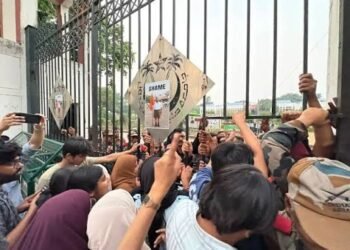
Even before any official confirmation of such a proposal, reports of a possible land swap have generated resistance in Manipur.
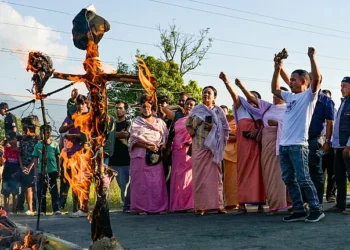
The Coordinating Committee on Manipur Integrity (COCOMI) has warned the Centre against transferring any part of the state’s territory, insisting that Manipur’s territorial integrity cannot be compromised.
According to local media reports, the organisation has threatened to launch a statewide agitation if the Centre proceeds with any decision affecting the state’s geographical boundaries without consulting its people.
COCOMI argued that Manipur has already witnessed territorial changes since its merger with the Indian Union in 1949 and said any further reduction in the state’s land area would be unacceptable. It also urged the Centre not to take decisions affecting the state’s boundaries without public consultation, cautioning that such a move could trigger widespread resentment.
Border Yet to Be Fully Demarcated
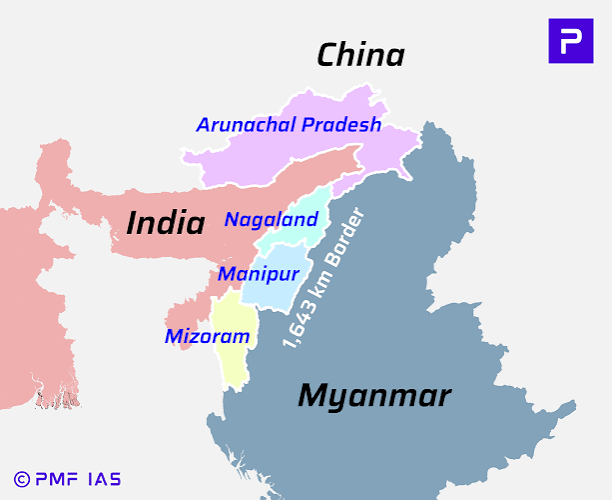
India and Myanmar share a 1,643-km international border stretching across Arunachal Pradesh, Nagaland, Manipur and Mizoram before entering Myanmar’s Sagaing Region and Chin State. Much of the frontier passes through remote hills and forests inhabited by tribal communities with long-standing cross-border ethnic and cultural ties.
Official figures from the Ministry of Home Affairs indicate that nearly 1,472 km of the boundary has already been demarcated through border pillars, while around 171 km remains unsettled, primarily in parts of Manipur and Arunachal Pradesh.
Successive rounds of bilateral talks have sought to resolve these remaining stretches through a joint boundary mechanism.
India thinking of taking some territory of Myanmar through manipur border 😳😳🔥🔥🔥🔥 pic.twitter.com/iAxEOooJtB
— indian (@priyaaarora12) August 4, 2026
Why the Border Matters
According to The Diplomat, the reported proposal is linked to the Centre’s broader effort to complete the demarcation of the India-Myanmar border so that fencing can be undertaken more effectively.
The government has argued that a clearly defined and fenced border is essential to curb illegal immigration, insurgent infiltration, arms trafficking and other cross-border criminal activities.
In 2024, New Delhi announced its decision to fence the entire India-Myanmar border while also discontinuing the Free Movement Regime (FMR), which had allowed residents of border villages to travel up to 16 kilometres across the frontier without a visa.
Security agencies have repeatedly expressed concern that the porous border has been exploited by insurgent groups and organised criminal networks operating on both sides.
Sensitive Boundary Points
The existing India-Myanmar boundary is governed by a bilateral agreement signed in 1967, although a handful of boundary pillars remain unresolved.
Among the most sensitive areas in Manipur are the Molcham sector (Boundary Pillars 64-68), the Moreh sector (Pillars 75-79) and the Choro Khunou sector (Pillars 88-95).
The Indian government has consistently maintained that it has no overall territorial dispute with Myanmar, describing the issue as one concerning a limited number of undemarcated boundary pillars rather than competing territorial claims.
The Diplomat also reported that the matter figured during Myanmar military leader Min Aung Hlaing’s visit to India last month, when officials reportedly discussed installing new and auxiliary boundary pillars in the Molcham sector while revisiting an earlier 2017 proposal prepared by the Ministry of External Affairs.
Not Without Precedent
A limited territorial adjustment between neighbouring countries would not be unprecedented.
In 2015, India and Bangladesh implemented the landmark Land Boundary Agreement, exchanging enclaves held by each country and bringing an end to one of South Asia’s longest-running boundary disputes.
Supporters of a similar approach with Myanmar argue that a carefully negotiated adjustment could permanently settle one of the last unresolved stretches of the border while facilitating infrastructure development and strengthening border security.
For now, however, the Centre has confirmed only that negotiations over the undemarcated sectors are continuing. Whether those discussions will eventually lead to a formal land exchange remains unclear, but the issue has already emerged as a politically sensitive one, particularly in Manipur, where territorial integrity remains deeply intertwined with questions of identity and history.