BY PC Bureau
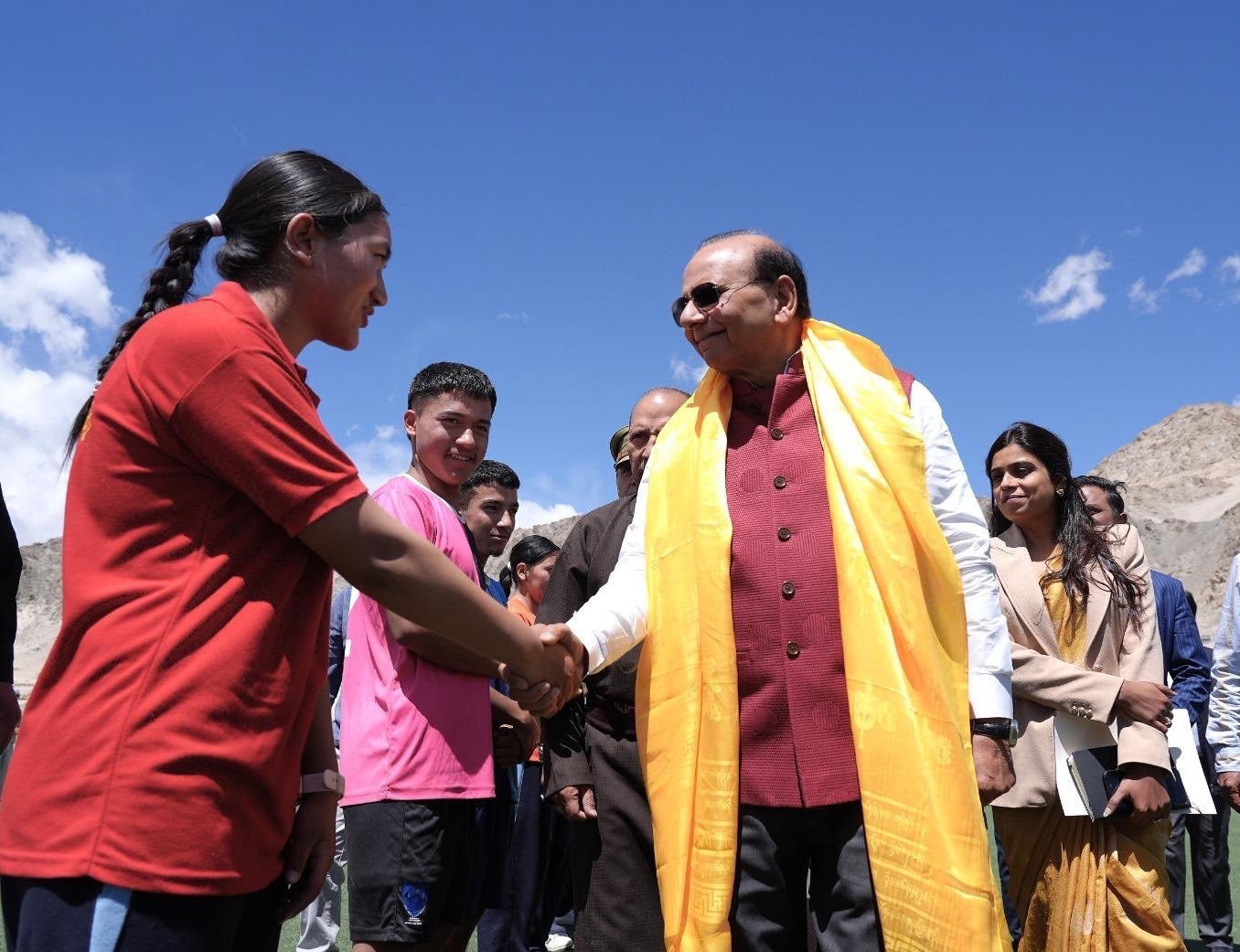
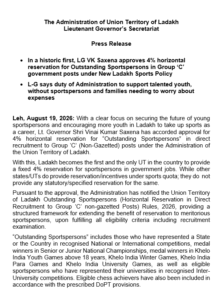
August 19, 2026 — Ladakh has moved to give sporting achievement a direct route into government employment, approving a 4% horizontal reservation for outstanding sportspersons in direct recruitment to Group ‘C’ non-gazetted posts under the Union Territory administration.
The move, notified through the Union Territory of Ladakh Outstanding Sportspersons (Horizontal Reservation in Direct Recruitment to Group ‘C’ Non-Gazetted Posts) Rules, 2026, is intended to provide athletes with a more secure career pathway while encouraging young people to pursue competitive sports.
The 4% provision was envisaged in the Ladakh Sports Policy, which provides for a fixed 4% horizontal reservation for outstanding sportspersons in non-gazetted government jobs.
READ: Cases That Keep Imran Khan Behind Bars: Justice or Vendetta?
The policy covers athletes who meet prescribed eligibility conditions and qualify through the relevant recruitment examination. Those eligible include sportspersons who have represented their state or country at recognised national or international competitions, medal winners at Senior or Junior National Championships and athletes who have achieved specified results at Khelo India Youth Games, Khelo India Winter Games, Khelo India Para Games and Khelo India University Games. Eligible chess players are also covered under the applicable DoPT guidelines.
What does ‘horizontal reservation’ mean?
The 4% sports quota does not create a separate social category alongside SC, ST, OBC, EWS or open merit.
Instead, it cuts across these existing categories.
For example, if 100 eligible Group ‘C’ vacancies are being filled and four are required to go to outstanding sportspersons, those four candidates are selected from among eligible athletes. Their selection is then adjusted against the social category to which each candidate belongs.
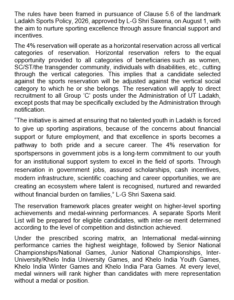
So, if a qualifying sportsperson belonging to the ST category is selected under the sports quota, that appointment counts against the ST position. A sportsperson belonging to another reserved category would similarly be adjusted against that category.
This is known as interlocking or horizontal reservation. Ladakh’s existing reservation rules use the same concept for categories such as persons with benchmark disabilities and ex-servicemen.
The distinction is important. Vertical reservation divides vacancies among social or economic categories, while horizontal reservation operates across those categories.
In simple terms:
Vertical reservation tells you which social category a vacancy belongs to; horizontal reservation tells you which special group must be represented within those categories.
Thus, a sportsperson does not necessarily receive an additional job on top of the existing reservation structure. The candidate occupies a vacancy within the relevant vertical category while simultaneously satisfying the sports reservation requirement.
Proud to announce a historic milestone for our youth!
Ladakh is now the first UT in India to provide a statutory 4% reservation for Outstanding Sportspersons in government jobs for Group ‘C’ Non-Gazetted posts.
Along with assured scholarships, cash incentives, and modern… pic.twitter.com/ZeX49Zjxdp
— LG Ladakh (@lg_ladakh) August 19, 2026
Merit list to determine sports quota
A separate Sports Merit List will be prepared for eligible candidates. Sporting achievements will be ranked according to a prescribed scoring system, with greater weight given to higher-level competitions and medal-winning performances.
International medals will receive the highest weightage, followed by achievements at Senior National Championships and National Games, Junior National Championships, Inter-University and Khelo India University Games, and Khelo India Youth, Winter and Para Games.
At each level, medal winners will rank above athletes who merely represented their team or state.
Only a candidate’s highest sporting achievement will be counted, meaning multiple medals will not result in multiple claims or additional weightage.
A three-member committee under the Department of Youth Services and Sports will verify certificates and the authenticity of sporting achievements.
The policy is part of Ladakh’s broader effort to create a sports ecosystem combining scholarships, cash incentives, infrastructure, scientific coaching and employment opportunities. The administration has described the 4% reservation as a means of ensuring that young athletes do not have to choose between sporting ambitions and economic security.
The move is particularly significant in a region where government employment remains an important source of economic security. By linking sporting achievement with a defined recruitment pathway, Ladakh is seeking to make competitive sport a viable long-term career option rather than an activity that young people may have to abandon for financial reasons.
The key feature of the policy, however, is its horizontal character: the sports quota cuts across the existing reservation framework rather than replacing or adding to it as a separate vertical category.