Police have registered a case against a woman over alleged expletives directed at Prime Minister Modi during the NEET protest at Jantar Mantar, prompting the CJP to question the use of criminal law against protesters.
BY PC Bureau
New Delhi/ July 30, 2026: A criminal case has been registered against a 25-year-old woman for allegedly using abusive and offensive language against Prime Minister Narendra Modi while participating in the anti-paper leak protests at Delhi’s Jantar Mantar earlier this month.
The accused, Ruchika Singh, allegedly made the remarks on July 23 during demonstrations organised by the Cockroach Janta Party (CJP), the youth-led movement that spearheaded nationwide protests over the alleged NEET paper leak.
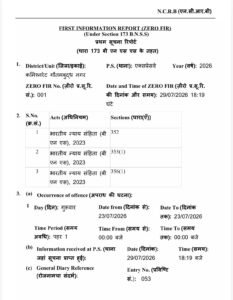
Following a complaint filed on Wednesday, police registered a Zero FIR at the Expressway Police Station in Noida before transferring the case to the Parliament Street Police Station in Delhi, which has jurisdiction over the protest site.
The FIR invokes provisions of the Bharatiya Nyaya Sanhita (BNS) relating to provoking a breach of peace, statements conducive to public mischief and defamation. Investigators will now examine video footage and other evidence to determine whether the alleged remarks constitute offences under the law.
According to the complaint, Singh’s comments were insulting to the office of the Prime Minister and had the potential to disturb public peace and communal harmony.
The case comes even as the Delhi government has announced that criminal cases against most student protesters would be withdrawn in accordance with assurances given to the CJP and the Supreme Court’s recent directions against coercive action against peaceful demonstrators without criminal antecedents.
READ: The State of TV News: Falling Revenues, ‘Godi Media’ Tag, and Crisis of Trust (Part 2)
CJP Criticises Criminal Proceedings
Reacting to the FIR, CJP spokesperson Saurav Das acknowledged that the language allegedly used by Singh could be considered inappropriate but questioned the decision to invoke criminal law.
“Of course, if any language used is derogatory in nature, the person concerned is free to pursue civil defamation or criminal defamation proceedings. However, using the criminal machinery against protesters is highly condemnable,” Das said.
He maintained that objectionable speech should not automatically invite police action unless it met the threshold prescribed by law.
“I’m not saying the language is right. It may be wrong or objectionable to some people, but that is no reason to invoke the criminal machinery against such individuals. It creates a chilling effect on free expression. The use of criminal machinery in such situations is completely unacceptable,” he said.
At the same time, Das appealed to young protesters to exercise restraint in their public statements while urging law enforcement agencies not to misuse criminal provisions for political purposes.
Delhi Government’s Position
The FIR assumes significance because it comes on the same day the Delhi government announced that it would not pursue criminal cases against most of those arrested during the anti-paper leak agitation.
Delhi Home Minister Ashish Sood said the government had honoured its commitment to student protesters by ordering a review of all arrests and police cases arising out of the demonstrations.
“We stand with the students, and it is in that spirit that we have issued this order,” Sood said.
He clarified, however, that the government’s decision would not protect individuals with criminal antecedents or those accused of exploiting the protests to commit acts of violence or other criminal offences.
Whether the FIR against Ruchika Singh falls within the category of cases proposed to be withdrawn or continues independently will depend on the course of the police investigation and the legal scrutiny that follows.
Section | Offence Description | Max Punishment | Old IPC Equivalent |
|---|---|---|---|
352 | Intentional insult to provoke breach of peace | 2 years / fine / both | 504 |
353 | Statements/rumours causing public mischief | 3 years (5 years in place of worship) / fine / both | 505 |
356 | Defamation | 2 years / fine / both | 499/500 |
These sections are commonly invoked together in cases involving public protests, abusive slogans, or social media posts targeting public figures, as they address both immediate provocation/public order and reputational harm.