A Naga organisation’s open reference to seeking China’s help if India fails to protect border villages marks a troubling new dimension in Manipur’s crisis — and a warning about how deeply confidence in the state has eroded.
By PC Bureau
September 30: A Naga organisation’s warning that people living along Manipur’s Myanmar border could seek China’s protection if the Indian and state governments fail to secure them has taken the state’s security crisis into uncharted territory. The reference to China—made publicly after the killing of four Tangkhul men in Kamjong and three people in a subsequent shooting in Senapati—is significant not because it establishes any move towards Beijing, but because a community on India’s frontier is openly questioning whether the Indian state can protect it.
Tangkhul Aze Katamnao Long (TAKL), also known as the Southern Tangkhul Students’ Union, president Yarchuiso Kashung said on Tuesday that continued failure by the Centre and the Manipur government to protect Naga-inhabited border areas could force people to seek support from neighbouring countries, including China. He was speaking days after four Tangkhul civilians were killed at Pilong in Kamjong district and amid fresh killings of Naga civilians elsewhere in the hills.
The significance of the statement lies less in whether China would actually be approached than in why such a thought has entered the public discourse at all.
For decades, China’s name in the Northeast has been associated with India’s most sensitive strategic and insurgency-related concerns. A civilian organisation invoking China as a possible source of protection for border communities is therefore not an ordinary expression of anger against a state government. It touches the most basic obligation of a sovereign state: the ability to protect its citizens and secure its own territory.
The immediate backdrop is the deteriorating security situation in Manipur’s Naga-inhabited hills.
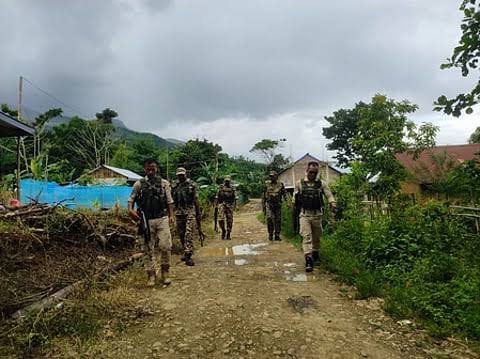
On September 24, four Tangkhul Naga civilians were killed at Pilong, close to the India-Myanmar border in Kamjong. Police said unidentified armed persons, suspected to have come from across the Myanmar border, carried out the attack and registered a suo motu case under several provisions, including the Unlawful Activities (Prevention) Act and Arms Act. Police have also suspected the involvement of the Myanmar-based Kuki National Army-Burma, although that attribution has not been officially established.
The victims were identified as Phami Jajo, Vareishim Jajo, Betterson Jajo and Ningthem Kashak. Naga organisations have alleged that KNA-B cadres were responsible. The allegations have not been independently verified, but the fact that the attack occurred close to the international border has intensified concerns about cross-border armed movement.
Within days, two Naga civilians were also shot dead in Senapati district, with two others injured, according to reports. The attack came amid a broader escalation of violence involving Naga and Kuki communities in several hill districts.
For Naga organisations, however, the problem is not confined to individual attacks.
Their complaint is increasingly about what happens after an attack — and, more importantly, what the government does to prevent the next one.
TAKL has demanded intelligence-led operations, identification of unauthorised camps, recovery of illegal weapons and arrests irrespective of community. Kashung has also questioned whether the Suspension of Operations arrangement involving Kuki armed groups is being adequately enforced, arguing that such agreements cannot permit armed groups to move around with weapons, extort civilians or attack villages.
The government faces a particularly difficult challenge on the Myanmar frontier. The border is remote, difficult to patrol and still substantially unfenced. Myanmar’s own prolonged internal conflict has added another layer of complexity, with armed groups operating in areas adjoining Manipur.
But the more worrying development is the erosion of confidence among communities living there.
A government can survive criticism over an individual security failure. It faces a much more serious problem when citizens living on a sensitive international frontier begin publicly questioning whether the Indian state can protect them at all.
That is why the China reference deserves to be taken seriously — not as evidence that Naga civilians have decided to turn to China, but as a warning about the depth of alienation and insecurity that has developed along the border.
It also raises a difficult question for New Delhi.
If citizens living along India’s international boundary feel sufficiently abandoned to publicly invoke another country for protection, what does that say about the effectiveness of the existing security architecture?
The question becomes even more serious because the violence in Manipur is no longer confined to the original Meitei-Kuki-Zo fault line that defined much of the conflict since May 2023.
Naga-Kuki tensions have intensified in the hill districts, with killings, abductions, attacks on villages and competing allegations against armed groups. The result is an increasingly complicated conflict in which the original ethnic divide has been joined by another layer of confrontation.
The danger is that every new killing becomes part of a retaliatory cycle, while the state is increasingly seen as reacting rather than preventing.
READ: From US to Italy, Voter Counts Rise — India’s SIR Stands Out as a Stark Global Anomaly
TAKL’s warning therefore needs to be read as a symptom rather than simply a provocation.
The organisation is effectively saying that repeated appeals for peace are no longer enough. Communities want to know who will protect them when armed men cross into their villages, who will recover illegal weapons, who will dismantle unauthorised camps and who will ensure that those responsible are arrested.
The government can answer the China reference without engaging in a political argument over China.
It can answer it by demonstrating that the Indian state is present, capable and trusted in its own border villages.
That means sustained security deployment, credible investigation of the Pilong and Senapati killings, action against armed camps and weapons, and a mechanism that prevents one community’s civilian deaths from becoming the trigger for another round of retaliation.
The most revealing part of the TAKL statement, therefore, is not the prospect of a Chinese flag actually being raised in a Manipur village.
There is no evidence that such a move is underway.
The warning matters because the idea has entered the public conversation at all.
In a state that has endured more than three years of ethnic violence, that may be one of the clearest indications yet of how far the crisis has travelled — from a breakdown of communal relations to a growing question about whether the Indian state can still command confidence among some of the communities living on its most sensitive frontier.