From the US and Brazil to Italy and South Africa, electoral rolls show growth or relatively gradual demographic-driven change over the past decade. India, meanwhile, faces the prospect of a sharp contraction in its electorate once the SIR process is completed.
BY Navin Upadhyay
New Delhi, September 30: The world’s large democracies are, by and large, adding voters—or, in ageing societies, seeing their electorates move only gradually with demographic decline. India is taking a dramatically different course.
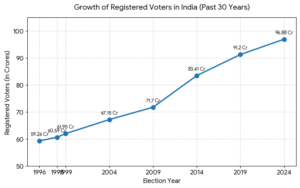
In 2024, India went to the Lok Sabha polls with 97.98 crore electors, the culmination of a two-decade expansion from 67.15 crore in 2004 to 71.70 crore in 2009, 83.41 crore in 2014 and 91.20 crore in 2019. The Election Commission’s own historical data shows the trajectory clearly.
The Special Intensive Revision (SIR) has now put that trajectory into reverse—at least at the draft stage.
More than 13 crore names have been left out of draft electoral rolls across the States and Union Territories covered by the exercise. They are not final deletions: claims, objections, hearings and applications for inclusion remain possible. But if the draft reduction were simply measured against the electorate that actually elected the 18th Lok Sabha, the number would fall from 97.98 crore to roughly 84.6 crore.
If another three crore names were eventually excluded, as the projected trajectory being discussed suggests, the figure would approach 81.6 crore—lower than India’s 2014 electorate of 83.41 crore.
That would mean that an electoral exercise begun after a 97.98-crore electorate voted in 2024 could, if the exclusions survive, leave India with fewer electors than it had a decade earlier.
That is the real global comparison.
The last Lok Sabha roll is the cleanest baseline
The 2024 Lok Sabha electorate is not an abstract administrative number. It was the roll on which India conducted a nationwide parliamentary election.
The Election Commission recorded 97,97,51,847 electors in 2024. In 2004, the corresponding figure was 67,14,87,930. In 2014 it was 83,40,82,814. In 2019 it rose to 91,19,50,734.
That makes the scale of SIR easier to understand.
Subtract 13.37 crore from the 2024 baseline and the arithmetic points to about 84.6 crore. Subtract another three crore and it approaches 81.6 crore.
The latter would not merely slow electoral growth. It would erase the entire increase in India’s electorate between 2014 and 2024 and push the count below the 2014 level.
Again, this is a scenario, not the final electorate. But it is the scale of the administrative change that the SIR draft has set in motion.
Country | ~2014 | ~2024 |
|---|---|---|
Brazil | 14.28 crore | 15.86 crore |
South Africa | 2.54 crore | 2.78 crore |
France | ~4.6 crore | ~4.93 crore |
Germany | 6.20 crore | 6.20 crore |
Italy | ~4.9 crore | ~5.12 crore |
Japan | 10.40 crore | ~10.4 crore |
United States | 14.22 crore | 17.39 crore |
What is happening in other large democracies?
The comparison becomes striking when India is placed alongside the United States, Britain, France, Germany and Italy—and then against other large democracies.
The United States has a completely different registration architecture from India: registration is decentralised and administered by states and local jurisdictions. Yet the direction is not one of sudden national contraction. The US Election Assistance Commission reported more than 211 million active registered voters for the 2024 general election, equivalent to 86.6% of the citizen voting-age population. Motor-vehicle offices and automatic registration were the two biggest sources of registration transactions. At the same time, US states continue to remove ineligible records, with nearly 40 million confirmation notices sent in 2024 as part of list maintenance.
The point is not that the American system is directly comparable to India’s. It is not. The point is that large-scale voter-list maintenance in the United States has not produced anything resembling a 13-crore contraction of the national electorate in a single revision cycle.
Britain presents another useful comparison. The UK maintains separate parliamentary and local-government electoral statistics, so figures have to be compared on a like-for-like basis. The Office for National Statistics reported 46.56 million parliamentary registrations in December 2021 and continues to publish annual electoral-registration datasets. The British system has a well-documented problem of incomplete registration among eligible citizens, but that is a different problem from taking a recently used national electoral register and removing a very large share of its names through an intensive re-verification exercise.
France provides an even clearer contrast. It had 49.34 million registered electors on May 8, 2024. By February 11, 2026, the number had risen to 50.19 million. In those 21 months, 5.69 million people were registered or re-registered while 4.85 million were removed. Crucially, INSEE says the increase was principally demographic: automatic registration of young people reaching 18 exceeded deaths.
That is almost the mirror image of India’s present SIR trajectory.
France removes the dead and people who register elsewhere, but adds new 18-year-olds and people who re-register. The net result is an expanding roll.
Germany is the important counter-example because its electorate can decline. But its decline is demographic and gradual.
Germany’s Federal Returning Officer records 61.998 million persons entitled to vote in the 2014 European election and 61.963 million in 2024—a difference of just 35,804 over a decade. The 2025 Bundestag electorate was 60.51 million.
Germany therefore demonstrates the distinction India must confront. An ageing society can have a flat or slowly declining electorate. But Germany did not suddenly lose 15% of its electoral roll through an administrative revision.
Italy belongs broadly to the same demographic category. For the 2024 European Parliament election, Italy had 51,198,828 registered electors. Its population has been ageing and declining, providing a demographic explanation for a largely stagnant electorate rather than a sudden administrative contraction.
The distinction is crucial: Germany and Italy offer demographic explanations for electoral stagnation or decline. India does not have the same demographic profile.
Then look beyond the West
Brazil’s numbers make the contrast even harder to miss.
Brazil had 155.91 million voters eligible for its 2024 municipal elections, up 5.4% from 2020. By December 2024, its electoral roll had reached 158.62 million, an increase of 3.23 million—or 2.08%—in a single year.
Pakistan, despite its very different political and electoral system, also shows the opposite direction. The Election Commission of Pakistan recorded 128.59 million registered voters for the 2024 general election.
South Africa’s registered electorate increased from about 25.39 million in 2014 to 27.78 million in 2024.
These countries differ enormously in electoral law, population structure and registration systems. But they share one basic feature: their electoral rolls have not undergone anything approaching India’s present draft contraction.
The demographic contradiction
This is where India’s case becomes exceptional.
A voter roll is not expected to rise in perfect proportion to population. People die. People migrate. People acquire or lose eligibility. Duplicate records must be removed. People can register elsewhere.
Every electoral authority performs such housekeeping.
But India’s demographic situation makes the scale and direction of SIR unusual.
India remains a growing country with a large young population. Millions of Indians continue to reach voting age. Indeed, the country’s electorate expanded by more than 30 crore between 2004 and 2024.
Yet the SIR draft has produced the possibility of taking that electorate back by more than 13 crore—and potentially by about 16 crore if the additional three-crore projection materialises.
The result would be a growing population accompanied by a dramatically smaller electoral register.
That is precisely the relationship that the international comparison exposes.
READ: Ahead of US Midterms, Iran’s IRGC Launches Direct Appeal to American Voters
Two very different ways of maintaining a voter roll
There is another important difference.
Much of Europe builds electoral eligibility from population and civil-registration systems. France’s experience illustrates this: INSEE says automatic registration of young people reaching 18 is one of the principal reasons its electorate increased after 2024.
The US takes the opposite institutional route: citizens generally have to register, and states then maintain those lists.
India sits somewhere between these models, but SIR introduces a particularly demanding feature: the existing voter must establish continuity with an earlier electoral record or otherwise satisfy the requirements for inclusion.
That changes the nature of list maintenance.
The question is no longer simply: Who should be removed because they have died, moved or been duplicated?
It becomes: Who among those already appearing on the electoral roll must now establish again that they belong there?
That distinction matters enormously when the exercise affects tens of millions of people.
to answer.