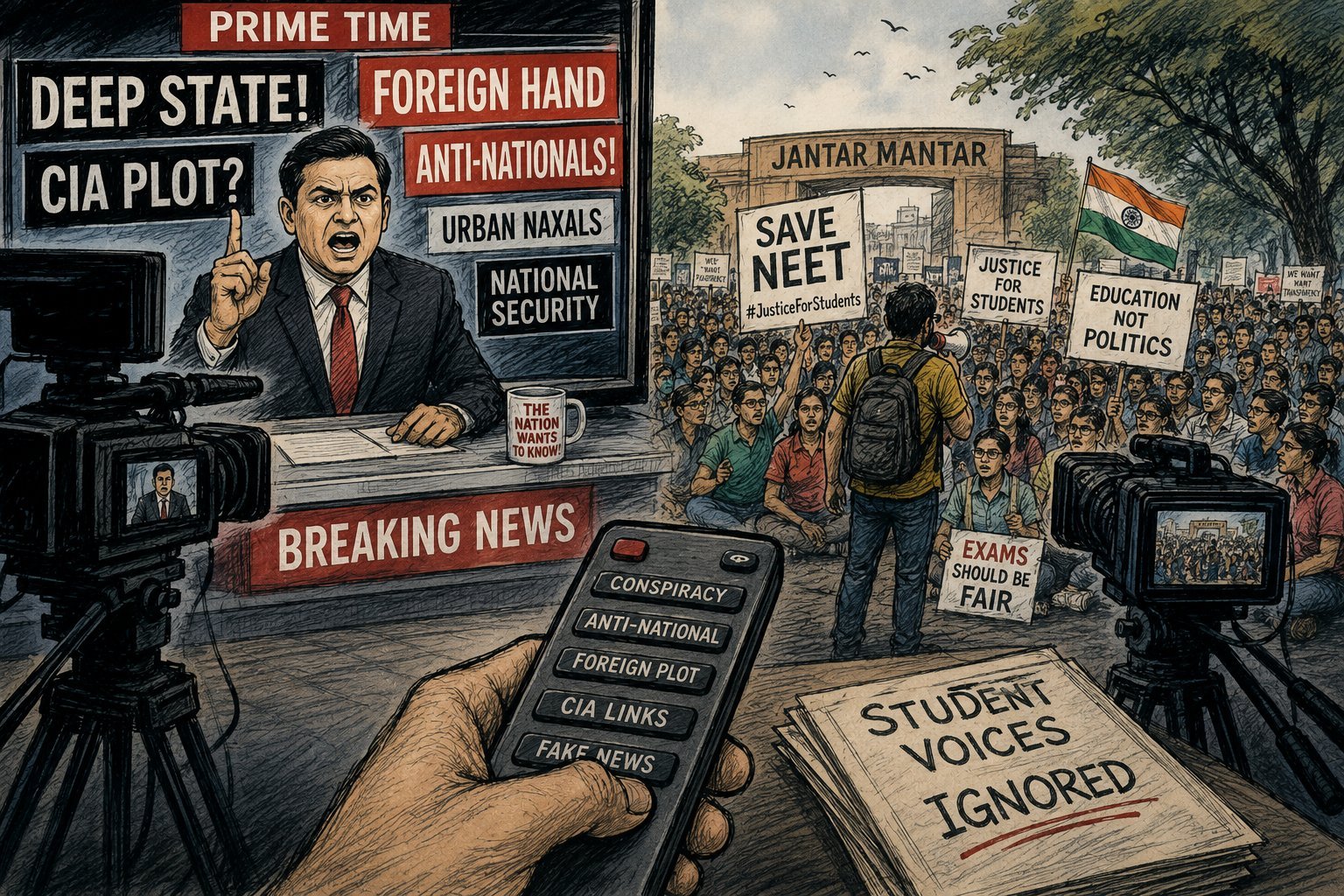
While students camped at Jantar Mantar demanding exam reform, prime-time TV found a different story to tell — foreign plots, “Deep State” operatives, and a movement recast as a national security threat. In part two of the three-part series, we look at what got airtime, what didn’t, and why.
BY NAVIN UPADHYAY
As tens of thousands of students and young professionals gathered at Delhi’s Jantar Mantar to demand accountability for NEET paper leaks, the protest quickly evolved into one of the largest youth mobilisations India had witnessed in recent years. Yet, while the demonstrators insisted, they were seeking reforms in the country’s education system, parts of India’s television news industry told a very different story.
The Cockroach Janta Party (CJP), founded in May 2026 by political communications strategist Abhijeet Dipke as a satirical political movement, organised the prolonged sit-in and marches that culminated in the resignation of Union Education Minister Dharmendra Pradhan. Thousands camped at Jantar Mantar for over a month, volunteers organised food and medical aid, and activist Sonam Wangchuk joined the agitation through a prolonged hunger strike. At its core, the movement centred on examination integrity, transparency and accountability.
However, instead of focusing primarily on those demands, several television channels shifted their attention towards portraying the movement as part of a larger conspiracy against the Indian state.
The ‘Deep State’ Narrative
Night after night, several prime-time programmes attempted to frame the agitation not as a student-led movement but as a foreign-sponsored operation allegedly designed to destabilise India.
CJP founder Abhijeet Dipke was repeatedly described on some broadcasts as a “Deep State” operative. Programmes referred to alleged CIA links, regime-change plots, foreign funding, international “toolkits,” Pakistan-based conspiracies and Western attempts to derail India’s rise. Viewers were told that foreign governments, intelligence agencies and hostile actors were orchestrating the agitation from behind the scenes.
These were serious allegations.
#CJPAttacksUniform | Are India’s men and women in uniform being deliberately targeted? As political controversies intensify and international voices weigh in on domestic protests, bigger questions emerge. Watch Arnab lead a high-voltage debate on national security, foreign… pic.twitter.com/vjw8eKckL4
— Republic (@republic) July 28, 2026
Yet no publicly available evidence was presented establishing that the organisers of the protest, or the thousands of students who occupied Jantar Mantar, were funded or directed by any foreign government or intelligence agency.
Investigating the finances, organisation and external links of any mass movement is unquestionably a legitimate journalistic exercise. The question is whether allegations of foreign interference should be presented as established fact without evidence meeting basic standards of verification.
From Students to ‘Anti-Nationals’
Equally striking was the language employed by some prime-time anchors.
Protesters were variously described as “anti-nationals,” “criminals,” “anarchists,” “CIA-funded elements,” “urban extremists” and agents working to “break India.” Some programmes questioned whether those camping at Jantar Mantar were genuine students at all.
One anchor repeatedly characterised the movement as a threat to national security while demanding action against its organisers. Another drew attention to the food being served at the protest site, suggesting foreign or Middle Eastern links without producing evidence that such logistical arrangements indicated external funding. Yet another compared the agitation to earlier politically contentious protests, reinforcing a narrative that the demonstrations were part of a coordinated campaign rather than a response to concerns over examination integrity.
Such framing dramatically altered the nature of the public debate. The central questions surrounding examination reforms, alleged paper leaks and student anxiety were increasingly overshadowed by discussions of conspiracies, espionage and national security.
What Was Left Out
Critics argue that equally important developments received far less sustained attention.
These included allegations of excessive police force during the “Chalo Sansad” march, reports of lathi charges and tear gas against students, prolonged silence from the government on the protesters’ principal demands, and statements by senior public figures acknowledging the legitimacy of concerns surrounding the examination system.
Former BJP president Murli Manohar Joshi, for example, publicly said students’ concerns over examination irregularities were genuine and cautioned against treating the issue purely as a law-and-order problem. Such interventions received considerably less prominence than conspiracy-centred debates on several prime-time programmes.
लो अब विदेश मंत्रालय बता रहा है कि CJP के प्रदर्शन में विदेशी फंडिंग के आरोप बेबुनियाद है 🧐
और यंहा सड़को से लेकर गोदिमीडिया के स्टूडियो तक मे भक्त मण्डली विदेशी फंडिंग को लेकर नंगा नाच रही थी 🤪 pic.twitter.com/RQL3FENj1L— निदेश सूर्यवंशी एडवोकेट _WITH INC (@Nidesh423) July 28, 2026
Similarly, live daytime coverage often showed the scale of the peaceful gathering and the participation of students from across the country. By prime time, however, the narrative on some channels had shifted decisively towards alleged foreign plots, violence and anti-national activities.
“There is nothing new in it. Most TV channels have become mouthpieces of the government. They are dedicated to polishing the image of their masters and painting any dissenter as anti-national,” said senior journalist Paranjoy Guha Thakurta.
He went on to add that India’s mainstream media stands highly compromised, and that this is the reason people are increasingly shifting towards social media. “Now, social media is setting the narrative. No one cares for the TV channels,” he said.
Accountability Must Apply Equally
The episode also raises broader questions about media accountability.
Governments routinely invoke national security and misinformation concerns when ordering the removal of social media posts or initiating legal action against individuals accused of spreading false information. Yet critics argue that comparable scrutiny is seldom applied when televised broadcasts make similarly grave allegations against individuals or protest movements without publicly verifiable evidence.
Freedom of the press necessarily includes the freedom to investigate funding sources, question organisers and examine possible external influence. It also carries a corresponding responsibility to distinguish verified facts from speculation, allegation and opinion.
Unsurprisingly, social media has been flooded with reaction condemning what critics call the “Godi media.” In a post on X, user Kapsalogy wrote that Godi media has lost its credibility, and that alternative media is what people, especially the younger generation, now watch. The post added that the government’s “misadventures, lies, and fake news” are being exposed by alternative media every day, and predicted a crackdown soon in the form of licensing restrictions, permission requirements, denial of press card access, and takedowns of YouTube channels.
Pakistan’s Disinformation Campaign Is a Separate Issue
Delhi Police later announced that more than 400 Pakistan-based social media accounts had allegedly circulated AI-generated videos, deepfakes and misinformation relating to the protests.
That finding addressed online disinformation campaigns targeting public discourse.
It did not, by itself, establish that the thousands of students participating in the CJP agitation were foreign-funded or acting under the direction of external agencies. The existence of coordinated online propaganda does not automatically validate broader allegations made about an entire protest movement.
The Cost of Polarised Journalism
The CJP protests illustrate a pattern that has become increasingly familiar in India’s television news landscape. Initial reporting on the grievances of protesters often gives way to highly polarised prime-time debates centred on external conspiracies, political motives and questions of patriotism.
Whether one agrees or disagrees with the methods, leadership or demands of the movement is a matter of legitimate democratic debate. A separate issue is whether news organisations should level accusations carrying profound legal and social consequences—such as being “anti-national,” “CIA-funded” or part of a “Deep State” conspiracy—without publicly presenting evidence that satisfies accepted journalistic standards.
The education minister eventually resigned, bringing the immediate agitation to an end. Whether that outcome reflected the strength of the protests or political calculation will remain open to interpretation. Less debatable, however, is the lasting question the episode leaves behind: in an era when misinformation is rightly viewed as a threat to democracy, should television news channels be held to the same evidentiary standards they routinely demand of others?
When some television anchors and prime-time hosts later confronted CJP spokesperson Saurav Das over the hostile reception their reporters had received at the Jantar Mantar protest site, Das expressed regret over the incidents and said the movement did not condone any form of violence or intimidation against journalists.
READ: Hockey India Sheds Iconic Blue Kit for Saffron, Sparks Row
“We apologise if any journalist was mistreated. The CJP does not endorse violence against anyone,” Das said, while alleging that some “BJP-backed goons” had infiltrated the protest to create disturbances and tarnish the movement’s image. The allegation has not been independently verified.
At the same time, Das warned that the growing distrust of sections of the television news media could eventually translate into public demands for accountability. “The day is not far when the country will seek accountability from television channels for running false narratives to discredit voices of dissent and democratic protests,” he said.
Asked whether television channels that allegedly disseminate false or misleading narratives should face legal consequences, media analyst Paranjoy Guha Thakurta responded with a wry smile. “Where will you go to prosecute them? On which platform?” he asked, suggesting that meaningful accountability for broadcast journalism remains difficult under the existing regulatory framework.
Former NDTV journalist Manish Kumar, who was associated with the channel from its inception and resigned following its takeover by the Adani Group, argued that sections of what critics describe as the “Godi media” have increasingly come to function as an extension of powerful corporate and political interests. Rather than examining the underlying causes of mass movements, he said, some broadcasters routinely frame them through the lens of conspiracy, law and order, or national security.
“The success of the CJP movement has shown that fear is gradually disappearing among ordinary people,” Kumar said. “I hope these channels also read the writing on the wall. I don’t want to say much more than that.”
Whether one agrees with that assessment or not, the CJP agitation has revived a broader debate about the role of television news in a democracy. To what extent should broadcasters be held accountable for the factual accuracy of their reporting while continuing to enjoy wide editorial freedom? As public confidence in traditional television news continues to be debated, that question is likely to become increasingly difficult to ignore.