BY PC Bureau
September 3: The Manipur government has warned of prosecution against anyone blocking highways, restricting the movement of people and essential goods or damaging public infrastructure, as the United Naga Council (UNC) announced that it would intensify its ongoing economic blockade on four major national highways.
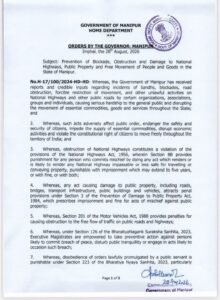
The government order, issued on August 28, comes amid escalating tensions between the state administration and the UNC over the Naga body’s demands concerning the May abduction and killing of Naga civilians and its opposition to the continuation of the Suspension of Operations (SoO) agreement with Kuki militant groups.
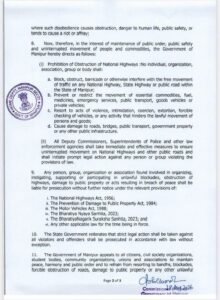
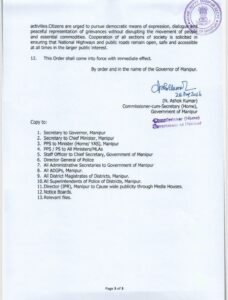
The Home Department notification, issued in the name of the Governor and signed by Commissioner-cum-Secretary (Home) N. Ashok Kumar, prohibits blockades and other forms of obstruction on National Highways, State Highways and public roads across Manipur. It took effect immediately.
The government said it had received reports and “credible inputs” about bandhs, blockades, forcible restrictions on movement and other unlawful activities on highways and public roads. Such actions, it said, had caused serious hardship to the public and disrupted the movement of essential commodities, goods and services.
The order warned that highway blockades could affect public order and the safety and security of citizens, disrupt economic activity and impede the movement of essential supplies.
Government warns of prosecution
The government cited several laws under which offenders could face action.
Under Section 8B of the National Highways Act, 1956, anyone who commits mischief that renders, or is likely to render, a National Highway impassable or less safe for travelling or transporting property can face imprisonment of up to five years, a fine, or both.
Damage to roads, bridges, government buildings, vehicles and other public infrastructure can attract provisions of the Prevention of Damage to Public Property Act, 1984. The government also cited Section 201 of the Motor Vehicles Act, 1988, concerning obstruction of the free flow of traffic.
It further referred to preventive powers available to Executive Magistrates under Section 126 of the Bharatiya Nagarik Suraksha Sanhita, 2023, and Section 223 of the Bharatiya Nyaya Sanhita, 2023, which deals with disobedience of orders lawfully promulgated by public servants.
The order specifically prohibits individuals, organisations and groups from blocking, barricading or otherwise interfering with traffic on national or state highways and public roads.
It also bars attempts to restrict the movement of fuel, medicines, emergency services, public transport, goods vehicles and private vehicles, as well as violence, intimidation, coercion, extortion and forcible checking of vehicles.
Deputy commissioners, superintendents of police and other law-enforcement agencies have been directed to ensure uninterrupted movement on the state’s highways and initiate prompt legal action against violators.
The government said anyone found organising, instigating, supporting or participating in unlawful blockades or acts resulting in a breach of peace could be prosecuted without further notice under applicable laws.
It also appealed to civil society organisations, student bodies, community groups, unions and other associations to pursue grievances through dialogue, peaceful representation and other democratic means.
UNC announces escalation
The government’s warning coincided with a decision by the UNC to intensify its economic blockade.
The UNC’s Emergency Presidential Council met on Wednesday at the Tangkhul Naga Long office in Ukhrul. Representatives of Naga tribes, the Naga Women Union, the All Naga Students’ Association, Manipur and the Naga People Union Imphal attended the meeting.
Briefing reporters, A.C. Thotso, member secretary of the UNC Working Committee, said the council had decided to intensify the blockade because, according to the UNC, the government had failed to deliver justice to the victims and families of the Leilon Vaiphei incident and had not addressed its charter of demands.
The UNC called on the state government to place its demands before the ongoing Assembly session.
The Naga body also said it had taken “serious note” of developments along IT Road and would take what it described as “appropriate action” to protect Naga land and people.
READ: Yasin Malik Seeks No Defence in Murder Trial, Seeks Death Penalty
Four demands
The UNC’s charter contains four principal demands.
It has called for the abrogation of the Suspension of Operations agreement with all Kuki militant groups and the arrest and prosecution of those it alleges were involved in the abduction of 18 Naga civilians at Leilon Vaiphei village on May 13.
According to the UNC, six of the abducted civilians were subsequently killed. It has also demanded action over the alleged killing of Wilson Thanga Chiru at Joujangtek on the same day.
The council has sought the arrest and prosecution of Lalboi Vaiphei, whom it identifies as the chief of Leilon Vaiphei village, along with others it alleges were involved in the abduction.
Its third demand is that the Kuki National Front–President (KNF-P) be declared a terrorist organisation.
The fourth is the removal of Deputy Chief Minister Nemcha Kipgen from office. The UNC has alleged that Kipgen’s husband, Semtinthang alias Thangboi Kipgen, is the president of the KNF-P and argued that her continuation in government compromises the state’s internal security interests.
These are claims and demands made by the UNC; they do not by themselves establish criminal liability or the political affiliation of individuals named by the organisation.
Highways become the new flashpoint
The confrontation puts the state government’s new prohibition and the UNC’s planned escalation on a collision course.
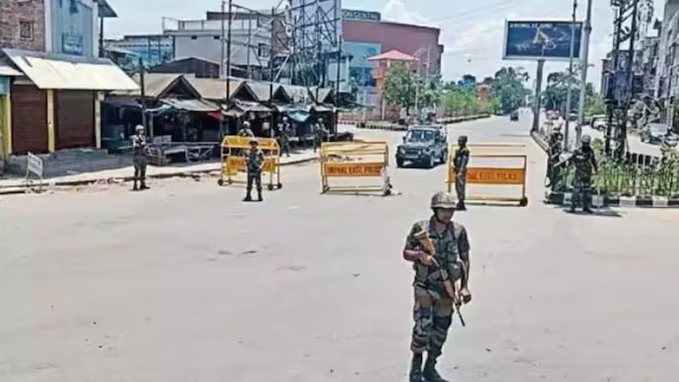
NH-2, NH-37, NH-102 and NH-202 are among Manipur’s critical road corridors, connecting the state with neighbouring regions and serving as major routes for the movement of fuel, food, medicines and other supplies.
Any prolonged blockade therefore carries consequences beyond the immediate political dispute, particularly for the availability and price of essential commodities.
For the government, the issue is one of maintaining public order and keeping vital supply lines open. For the UNC, the blockade is being used as pressure to force action on what it regards as unresolved grievances concerning the safety of Naga civilians and the state’s approach to Kuki militant groups.
The two positions leave little room for ambiguity. The government has warned that blockades will invite prosecution. The UNC has announced that it intends to intensify one.
The coming days will therefore test whether the administration can keep Manipur’s main supply routes open without triggering another confrontation with the Naga civil society leadership.
At stake is not only the movement of goods along four highways, but the government’s ability to enforce its authority while addressing competing security and political demands from communities already divided by more than three years of ethnic conflict.