More than a month after the United Naga Council imposed an economic blockade, Kangpokpi district remains cut off from essential supplies. With fuel prices soaring, food shortages worsening and medicines becoming scarce, residents are questioning why the Manipur government has failed to restore normalcy.
By Navin Upadhyay
June 19, 2026:
More than a month after an economic blockade brought one of Manipur’s largest districts to the brink of a humanitarian crisis, a fundamental question remains unanswered: why has the state government failed to restore the flow of essential supplies to Kangpokpi?
The prolonged blockade along the vital NH-2 corridor between Senapati and Kangpokpi is pushing thousands of residents deeper into a severe humanitarian crisis.
Since May 17, residents of Kangpokpi district have faced severe shortages of fuel, cooking gas, food and medicines following an indefinite economic blockade imposed by the United Naga Council (UNC). The blockade was launched after six Liangmai Naga men, including church leaders, remained untraceable following their alleged abduction in mid-May. The recovery of their bodies in June further intensified tensions and hardened the UNC’s resolve to continue the blockade until its demands for justice are met.
While the origins of the blockade lie in a serious criminal case that warrants a thorough investigation and prosecution, the consequences have extended far beyond the dispute itself. More than 30 days later, ordinary civilians in Kangpokpi are bearing the burden of a crisis they neither created nor control.
“It’s unprecedented situation,” says Janghaolun Haokip, spokesperson of Kuki Inpi Manipur. “ It’s unfortunate that the state government has done nothing to resolve the situation.”
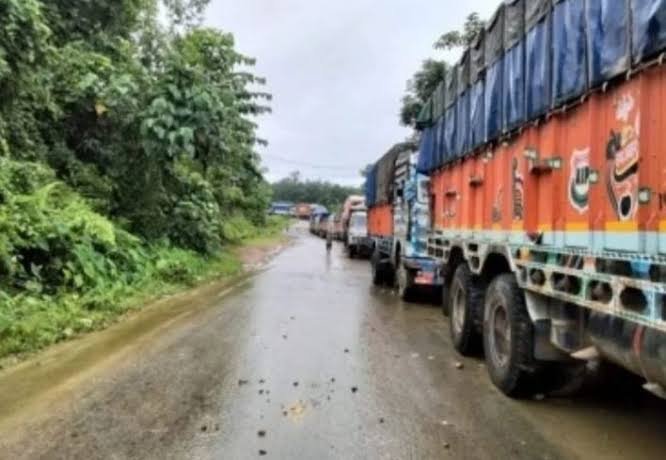
With a population of more than 2.25 lakh, Kangpokpi has effectively become isolated from major supply routes. National Highway-2, the district’s primary lifeline connecting it to Nagaland and Imphal, has been disrupted for weeks. Reports indicate that hundreds of trucks carrying fuel, food grains, medicines and other essential commodities have been stranded along various points of the highway, unable to proceed because of the blockade and the prevailing security situation.
The impact on daily life has been severe.
According to multiple reports from the district, petrol prices have surged to between Rs 230 and Rs 350 per litre in some areas. LPG cylinders have reportedly been sold for as much as Rs 5,000. The price of a 50-kilogram bag of rice has risen from around Rs 1,700 to nearly Rs 3,000. The humble potatoes is being sold at rs 80a kg. Residents have reported acute shortages of eggs, sugar, vegetables and other household necessities.
The shortage of cooking gas has forced many families to return to firewood and coal for cooking. Small businesses, restaurants and roadside eateries have either reduced operations or shut down entirely due to rising costs and dwindling supplies.
The Kuki Community demands the immediate reopening of the National Highway between Senapati District and Kangpokpi District. The ongoing blockade has severely disrupted the transportation of essential commodities, including food, rice, drinking water, medicines, and other daily… pic.twitter.com/suxBiNyES3
— Mighty Warrior Kuki (@Kamginthan40473) June 18, 2026
READ: Accenture Sparks Stock Market Crash, Wipes Out Rs 2 Lakh Crore
READ: Delhi HC Upholds Telegram Curbs Ahead of NEET-UG Re-Exam
The crisis is particularly concerning because Kangpokpi is home to thousands of internally displaced persons who have been living in relief camps since the outbreak of ethnic violence in Manipur in May 2023. Many of these families were already dependent on external assistance and fragile supply chains. The blockade has added another layer of hardship to communities that have already endured years of displacement and uncertainty.
The state government’s response has largely consisted of statements, assurances and appeals for calm. Yet there is little evidence that authorities have been able to restore regular supply lines or establish a reliable humanitarian corridor for essential commodities.
This is not merely a law-and-order issue. It is a test of governance.
Governments may not always be able to prevent communal tensions or political disputes, but they are expected to ensure that civilians have access to food, fuel, healthcare and other necessities. The continued disruption of supply routes for more than a month raises serious questions about the state’s ability to perform these basic functions.
The blockade has also exposed the vulnerability of Manipur’s transport network. With NH-2 serving as a critical artery for supplies into large parts of the state, prolonged disruptions have demonstrated how quickly communities can be cut off when alternative logistics arrangements are absent or inadequate.
Meanwhile, the humanitarian consequences continue to grow.
Patients requiring regular medication face uncertainty about future supplies. Families are paying several times the normal price for basic commodities. Businesses are struggling to survive. Relief camp residents are coping with fresh shortages. Every additional day of disruption deepens the economic and social impact on a population already affected by conflict.
The UNC has maintained that the blockade will continue until those responsible for the abduction and killing of the six Naga victims are arrested and prosecuted. The organisation has also submitted a charter of demands to both the Manipur government and the Union Home Ministry.
Those demands deserve a lawful response through investigation and due process. However, the prolonged interruption of essential supplies has created a parallel humanitarian emergency that also requires urgent attention.
“Around 15 Kuki-Zo civilians have been killed in the ethnic violence over the past three months, while hundreds of houses have been destroyed. There is suffering on all sides, and the UNC should not present the crisis as affecting only one community,” said a resident of Kangpokpi from the Kuki-Zo community.
For over a month, the residents of Kangpokpi have lived with scarcity, uncertainty and rising costs. The longer the crisis persists, the harder it becomes to avoid the conclusion that the state has struggled to protect one of its own districts from the consequences of a deepening blockade.
The people of Kangpokpi do not need more assurances. They need functioning supply lines, access to essential goods, effective security arrangements and visible administrative action. Until that happens, the blockade will remain not only a symbol of Manipur’s unresolved ethnic tensions but also a stark reminder of the state’s inability to shield ordinary citizens from the fallout of a crisis unfolding in plain sight.
Price Surge of Essential Goods in Kangpokpi(as of mid-June 2026 amid the ongoing blockade)
| Essential Item | Normal Price (approx.) | Current Black-Market Price | Increase |
| Petrol (per litre) | ₹100 – ₹110 | ₹230 – ₹350 | 2x – 3.5x |
| LPG Cylinder (14.2 kg) | ₹1,050 – ₹1,100 | ₹5,000 | ~5x |
| Rice (50 kg bag) | ₹1,700 | ₹3,000 | ~1.8x |
| Diesel (per litre) | ₹85 – ₹95 | ₹180 – ₹250 | ~2.5x |
| Eggs (per dozen) | ₹60 – ₹80 | ₹ 300 | 5x |
| Sugar (per kg) | ₹45 – ₹50 | Not available | |
| Cooking Oil (1 litre) | ₹140 – ₹160 | ₹250 – ₹350 | ~2x |
| Medicines & Baby Food | Normal MRP | Scarce / 2–3x markup | Severe shortage |
Note: Prices vary by locality and availability. Many shops have run out of stock, forcing residents to rely on firewood for cooking and face acute shortages of life-saving medicines.