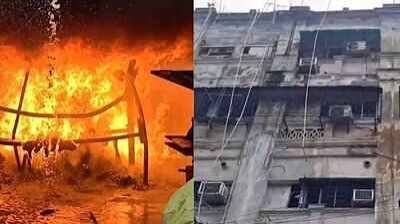
Questions over fire-safety enforcement are mounting after nine people died in a Kolkata hotel fire, just two days after another fatal hotel blaze in Birbhum. Investigators are examining the cause of the latest fire as well as whether the hotel complied with mandatory safety regulations.
BY PC Bureau
KOLKATA, August 19 — A pre-dawn fire swept through a hotel in central Kolkata on Wednesday, killing at least nine people, including a child, and raising fresh questions over compliance with mandatory fire-safety norms in the city’s densely packed commercial areas.
The blaze broke out around 2 am at a hotel on Mirza Ghalib Street, also known as Free School Street, near the New Market area. Thick smoke rapidly engulfed the building, trapping guests inside as firefighters struggled to reach the upper floors. At least six people were injured and taken to hospitals.
Several of those killed were Bangladeshi nationals who had travelled to Kolkata for medical treatment, according to the fire department and news agency ANI. The victims included a four-year-old child.
Firefighters were alerted at about 2:07 am. Rescue teams evacuated dozens of people from the building, while fire personnel battled dense smoke that made access to the upper floors particularly difficult. The flames were eventually brought under control.
READ: Goa Moves SC for Harsher Sentence for Tarun Tejpal
The cause of the fire has not yet been established. An air-conditioner malfunction or explosion has emerged as one possible explanation, but officials have not reached a definitive conclusion. Police and forensic teams are investigating the circumstances surrounding the blaze.
Nine people have died and several have suffered injuries in a fire that broke out in a hotel in Kolkata’s Mirza Ghalib Street around 2 am today.
Teams of Police and Civil Defence are present at the accident site. pic.twitter.com/KkkcydqEnN
— Shruti Dhore (@ShrutiDhore) August 19, 2026
Fire-safety compliance under scrutiny
The tragedy has put the spotlight on whether the hotel possessed the mandatory approvals and whether the building complied with West Bengal’s fire-safety requirements.
West Bengal’s fire-safety regime operates primarily under the West Bengal Fire Services Act, 1950, along with the West Bengal Fire Services (Fire Prevention and Fire Safety) Rules, 2003, the Fire License Rules, 2004, the National Building Code and applicable municipal laws. The state Fire and Emergency Services Department itself says its regulatory work is governed by these laws and the National Building Code.
For buildings covered by the high-risk provisions of the Act, owners or occupiers are required to provide and maintain prescribed fire-prevention and fire-safety measures. The law also provides for a Fire Safety Certificate and requires specified high-risk buildings to conduct an annual mock fire drill involving their staff.
The state’s official fire-safety guidance for hotels sets out specific structural requirements. These include an enclosed staircase with prescribed fire resistance, ventilation arrangements, adequate staircase width, fire- and smoke-resistant doors and access to the terrace. The guidance also specifies requirements concerning access for fire engines.
West Bengal’s online regulatory system separately lists Fire Safety Recommendation, Fire Safety Certificate, renewal of the certificate, Fire License and renewal of Fire License among the services administered by the Fire and Emergency Services Department. It also specifically provides for self-certification of fire safety for standalone non-star hotels.
The state government’s fire-safety certificate process requires documents including sanctioned building plans, building-completion certificates, floor plans, site plans and earlier fire-safety recommendations or certificates.
The law also provides for criminal penalties for violations of the fire-safety provisions. Contravention of the relevant chapter or rules can attract imprisonment of three to five years, a fine ranging from Rs 20,000 to Rs 5 lakh, or both, with additional penalties for continuing offences after conviction.
Against this legal framework, the central questions in the Kolkata case are whether the hotel had valid fire-safety approvals, whether its installed systems were functional and maintained, whether evacuation routes complied with prescribed standards, and whether inspections had identified any violations.
Reports from the scene have raised concerns about the adequacy of emergency exits and fire-safety infrastructure, but these issues will need to be established through the official investigation rather than treated as conclusively proven.
A second hotel tragedy in two days
The Kolkata fire comes just two days after another fatal hotel blaze in West Bengal.
On August 17, a fire at Hotel Bideshini in Tarapith, Birbhum district, killed several people and injured others. The blaze broke out around 4:30 am on the ground floor of the five-storey hotel while guests were asleep. Five members of a Meghalaya family, including two children, were among those who died after becoming trapped while attempting to escape.
The two incidents in quick succession are likely to intensify scrutiny of fire-safety enforcement at hotels, particularly older and budget properties operating in congested urban and pilgrimage areas.
For investigators, the immediate task is not only to establish how the Kolkata fire started, but also to determine why guests were unable to escape safely once smoke spread through the building. That question could prove as important as the eventual identification of the ignition source.