


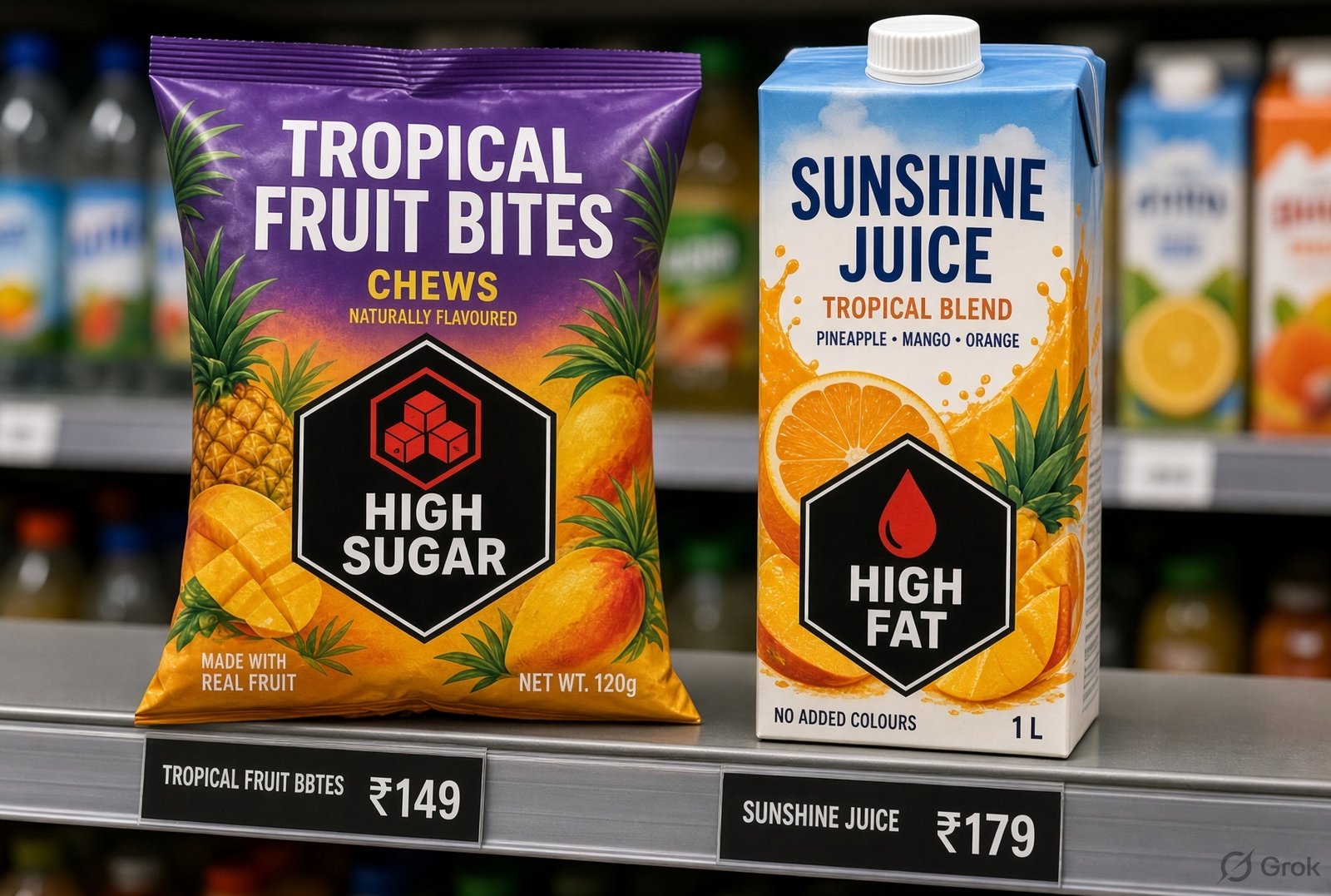
Ordering prominent ‘HIGH FAT’, ‘HIGH SUGAR’ and ‘HIGH SALT’ warnings, the Supreme Court has asked FSSAI to scientifically determine nutrient thresholds to prevent misleading or excessive labelling on packaged foods.
BY PC Bureau
November 26: The Supreme Court has directed the Centre and the Food Safety and Standards Authority of India (FSSAI) to introduce prominent, easy-to-read warning labels on packaged food products containing high levels of fat, sugar and salt. The warnings must use bold hexagonal symbols carrying the words ‘HIGH FAT’, ‘HIGH SUGAR’ or ‘HIGH SALT’ to alert consumers to potentially harmful ingredients in packaged foods.
A bench of Justices JB Pardiwala and K Vinod Chandran on Thursday ordered the effective implementation of Front-of-Package Nutrition Labelling (FOPNL), directing the government and FSSAI to ensure that the proposed warnings are clearly visible on packaged food products.
The Court specified that each warning must appear inside a hexagonal symbol, accompanied by a standard pictorial representation of the nutrient concerned and a prominent written warning identifying its high content.
The directions are intended to make nutritional information more accessible to consumers and help them identify products containing excessive amounts of ingredients associated with health risks.
The bench asked FSSAI to determine the warning thresholds on the basis of total sugars and saturated fat, rather than limiting the assessment to added sugar and added fat in packaged foods.
Supreme Court pronounces verdict in case relating to FSSAI’s implementation of front-of-pack warning labels on packaged food products containing high levels of sugar, salt and saturated fat.
Bench: Justices JB Pardiwala and K Vinod Chandran https://t.co/3LRX9vkmK8
— Bar and Bench (@barandbench) November 26, 2026
READ: Bomb Threats to Bachchan’s “Jalsa’, Diljit Dosanjh Concert
It also directed the regulator to recalibrate the cut-off levels for individual nutrients using scientific evidence, cautioning against setting thresholds that are either too low or too high.
The Court observed that excessively low thresholds could result in warning labels appearing on almost every packaged food product, potentially causing consumers to become indifferent to them. Such widespread labelling could lead to warning fatigue and undermine the purpose of the exercise.
On the other hand, thresholds set too high could allow a large number of food products containing potentially harmful levels of sugar, salt and saturated fat to escape mandatory warnings, leaving consumers inadequately informed.
The bench also stressed the importance of legibility, directing FSSAI to prescribe sufficiently large font sizes within the hexagonal symbols so that the warning text remains prominent alongside the pictorial representation on the packaged foods.
The matter has been listed for further hearing after ten weeks.
FSSAI has been directed to file an affidavit detailing the progress made on the proposed draft regulations.
The Supreme Court also directed the Union government to ensure strict implementation of existing food-labelling provisions, including the Food Safety and Standards (Labelling and Display) Regulations, 2020, in both letter and spirit.