

Nearly seven years after Jet Airways shut down, thousands of its former employees are set to receive long-pending statutory benefits, with the National Company Law Appellate Tribunal (NCLAT) directing the release of around ₹480 crore in gratuity and provident fund (PF) dues within a fortnight.
BY PC Bureau
NEW DELHI, November 26: In a major relief to former Jet Airways employees, the NCLAT on Thursday directed the release of outstanding gratuity payments, including accrued interest, and pending provident fund contributions within two weeks.
Under the directions, eligible employees must receive their gratuity dues directly in their bank accounts. Outstanding PF contributions are to be deposited through the Employees’ Provident Fund Organisation (EPFO) into the respective accounts.
The total payout is estimated at approximately ₹480 crore.
The detailed text of Thursday’s order is awaited. It is expected to clarify the methodology for calculating interest and the procedure for distributing the money among eligible former employees.
Why the gratuity and PF ruling matters
Gratuity and provident fund are statutory employment benefits intended to provide workers with financial security after retirement, resignation or termination of employment.
Under the Payment of Gratuity Act, 1972, employees generally become eligible for gratuity after completing five years of continuous service, subject to statutory exceptions. The amount is ordinarily calculated at 15 days’ wages for every completed year of service.
Provident fund contributions are governed by the Employees’ Provident Funds and Miscellaneous Provisions Act, 1952. Under the applicable statutory framework, both employers and employees generally contribute 12 per cent of basic wages and dearness allowance, subject to the prescribed rules.
For Jet Airways employees, the prolonged non-payment of these benefits had meant years of uncertainty over savings and retirement entitlements.
READ: SC Orders Bold ‘HIGH FAT, HIGH SUGAR, HIGH SALT’ Warnings on Packaged Foods
How the legal battle unfolded
The latest NCLAT directive follows a series of important judicial decisions that have strengthened the employees’ claims during the airline’s insolvency and liquidation proceedings.
On February 4, 2026, the National Company Law Tribunal (NCLT), Mumbai, directed the liquidator to release outstanding provident fund, pension and gratuity dues.
The NCLAT upheld that decision on June 30, 2026, rejecting challenges mounted by financial creditors led by the State Bank of India (SBI).
A key question before the appellate tribunal was whether employees could claim statutory benefits outside the pool of assets available for distribution among creditors during liquidation.
Under Section 36(4)(a)(iii) of the Insolvency and Bankruptcy Code (IBC), 2016, provident fund, pension fund and gratuity fund amounts are excluded from the liquidation estate.
This means such employee benefits are not ordinarily subject to the distribution hierarchy prescribed under Section 53 of the IBC, popularly known as the waterfall mechanism. Under that framework, creditors receive payments in a specified order based on the assets available to the liquidator.
SBI and other financial creditors had argued that the statutory protection should apply only where the company had maintained separate, identifiable funds for provident fund and gratuity liabilities at the beginning of liquidation.
The NCLAT rejected this interpretation, holding that the protection attached to the employees’ statutory entitlements and did not depend solely on whether separate funds had physically been maintained.
The tribunal also addressed the calculation of workmen’s dues, directing that the extended period consumed by legal proceedings be excluded while determining the relevant 24-month look-back period.
The employees received another significant boost in August 2026, when the Supreme Court dismissed SBI’s appeal against the NCLAT’s June ruling.
With the Supreme Court’s intervention, the legal position protecting the employees’ statutory claims was further reinforced.
Earlier estimates of the outstanding PF and gratuity liabilities, including interest, ranged from approximately ₹265 crore to ₹476 crore. The latest estimated payout has risen to around ₹480 crore.
From India’s aviation success story to liquidation
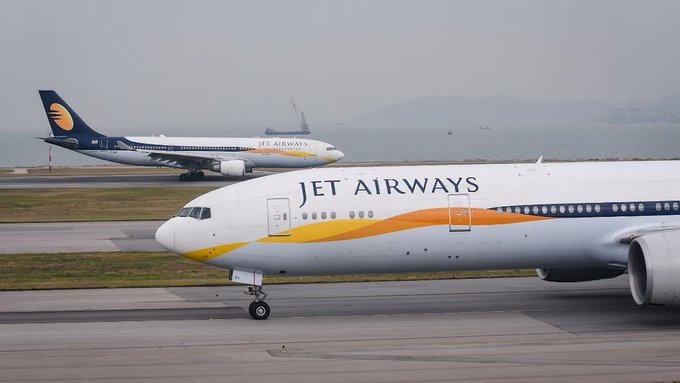
Founded by Naresh Goyal, Jet Airways began commercial operations in May 1993 with four leased Boeing 737-300 aircraft.
It received scheduled airline status in 1995 and went on to become one of India’s leading private full-service carriers, competing with the state-owned Indian Airlines and later Air India.
The airline expanded rapidly, including through its acquisition of Air Sahara in 2007. However, mounting debt, rising operating costs and financial difficulties eventually pushed it into a crisis.
Jet Airways suspended all flight operations in April 2019 after failing to secure emergency funding.
Subsequent attempts to revive the airline through the insolvency resolution process, including a resolution plan involving the Jalan-Kalrock Consortium, failed to produce a sustainable revival.
In November 2024, the Supreme Court ordered the airline’s liquidation, overturning the earlier decision that had allowed the resolution plan to proceed despite outstanding obligations to creditors.
The court invoked its extraordinary powers under Article 142 of the Constitution to bring the resolution process to an end and clear the way for liquidation.
What happens next?
The immediate challenge is to ensure that the money reaches the eligible former employees within the two-week deadline.
The liquidator will have to oversee the disbursement of gratuity payments and coordinate with the EPFO for the transfer of outstanding provident fund contributions.
The detailed order is expected to provide greater clarity on the calculation of interest, identification of beneficiaries and the mechanics of payment.
For thousands of former Jet Airways employees, the latest ruling represents more than a financial settlement. It is the culmination of a nearly seven-year struggle to recover statutory benefits earned during their years of service.
The case also reinforces an important principle under insolvency law: employee provident fund, pension and gratuity entitlements enjoy specific statutory protection and cannot simply be treated as ordinary claims competing with banks and other creditors during liquidation.