For the Iranian leadership, the funeral is about far more than bidding farewell to a long-serving ruler. It is a test of the state’s organisational capacity, its ability to maintain public order and its success in projecting national unity after a devastating war.
BY PC Bureau
July 4, 2026: The state funeral of Iran’s late Supreme Leader, Ayatollah Ali Khamenei, is unfolding on a scale rarely witnessed in modern history. Stretching over nearly a week and spanning cities across Iran and Iraq, the ceremonies are designed to honour the man who dominated Iranian politics for more than three decades. But behind the images of millions of mourners, elaborate processions and defiant slogans lies an extraordinary security and humanitarian operation driven as much by fears of catastrophe as by national mourning.
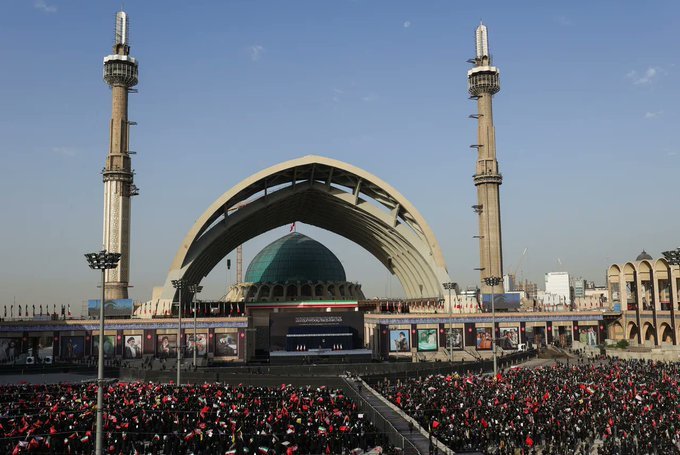
Iranian authorities expect the funeral to attract millions of participants, with some official estimates putting attendance as high as 15 to 20 million across the various ceremonies. The body, lying in state at Tehran’s Imam Khomeini Grand Mosalla, will be taken in procession through Tehran before travelling to the holy cities of Qom, Najaf and Karbala, finally reaching Mashhad for burial later this week. The funeral, delayed for months because of the war that followed Khamenei’s death in a joint U.S.-Israeli strike on February 28, has become the Islamic Republic’s biggest political and religious event in decades.
Yet the unprecedented mobilisation has also exposed the regime’s deep anxieties. According to reports by German daily WELT, Iranian emergency agencies have privately prepared for the possibility of between 1,500 and 3,000 deaths during the ceremonies due to crowd crushes, heatstroke and medical emergencies. A confidential communication from the Iranian Red Crescent and the National Crisis Management Organisation reportedly prompted the creation of a special task force to handle fatalities and missing persons. Thousands of graves are said to have been readied at Tehran’s Behesht-e Zahra cemetery as a contingency measure.
In Iran, the “funeral of the century” has begun for Supreme Leader Ayatollah Khamenei. Up to TWENTY MILLION mourners are expected to turn out.
This will probably be THE LARGEST FUNERAL IN RECORDED HISTORY.https://t.co/Wg2Nett1wb
— Steve Hanke (@steve_hanke) July 4, 2026
READ: Thousands Join Kuki-Zo Rally Against ‘Selective Justice’ in Manipur
The concern is far from hypothetical. Iran has experienced deadly stampedes during major state funerals before. In 2020, the funeral of Revolutionary Guard commander Qasem Soleimani in Kerman claimed at least 56 lives after a crowd crush. Earlier, the funeral of Ayatollah Ruhollah Khomeini in 1989 descended into chaos as millions overwhelmed security arrangements. With temperatures soaring above 40 degrees Celsius in parts of Iran, emergency planners fear dehydration, exhaustion and panic could trigger another tragedy.
To prevent such an outcome, the government has mounted an unprecedented logistical operation. Tehran has deployed around 11,000 buses, while metro and Bus Rapid Transit services are operating round the clock free of charge. Schools, mosques and public buildings have been converted into temporary shelters for pilgrims. Mobile kitchens, medical camps, water stations and emergency response teams have been positioned along the funeral routes, while security personnel have sealed off key locations and imposed extensive traffic restrictions. Reports suggest that Tehran alone has allocated millions of euros for the ceremonies, with additional funding provided for events in Qom, Mashhad and Iraq.
Beyond mourning, the funeral has become a carefully choreographed display of political power. State television has broadcast images of vast crowds pledging loyalty to the Islamic Republic and chanting against the United States and Israel. Hard-line clerics have used the ceremonies to demand retaliation for Khamenei’s killing, while portraying the late leader as a martyr whose legacy must continue under his successor, Ayatollah Mojtaba Khamenei.
For the Iranian leadership, the funeral is about far more than bidding farewell to a long-serving ruler. It is a test of the state’s organisational capacity, its ability to maintain public order and its success in projecting national unity after a devastating war. Every procession, every slogan and every televised image is intended to reinforce the message that the Islamic Republic remains resilient despite the loss of its most powerful figure.
Whether history remembers the event as a triumph of national solidarity or as a demonstration of a regime seeking to consolidate power after an unprecedented crisis may depend not only on the scale of the crowds, but also on whether Iran can safely manage one of the largest public gatherings the country has ever attempted.