

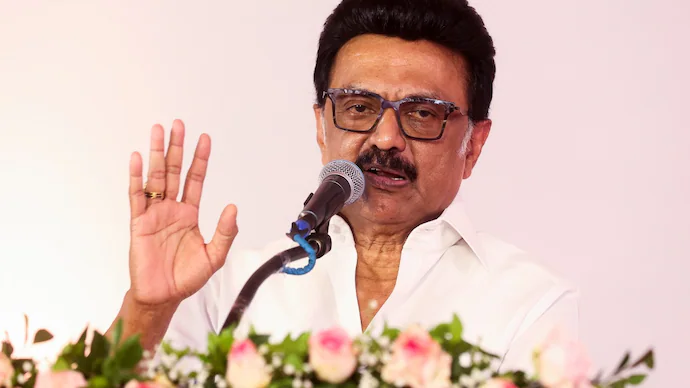
DMK says the revised formula for delimitation safeguards southern states against losing political representation for successfully controlling population growth.
BY PC Bureau
Chennai, November 28: The Dravida Munnetra Kazhagam (DMK) has decided to support the Centre’s revised delimitation legislation after the government incorporated key safeguards sought by Tamil Nadu, including a uniform 50 per cent increase in parliamentary seats across states and a 25-year freeze on their existing proportional representation.
The decision was taken at a meeting of DMK Members of Parliament chaired by party president M.K. Stalin in Chennai on Saturday. The move marks a shift from the party’s earlier opposition to the proposed delimitation exercise.
DMK leaders A. Raja and Dayanidhi Maran said the revised legislation addressed the party’s principal concerns by ensuring that states would receive the same percentage increase in Lok Sabha seats, while their relative share of parliamentary representation would remain unchanged until 2051.
Under the proposed formula, Tamil Nadu’s Lok Sabha representation would increase from 39 to approximately 59 seats in an expanded House. However, its share of the total seats would remain broadly unchanged at around 7.18 per cent.
The Union Cabinet cleared the legislative package on Friday. It comprises a Constitution Amendment Bill and a fresh Delimitation Bill, proposing to increase the maximum strength of the Lok Sabha from 550 to 850 seats. The effective elected strength is expected to be around 815-816.
VIDEO | Chennai: After DMK MPs meeting with MK Stalin concludes, party MP Dayanidhi Maran (@Dayanidhi_Maran) says, “Tamil Nadu and other southern states have followed family planning sincerely. Our population has been under control, and we should not be penalised for that. Our then Chief Minister M.K. Stalin, stated in a resolution passed in the Tamil Nadu Assembly, the DMK wants a fair deal. The rights of southern states must be protected, and their number of seats should not be reduced. At the same time, states like Uttar Pradesh and other northern states that did not follow family planning should not have their seats increased in a way that tips the balance. The demand put forward by the DMK has now been implemented in the sense that seats are being increased by 50 per cent across every state. So, the status quo is being maintained, with the same proportion of seats increasing across states. The advantage now is that 33 per cent reservation for women is going to come into force, which the DMK supports. The DMK was the first state in India to implement 50 per cent reservation for women in local body elections. We welcome this because we have always supported it.”
(Full video available on PTI Videos – https://t.co/bIyFWTfmBd)
— Press Trust of India (@PTI_News) November 28, 2026
The proposed expansion is linked to the implementation of 33 per cent reservation for women in the Lok Sabha and state legislative assemblies, with the government aiming to bring the quota into effect by 2029. A corresponding increase of 50 per cent in the strength of state assemblies is also proposed.
READ: Nigerian Sentenced for Illegal Entry, US National Off After Fine: Two Foreigners, Two Outcomes
Why delimitation became contentious
The delimitation proposal had triggered strong opposition from southern states, particularly Tamil Nadu, which feared that a population-based redistribution of parliamentary seats would reduce their relative representation.
Southern states have argued that they should not lose political representation for successfully implementing family planning programmes and controlling population growth. Under a purely population-based exercise, states with higher population growth could gain a larger share of parliamentary seats.
In April 2026, an earlier version of the legislation, which included the Constitution (131st Amendment) Bill, failed to secure the two-thirds majority required for passage in the Lok Sabha.
Stalin had subsequently mobilised opposition to the proposed exercise, bringing together southern chief ministers and political representatives through a Joint Action Committee. The Tamil Nadu Assembly also passed resolutions demanding that the state’s existing share of around 7.18 per cent be protected and that the freeze based on the 1971 Census be extended for another 25 years.
On Friday, Stalin reiterated that the DMK would not compromise on the issue. In a post on X, he said there would be no change in the party’s position and insisted that Tamil Nadu’s share of parliamentary seats must not fall below 7.18 per cent.
DMK says revised formula meets its demands
Explaining the party’s decision after Saturday’s meeting, A. Raja said the DMK would support the revised legislation because the uniform 50 per cent increase would protect the existing proportions of representation among states.
Dayanidhi Maran said the DMK had consistently opposed any formula that penalised southern states for controlling population growth.
He argued that Tamil Nadu and other southern states had implemented family planning measures effectively and should not lose their political representation as a consequence.
Maran said the revised proposal ensured that every state would receive the same percentage increase in parliamentary seats, preserving the existing balance between states.
He also welcomed the proposed implementation of 33 per cent reservation for women, pointing out that Tamil Nadu had been among the first states to introduce 50 per cent reservation for women in local body elections.
The DMK had preferred that the strength of Parliament remain unchanged, Maran said. However, if an expansion was necessary, the existing proportional representation of southern states had to be protected.
Party leaders also rejected suggestions that the decision reflected any political realignment or differences with the Congress in Tamil Nadu. They maintained that safeguarding the interests of southern states had been the DMK’s consistent position.
Political implications
The DMK’s decision to support the revised legislation could strengthen the government’s efforts to secure the two-thirds majority required for the constitutional amendment.
The party has 22 members in the Lok Sabha, making its support significant ahead of the special session of Parliament scheduled to begin on November 30. The Rajya Sabha is expected to meet on December 2.
The earlier defeat of the constitutional amendment in April had exposed the government’s difficulty in securing the required numbers. The revised proposal, incorporating the uniform seat increase and extended freeze, has now changed the political equation.
The legislation will nevertheless require support from a wider range of parties in both Houses. The constitutional amendment will also require ratification by at least half of the state legislatures.
Under the proposed arrangement, the existing inter-state proportions of parliamentary representation would remain protected until 2051, even as constituency boundaries are redrawn within the expanded strength of the Lok Sabha.
The DMK has described the revised formula as a safeguard for federal balance and the political interests of southern states, while backing the long-pending women’s reservation proposal.