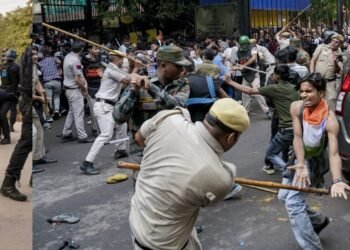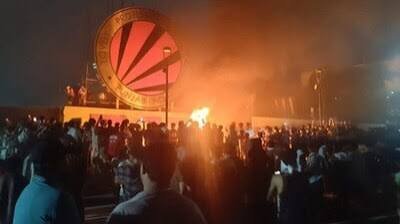
With heavy security deployed following clashes, students remaining at LPU have been advised to stay inside hostels or residences and avoid unnecessary movement.
BY PC Bureau
NEW DELHI, September 28: A protest at Lovely Professional University in Phagwara, Punjab, over an unverified allegation that a female student was sexually assaulted on campus spiralled into violence on Sunday, with students damaging university property, blocking NH-44, pelting police with stones and setting vehicles and other objects on fire.
The allegation — which also spread online in a more serious version claiming that the student subsequently died by suicide — has not been established by police. An FIR has nevertheless been registered against an unidentified person on the basis of a student’s complaint, and a Special Investigation Team has been constituted to determine what, if anything, happened. Police said forensic evidence, CCTV footage and phone records would be examined.
Several police personnel were injured during the clashes. Two police vehicles were reportedly set on fire and several others damaged, while parts of the campus, including windows, flower pots, vehicles and other property, were vandalised. Some protesters climbed onto a decommissioned MiG-23UM aircraft and a military tank displayed on the campus.
The university has now suspended regular classes for 10 days from September 28 and postponed mid-term examinations indefinitely. Students remaining on campus have been advised to stay inside hostels or residences and avoid unnecessary movement.
READ: Sangma Helped BJP Grow in Meghalaya. Now He Feels the Heat
How a social-media claim became a campus confrontation
The unrest began in the early hours of Sunday near Girls’ Hostel-3. Students alleged that a female student had been sexually assaulted several days earlier by an outsider working as a plumber or construction worker and that the hostel authorities had been informed but failed to act.
The allegation quickly moved through student groups and social media. A second claim then emerged that the alleged victim had subsequently died by suicide.
Neither claim was independently established when the protest gathered momentum.
🚨 LPU IN CHAOS, STUDENTS NOW LEAVING CAMPUS
A night of violence at Lovely Professional University, Punjab, has sent shockwaves across the campus.
Videos circulating online show police using lathis during clashes with students, including visuals of female students being… pic.twitter.com/DAoUFj5Ndq
— News Matrix (@NewsMatrixIND) September 28, 2026
According to police, they became aware of the alleged sexual assault only after students began gathering. Kapurthala SSP Gaurav Toora said police had no prior report of such a crime. Police subsequently registered an FIR on the basis of a student’s complaint and constituted an SIT rather than dismissing the allegation outright.
By around 4 a.m., students had moved towards the university entrance and blocked the Jalandhar-Phagwara stretch of NH-44. The blockade brought traffic to a standstill and sharply escalated the confrontation with the authorities.
Police attempted to clear the highway. After protesters allegedly pelted personnel and police vehicles with stones, officers used a lathi charge. The confrontation subsequently spread into the campus, where substantial property damage was reported.
LPU Is Facing fresh Scrutiny after a Protest over an alleged sexual turned violent
Where is CJP and their Three Monkeys @abhijeet_dipke @SauravDassss @AshutoshRanka who became the voice of the Students across India but their selective approach for students are related only… pic.twitter.com/RASUPS9iJ5
— Hemir Desai (@hemirdesai) September 28, 2026
Some protesting students later claimed that people who caused the most serious damage were not LPU students, although that claim has not been independently established.
What the investigation has established — and what it has not
The central allegation remains under investigation.
The SIT, headed by SP (Phagwara) Major Singh and including a DSP, a woman police officer and student representatives, is expected to examine forensic material, CCTV footage and telephone data. Police have also sought cooperation from students who may have information about the alleged incident.
Police officers told The Indian Express that the three students occupying the room identified in the allegation denied that any sexual assault had occurred there. Investigators nevertheless said the inquiry would continue.
This distinction is important. The fact that police have registered an FIR does not establish that the alleged assault occurred; equally, the university’s denial does not by itself establish that the allegation was fabricated. The investigation is intended to determine the facts.
A separate issue involving the death of a female LPU student from Telangana has also entered the discussion. Police said that student died by suicide about 15 days earlier and that her mobile phone had been seized for forensic examination. Police have said any indication of foul play would be investigated. Authorities have not established a connection between that death and the allegation that triggered Sunday’s protest.
LPU’s crisis-management strategy comes under scrutiny
LPU’s response followed two tracks: an immediate attempt to reassure students and parents that the rape claim was false, and cooperation with the police investigation.
Registrar Monica Gulati described the allegation as “false, baseless and fabricated” and said anti-social elements and people with vested interests were creating confusion. The university urged students and parents not to circulate unverified information and to rely on official communications.
But one of the university’s principal efforts to counter the allegation produced a new controversy.
LPU released a video of three female students identified as residents of Room 504 in Girls’ Hostel-3, the room named in the circulating allegations. In the video, the students said no such incident had occurred in their room.
A second video subsequently circulated in which the same students appeared to say that they had been instructed about what to say, that portions of the earlier recording had been edited before being posted on Instagram, and that their consent had not been properly obtained. One of them alleged that a “random room” had been identified.
The authenticity and circumstances surrounding the second recording will themselves require verification. But the episode illustrates a central weakness in the university’s communication strategy: an attempt to rebut a viral claim through a student video became another source of suspicion and competing narratives.
When misinformation outruns verification
The LPU episode demonstrates how quickly an unverified allegation can acquire the characteristics of an established event in a closed residential environment.
The original claim reportedly circulated through student groups before spreading more widely online. Within hours, it had evolved into multiple versions — an alleged rape, alleged administrative inaction, and an alleged subsequent suicide.
By the time police reached the campus, students were already acting on information that had not been independently verified.
The speed of the escalation created a difficult situation for the university. A simple denial was unlikely to satisfy students who believed that a fellow student had been harmed. At the same time, publicly identifying students or rooms in an attempt to disprove the allegation created privacy and credibility concerns.
The episode also shows the danger of trying to fight viral misinformation with competing viral content. Once contradictory videos begin circulating, each becomes evidence for different groups of viewers, even when the underlying facts have not been established.
The more effective response in such a situation is likely to depend on transparent verification: identifying what has been independently established, what remains an allegation, what evidence is being examined and when students can expect an update.
Students’ concerns went beyond the original allegation
The protests also revealed broader concerns among students about security and accountability inside the women’s hostels.
Protesters demanded stronger security arrangements, greater accountability of hostel officials, restrictions on male staff entering areas where female students reside, and action against officials if negligence is established. Some demanded the removal of the hostel warden.
They also sought assurances that students would not be punished merely for participating in the protest and demanded continued access to the University Management System.
Students repeatedly sought the presence of LPU founder-chancellor Ashok Mittal, a Rajya Sabha MP, at the protest site. Several rounds of discussions with university officials failed initially to end the agitation. Vice Chancellor Jaspal Singh Sandhu subsequently said the university would cooperate fully with the investigation and provide police with CCTV footage and other material requested.
Police move in as campus unrest spreads
The administration eventually deployed more than 2,000 security personnel around the university.
Senior police officers said law and order had been restored and that hostels had been checked. Authorities also sought to reassure parents that students were safe and that traffic on NH-44 had been restored.
Punjab Chief Minister Bhagwant Mann directed strict action against those responsible for violence and asked DGP Gaurav Yadav to assess the situation.
The police investigation will now have to address two distinct questions: whether the original allegation of sexual assault has any factual basis, and who was responsible for the subsequent violence, vandalism and attacks on police personnel.
A crisis that began with uncertainty
For LPU, the immediate crisis is no longer limited to determining whether a reported sexual assault occurred. The university must also deal with damaged property, disrupted academic schedules, heightened student distrust and competing accounts circulating online.
Classes have been suspended for 10 days and examinations postponed, while students have begun leaving the campus. The university’s handling of the episode — particularly its decision to publicly release a video involving students from the room at the centre of the allegation — will itself face scrutiny.
The most consequential issue, however, remains the gap between what students believed had happened and what investigators can establish actually happened.
Until the SIT completes its inquiry, the rape allegation and the alleged connection to a suicide should not be treated as established facts. At the same time, the violence cannot be explained away merely as a rumour: it has produced documented injuries, property damage, a highway blockade and a major disruption to the university’s academic operations.
The LPU episode is therefore both a law-and-order crisis and an information-management crisis — one in which an allegation moved faster than verification, and attempts to control the narrative became part of the controversy itself.