



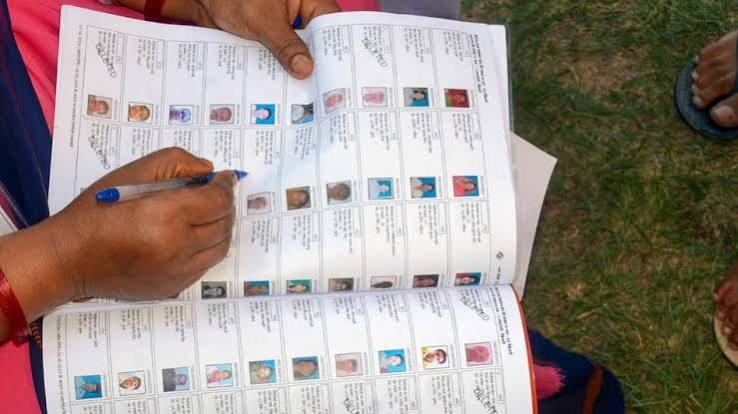
The discrepancy has raised questions about the accuracy of the SIR exercise, with people classified as dead in parliamentary and Assembly electoral rolls retaining their voting rights in panchayat elections.
BY PC Bureau
New Delhi/ November 7: In a striking discrepancy between two election authorities, 1.82 lakh people declared dead by the Election Commission of India (ECI) during its Special Intensive Revision (SIR) of electoral rolls have been found listed as living voters in Rajasthan’s panchayat elections. The contradiction raises serious questions about the accuracy of voter verification and coordination between the two election bodies.
An investigation by The Reporters’ Collective, which compared the ECI’s voter database with the Rajasthan State Election Commission’s (SEC) panchayat electoral rolls, identified 1,82,440 people marked as dead by the ECI who continue to appear as eligible voters in the state body’s records. The discrepancy means that if these individuals are alive, they can vote in panchayat elections but cannot exercise their franchise in parliamentary or Assembly polls.
The ECI’s SIR exercise, conducted between October 2025 and February 2026, resulted in the net deletion of nearly 32.31 lakh voters from Rajasthan’s electoral rolls. Among those removed were approximately 8.75 lakh people classified as dead.
Why is it that every time the ECI’s handiwork is put to the test, rechecked or independently verified, it turns out to be one big pile of bunkum?
Of the voters declared dead by Gyanesh Gupta’s SIR in Rajasthan, at least 2 lakh have now been confirmed alive by the State Election Commission during the Panchayat elections.
In any functioning democracy, this alone would trigger a massive investigation and accountability for the officials responsible — chief among them, the Chief Election Commissioner.
But this is Modi’s India, where democracy has been captured by the very CEC who should be held accountable and, ideally, behind bars.
But that day will come too. And soon.
— Pawan Khera 🇮🇳 ಪವನ್ ಖೇರಾ (@Pawankhera) November 7, 2026
Separately, the Rajasthan SEC announced a revision of panchayat electoral rolls in December 2025. Although the two bodies are independent authorities, their electoral databases are expected, in principle, to reflect the same population of eligible voters.
The ECI maintains electoral rolls for Lok Sabha and Assembly elections, while state election commissions are responsible for elections to panchayats and urban local bodies.
The Reporters’ Collective compared the ECI’s Absent, Shifted, Dead and Duplicate (ASDD) list with the SEC’s panchayat electoral rolls to identify the discrepancies.
Both revision exercises were conducted largely during the same period. The ECI completed its SIR on February 21, 2026, while the SEC finished its revision four days later, on February 25.
The Reporters’ Collective accessed, downloaded and analysed the two databases in October 2026, by which time polling for Rajasthan’s four-phase panchayat elections had already begun. Electoral rolls are locked once polling starts.
The ECI has continued updating its electoral rolls after the draft stage and on a monthly basis following the completion of SIR. However, these changes have been relatively small. The investigation said it could not fully account for post-SIR updates because the ECI does not clarify whether voter identification numbers are reassigned or restored when people previously classified as dead are subsequently reinstated as living voters.
One example cited in the investigation is Seema Devi of the Malvi constituency in Udaipur. The ECI’s records classify her as dead, while the panchayat electoral roll lists her as a living voter.
How the discrepancy was established
To establish the figure of 1,82,440, The Reporters’ Collective conducted a two-stage verification exercise.
First, it matched voter identification numbers and Electors Photo Identity Card (EPIC) numbers in the ECI’s database against the Rajasthan SEC’s panchayat electoral rolls. After identifying matching entries, it cross-checked a sample through a separate SEC portal that displays individual voter details when an EPIC number is entered.
The investigation found the discrepancies particularly significant because the two revision exercises were completed within days of each other. A longer interval might have allowed either commission to argue that changes in voters’ circumstances accounted for the differences. In this case, however, the SEC’s draft electoral roll was published after the ECI had already identified and removed people it classified as dead, shifted, absent or duplicate.
READ: ‘E20 or 420?’ Rahul Gandhi Alleges Excess Ethanol in Petrol
Garhi and Sirohi record highest discrepancies
The highest numbers of voters classified as dead by the ECI but retained as living voters in the panchayat rolls were found in Garhi Assembly constituency, with 4,889 such entries, and Sirohi, with 4,624.
The investigation did not conduct ground-level verification to establish which of the two commissions had the correct information. Consequently, it could not independently determine how many of the 1.82 lakh people were actually alive.
One case highlighted was that of Shalu Doliya, a 26-year-old woman from the Kishangarh Assembly constituency in Ajmer. The ECI’s ASDD list classifies her as dead, but she remains on the panchayat electoral roll and is eligible to vote in local elections if she is alive.
The Reporters’ Collective also contacted three Booth Level Officers (BLOs) to investigate the discrepancies. One declined to comment. A BLO involved in the ECI’s SIR exercise denied that such cases existed, saying: “Aesa toh koi nahi hai jiska SIR mein naam kata ho” (There is no such person whose name was deleted in the SIR).
Another BLO from Lotiyana Gram Panchayat also rejected the findings, saying: “Aesa nahi hai ki delete ho gaye” (It is not the case that voters have been deleted).
However, the database comparison conducted by the investigators contradicted both officers’ claims.
The Reporters’ Collective said detailed questions sent to the ECI and the Rajasthan SEC about the discrepancies had not received responses.
The findings raise questions about the reliability of the SIR exercise, the verification procedures followed by the two election authorities and the possibility of eligible voters being deprived of their right to vote in parliamentary and Assembly elections even while remaining on local election rolls.






Comments 1