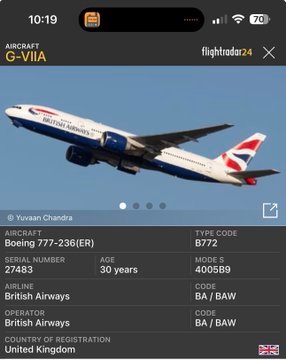
BA295 transmitted squawk 7700 before reversing course towards Heathrow. The reason for the emergency has not been disclosed, and reports of possible cabin depressurisation remain unconfirmed.
BY PC Bureau
October 5: A British Airways Boeing 777 bound for Chicago turned back to London after declaring a general emergency over Ireland on Monday, following a dramatic descent from cruising altitude that prompted the crew to reverse course.
Flight BA295, operating from London Heathrow to Chicago O’Hare, had departed Heathrow Terminal 5 at around 11:50 a.m. local time. Flight-tracking data showed the aircraft, a Boeing 777-200ER registered as G-VIIA, climbing to about 37,000 feet before descending sharply to roughly 9,000 feet while flying over Ireland.
The aircraft transmitted squawk 7700, the internationally recognised transponder code indicating a general emergency and alerting air traffic controllers that the crew required priority assistance.
After continuing west for a short distance at the lower altitude, the aircraft turned back towards Heathrow. Tracking data later showed it entering a holding pattern and lowering its landing gear, which can be used to increase drag and burn fuel before landing when an aircraft needs to reduce its weight.
The nature of the emergency has not been disclosed. While a rapid descent to below 10,000 feet can be associated with a suspected cabin depressurisation, there is no confirmation that this was the cause of the BA295 incident.
🚨🇬🇧 #BREAKING | NEWS⚠️
British Airways flight (#BA295) departing from London headed towards Chicago started squawking
7700 emergency when flying over
Ireland 🇮🇪 and has asked for emergency landing back in London. https://t.co/PO9fQvg3dg— Todd Paron🇺🇸🇬🇷🎧👽 (@tparon) October 5, 2026
What does squawk 7700 mean?
Aircraft use four-digit transponder codes, known as squawks, to communicate information to air traffic controllers. Squawk 7700 is reserved for a general emergency.
READ: Journalists Seeking Probe Into Sexual Harassment Detained
The code does not identify the nature of the problem. Instead, it alerts controllers that an aircraft is experiencing an emergency and may require priority routing, assistance or a clear approach for landing.
The British Airways incident comes only days after another aviation emergency attracted international attention.
On September 30, flydubai flight FZ1073, travelling from Dubai to Tel Aviv, diverted to Tabuk, Saudi Arabia, after an emergency was declared on board. Tracking data showed the Boeing 737-8 descending by about 17,400 feet in less than two minutes.
According to reports, the aircraft’s co-pilot, an Omani national, allegedly attacked the captain with a crash axe and attempted to take control of the aircraft. Passengers intervened and subdued him after Captain Smit Machchhar opened the cockpit door.
The aircraft, carrying 174 passengers, including children, subsequently landed safely at Prince Sultan Bin Abdel Aziz Airport in Tabuk.
The captain’s actions were later praised publicly by Israeli Prime Minister Benjamin Netanyahu, Indian Prime Minister Narendra Modi and US President Donald Trump, who described him as having acted heroically. Israel has since ordered a security review of international flights.
Unlike the flydubai incident, there is currently no indication that the British Airways emergency involved an onboard security incident. The cause of the BA295 emergency remains unclear pending further information from the airline or aviation authorities.