

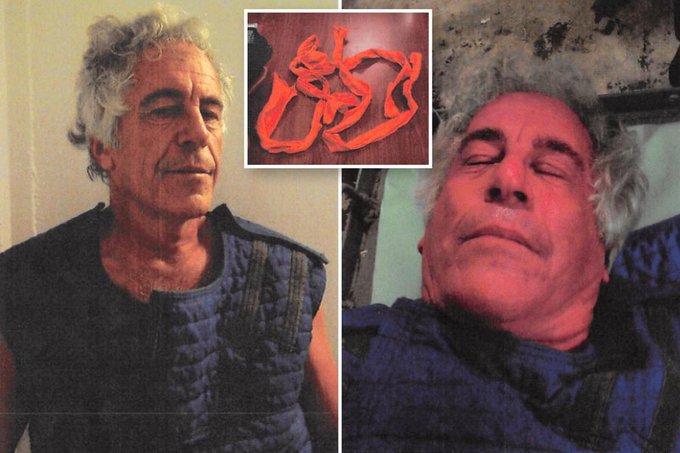
A London presentation by pathologists and researchers directly contradicts the New York medical examiner, arguing Epstein ligature marks are consistent with an assault and struggle using a narrow knotted fabric
By PC Bureau
November 17: A fresh forensic examination of Jeffrey Epstein death has challenged the official conclusion that the convicted sex offender died by suicide in a New York prison cell in 2019. A forensic expert who reviewed the autopsy records and photographs says the injuries point instead to homicide by strangulation.
Professor Michael Freeman presented his findings in London on Monday, November 16, alongside forensic pathologist Anders Eriksson of Sweden’s Umeå University and cognitive neuroscientist Itiel Dror.
Freeman said his examination of the New York City medical examiner’s files, photographs and a reconstruction of the scene suggested that Epstein had been assaulted and strangled, possibly from behind, before his body was suspended from a bunk bed.
The New York City Office of Chief Medical Examiner, however, has rejected any suggestion that its original conclusion was incorrect.
“Our office stands by its determination,” a spokesperson told CNN, reiterating the 2019 finding of suicide by hanging.
Freeman, who is editor-in-chief of the Journal of Forensic and Legal Medicine, said the pattern of injuries was inconsistent with the official explanation. He pointed to a deep haemorrhage in Epstein’s left shoulder, facial injuries and marks on his neck that he believes could indicate an attempt to resist strangulation.
He also questioned the interpretation of the ligature marks, arguing that their pattern was more consistent with a narrow, knotted fabric ligature being pulled from behind than with a conventional hanging.
“The injuries and the way the body was found don’t match up,” Freeman told the BBC. He said the evidence, in his assessment, pointed to homicidal strangulation.
READ: VanDyke says Russia Pressured India To Jail him On False Charges, Denies Insurgent Link
Analysis based on autopsy files, not a fresh examination
The new findings come with important qualifications. Freeman did not examine Epstein’s body. He based his conclusions on autopsy records and photographs supplied by Epstein’s brother, Mark Epstein, who has consistently maintained that his brother was murdered.
Freeman said his work was independent and that he had not been paid by Mark Epstein. His findings have not undergone peer review. CBS News reported that an academic journal had declined to publish the report, although Freeman said he planned to resubmit it.
A forensic expert claims Epstein was killed, based on his analysis of the autopsy results. https://t.co/Mf05TeSXdO
— HatsOff (@HatsOffff) November 16, 2026
Freeman worked with Eriksson and Dror on the presentation. Their assessment has reopened questions about the medical evidence, but it does not amount to a new official determination of the cause of death.
The original autopsy was conducted on August 11, 2019, a day after Epstein was found dead at the Metropolitan Correctional Center in Manhattan.
The medical examiner, Dr Barbara Sampson, concluded that Epstein died by suicide. She told investigators that the injuries were consistent with hanging and that there were no defensive wounds of the kind generally expected in a homicide involving strangulation.
A Justice Department investigation also examined the circumstances surrounding the death. The prison guard who discovered Epstein’s body said he lowered it to the floor and attempted resuscitation. Epstein had been placed on suicide watch briefly in the month before his death, according to the department’s report.
Questions over prison investigation
The circumstances surrounding Epstein’s death have remained controversial, partly because of serious failures at the federal prison.
A subsequent investigation documented that guards failed to carry out required checks, some prison records were falsified and several surveillance cameras in the relevant area were not functioning.
CBS News has also reported that the cell was not properly secured as a crime scene and that Epstein’s body was moved before investigators could adequately document its original position.
Freeman has questioned whether the medical examiner had access to all the relevant information about the scene and whether certain injuries were adequately explained in the original autopsy.
The new analysis is not the first independent challenge to the suicide ruling. In 2020, Epstein’s brother commissioned forensic pathologist Michael Baden to examine the medical evidence. Baden also questioned whether the neck injuries were consistent with suicide by hanging.
However, a separate investigation by The New York Times, based on tens of thousands of pages of documents and Epstein jail records, found indications that he had been contemplating suicide. The newspaper also reported that most forensic specialists it consulted believed the available medical evidence alone could not conclusively establish whether the death was suicide or homicide.
Epstein’s death continues to attract scrutiny
Epstein was awaiting trial on federal sex-trafficking charges when he was found dead on August 10, 2019. Prosecutors alleged that he had operated a network that sexually exploited underage girls, some as young as 14, between 2002 and 2005.
Epstein death prevented the trial from taking place and left unanswered questions about the extent of his network and the powerful individuals with whom he had associated.
The release of millions of pages of Epstein-related documents by the US Justice Department has renewed scrutiny of his relationships with politicians, business leaders, billionaires, royals and other prominent figures. The documents have generated fresh questions but have not established several widely circulated claims, including the existence of a definitive blackmail client list.
Freeman has said he has no theory about who might have killed Epstein, if his interpretation is correct. His stated focus is the forensic evidence and what he considers shortcomings in the original investigation.
In an interview with The New York Times, he summed up his concern with a question: “All I’m interested in is, how did this get so sideways?”