The State says the AK-47 was used only under extraordinary circumstances and that no protester was injured by the firing. Yet footage appearing to show the constable unimpeded when he opened fire puts the affidavit’s central justification under scrutiny.
BY PC Bureau
NEW DELHI: The Bihar government’s affidavit before the Supreme Court on the July 25 Siwan violence rests on a crucial factual assertion: Constable Abhishek Kumar opened fire from an AK-47 only after he “got trapped in the crowd” near JP Chowk and fired four rounds “in the air”.
But that explanation faces a potentially serious credibility problem when tested against the publicly circulating video footage of the incident.
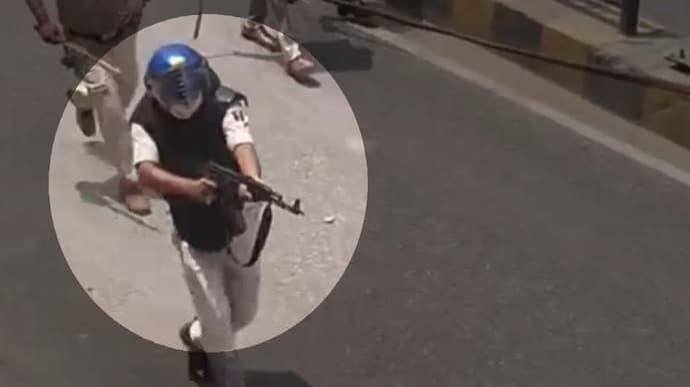
The footage appears to show the armed constable moving and running down an open stretch of road before discharging the rifle, with no visible crowd surrounding or physically trapping him at the moment of firing. The visual sequence therefore raises a question at the heart of the State’s justification: if the constable was not surrounded when he fired, on what basis does the affidavit describe the firing as an act compelled by his being trapped?
The distinction is not cosmetic. It goes directly to the necessity and proportionality of the use of an assault rifle during a civilian protest.
The State’s counter-affidavit, filed in response to petitions alleging police excesses during the student protests, says Kumar, a District Intelligence Unit constable, became trapped in the crowd near JP Chowk and fired four rounds from his AK-47 into the air. It says nobody was injured by those rounds. The State has also said that three protesters suffered minor firearm injuries elsewhere, but maintained that those injuries were neither caused by the AK-47 nor suffered at the place where Kumar fired. A ballistic examination is reportedly under way.
Yet the publicly available footage presents a materially different visual narrative.
The ‘trapped’ claim
A person surrounded by a hostile crowd and a policeman running down an apparently open road before firing are two very different factual circumstances.
If the video is authentic, properly dated and correctly located, it appears to show the constable moving away from the immediate confrontation rather than being physically hemmed in by protesters. There is no obvious crowd immediately surrounding him when he fires.
That does not, by itself, establish that the officer faced no danger. A threat can exist beyond the immediate camera frame, and a policeman protecting senior officers or colleagues may act on information unavailable to the viewer.
But it does mean that the State has an evidentiary burden to explain the apparent contradiction.
The question is not simply whether the constable was somewhere in a violent crowd moments earlier. The critical question is what was happening at the precise instant he pulled the trigger.
Was he surrounded? Was he being attacked? Was there an imminent threat to his life or the life of another officer? Had the crowd breached a police cordon? Was he attempting to retreat? Had he received an order to fire? Or was he running along an open road and firing while moving away from the immediate confrontation?
Those questions cannot be answered conclusively from a short viral video alone. But neither can the State’s description of the officer as “trapped” be treated as established fact when the available visual record appears to show something else.
The affidavit itself makes the contradiction more striking
There is an important admission in the State’s own account.
Bihar has told the Supreme Court that an AK-47 is a “platoon-level weapon” intended for special operations and not for ordinary law-and-order situations. It has also said Kumar was suspended for “undesired conduct” and that departmental proceedings were initiated against him.
That means the government is effectively making two submissions simultaneously.
First, the weapon was not meant for routine crowd-control duties.
Second, the individual constable nevertheless used it during a violent protest because, according to the State, he had become trapped.
The second proposition therefore becomes critical to the first. If the circumstances did not actually amount to the kind of emergency contemplated by the State’s own justification, why was an AK-47 discharged at all?
The issue is made still more serious by reports that Bihar Police’s own senior officers had described the firing as having taken place without orders. The Indian Express reported that DGP Vinay Kumar said the constable had used the sophisticated weapon “without orders” and that the constable was suspended.
That raises a fundamental chain-of-command question.
If there was no prior order to fire, what was the immediate threat that justified an individual constable independently resorting to an automatic rifle?
And if the threat was so grave that the constable was entitled to act without waiting for an order, where is the evidence of that grave and immediate threat?
‘Fired in the air’ does not end the inquiry
The State’s insistence that the four rounds were fired into the air addresses one question — whether the rounds directly struck protesters at JP Chowk.
It does not necessarily answer the larger question of whether discharging an AK-47 in a crowded civilian environment was reasonable, necessary or proportionate.
The distinction matters.
An automatic rifle fired upwards in a populated area still creates risks. Bullets fired into the air do not simply disappear; they eventually come down. More importantly, the act of firing a military-style weapon can escalate rather than de-escalate a volatile crowd.
READ: No Remorse: Delhi Police Justify Action Against Student Protesters
The Indian Express, citing police officials, reported that the accepted escalation framework in civilian protests proceeds through warnings, negotiation and other crowd-control measures before firearms are contemplated, with firearms reserved for exceptional circumstances such as preventing loss of life or responding to lethal threats. It also reported that police officers regarded unauthorised firing of an automatic weapon as a serious breach.
The State’s affidavit itself acknowledges that the AK-47 was not a routine law-and-order weapon. That makes the circumstances surrounding its use more, rather than less, important.
“Trapped constable fired 4 rounds from AK-47 in the air… none injured.”😱
— BJP-ruled Bihar’s affidavit in Supreme Court.
Alt News verified at least 9 rounds from videos. 3 students shot.
Constable suspended only after video went viral. #StudentProtest #NEET #Bihar pic.twitter.com/vG6TgaWKWW— Rajat Jain (@RajatJain) August 18, 2026
The video changes the central question
The controversy initially appeared to be about whether an AK-47 had been used during a student protest.
That fact is no longer seriously disputed. Bihar has acknowledged that four rounds were fired from an AK-47.
The question has now moved to a much more consequential one:
Why was it fired?
The answer offered by the State is that the constable was trapped.
But if the available video shows him running along an open street and firing when he was not visibly surrounded, that central explanation requires reconciliation.
The State cannot simply point to the fact that the protest had turned violent elsewhere. Nor does the fact that police personnel were injured automatically establish that Kumar was himself under an immediate threat when he fired.
The affidavit must be tested against the contemporaneous evidence.
What the Supreme Court should examine
The answer may lie in evidence that is more reliable than either the affidavit or a viral clip viewed in isolation.
The Supreme Court can ask for the complete, unedited CCTV and video record from JP Chowk and adjoining roads; police wireless communications; deployment charts; the constable’s duty assignment; the arms register; ammunition issue and return records; orders governing the deployment of automatic weapons; the precise timing of the firing; and ballistic and forensic findings.
The Court can also examine the footage frame by frame to establish the sequence.
Was the constable surrounded immediately before the shooting?
Did he break away from a crowd?
Was anyone pursuing him?
Was the SP or another officer in danger?
Was there stone-pelting at the precise location?
What was in front of the rifle when it was discharged?
And most importantly, does the video chronology support the words “got trapped in the crowd”?
These are factual questions, not political ones.
The three injured protesters
The State has separately acknowledged that three protesters suffered minor firearm injuries but says those injuries were not caused by the AK-47 and that the injured persons were not present at the location where Kumar fired. It has said ballistic examination is continuing to determine the weapon, distance and angle involved.
That distinction is important and should not be blurred.
It would be inaccurate to attribute those injuries to Kumar’s AK-47 merely because they occurred during the same episode.
But the absence of a confirmed AK-47 injury does not automatically resolve the question of whether the firing itself was justified.
The legality and proportionality of the act must be assessed independently of whether a bullet happened to hit somebody.
The State’s own conduct is telling
There is another element that complicates the government’s defence.
Kumar was suspended and departmental proceedings were initiated against him for what the State calls “undesired conduct”. At the same time, the affidavit says the weapon he used was intended for special operations and not ordinary law-and-order duties.
That does not establish misconduct as a matter of law. A departmental proceeding is not a finding of guilt.
But it does demonstrate that the government itself did not treat the incident as entirely routine.
The affidavit therefore needs to explain why an act serious enough to result in suspension and departmental proceedings is being presented as an unavoidable consequence of the constable being trapped.