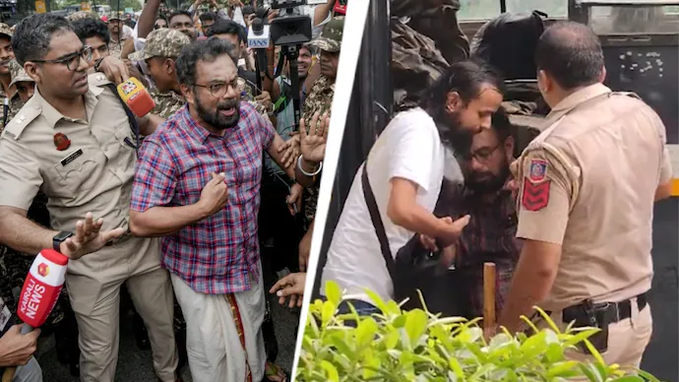
John Brittas has sought an independent investigation, preservation of video evidence and action against the personnel involved, alleging a serious assault on democratic rights and constitutional institutions.
By Navin Upadhyay
New Delhi: CPI(M) Rajya Sabha MP John Brittas has alleged that Delhi Police and CRPF personnel forcibly dragged him, assaulted him inside a police vehicle and dumped him on the roadside after he identified himself as a sitting Member of Parliament. The alleged assault took place at Connaught Place on October 11, amid protests demanding the resignation of Chief Election Commissioner Gyanesh Kumar over alleged irregularities in the Special Intensive Revision (SIR) of electoral rolls.
In a letter to President Droupadi Murmu, the Chairman of the Rajya Sabha and the Chief Justice of India, Brittas described the incident as a grave assault on democratic rights and constitutional institutions. He sought an independent investigation, preservation of evidence and accountability for the personnel involved.
The allegations came hours after the Supreme Court issued directions concerning the handling of protests in Delhi, including safeguards against unlawful detention and instructions that journalists and other professionals should not be obstructed in the discharge of their duties.
Dragged While Speaking to Journalists
According to Brittas’s account, he reached Connaught Place around 12.30 pm after learning that student activists, including members of the Students’ Federation of India (SFI), were being assaulted and detained.
He was speaking to journalists when police and CRPF personnel allegedly manhandled him and dragged him for around 50 metres. Despite repeated attempts by Brittas and journalists present to establish that he was a sitting MP, some personnel allegedly lifted him bodily and carried him towards a police vehicle.
Brittas said the treatment continued inside the vehicle, where personnel allegedly pinned him down and assaulted him even after he identified himself and displayed his parliamentary identity card.
He reported severe physical pain, discomfort and difficulty breathing. A young man from Jharkhand, identified in media reports as Sajid Hussain, was also inside the vehicle and later assisted the MP.
According to Brittas, a Deputy Commissioner of Police became aware of what had happened and ordered his release over the phone. Some reports have identified the officer as DCP Sachin Rawat. Brittas said there was no lawful basis for his detention.
Rajya Sabha MP John Brittas was brutally attacked by the Delhi Police. He was later dropped by the roadside, visibly injured and in distress.
DELHI POLICE HAS CROSSED ALL LIMITS! https://t.co/0Q5TCpi2Mj
— CPI (M) (@cpimspeak) October 11, 2026
He alleged that he was subsequently pushed out of the vehicle and left on the roadside. Distressed and struggling to breathe, he sat on the pavement before Sajid helped him into an autorickshaw.
Brittas was subsequently taken to Ram Manohar Lohia Hospital for medical examination, including checks for possible chest injuries. CPI(M) general secretary M.A. Baby and other party leaders visited him at the hospital.
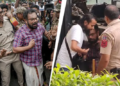
Videos and photographs carried by news organisations showed several uniformed personnel restraining Brittas amid the presence of journalists. The CPI(M) condemned the incident, accusing the police of crossing all limits.
In his account to the media, Brittas questioned the use of force against an elected representative who was speaking to reporters. He said the episode demonstrated the treatment meted out to an MP in the national capital.
The specific allegations concerning the degree of force used, the circumstances of his release and the role of individual officers require an independent investigation.
Manhandled, dragged, assaulted n misbehaved inside a police vehicle and dumped by the roadside – for the crime of speaking to the media.
This is not merely an assault on an MP. It is an assault on democratic freedoms and the rule of law. More chillingly, it happened within hours of the Supreme Court issuing directions to safeguard peaceful protest and constitutional rights.
I have written to the Hon’ble President of India @rashtrapatibhvn , the Chairman of the Rajya Sabha @VPIndia and the Chief Justice of India seeking urgent intervention and fixing accountability for the police personnel, and action on the question of parliamentary privilege.
The Government cannot intimidate democracy into silence. It cannot substitute the force of the baton for the force of debate. And it shouldn’t expect the people to surrender their constitutional freedoms merely because those in power find dissent inconvenient. The strength of a democracy lies not in its capacity to suppress dissent, but in its ability to address it.
— John Brittas (@JohnBrittas) October 11, 2026
Police Action Despite Supreme Court Directions
The alleged assault took place amid intensified protests by the Cockroach Janata Party (CJP), Left parties, student organisations and other opposition groups against the SIR process and Gyanesh Kumar’s continuation as Chief Election Commissioner.
Protesters have alleged that the electoral-roll revision risks disenfranchising legitimate voters and have demanded greater transparency and accountability from the Election Commission. The allegations remain contested and must be assessed against the official record.
The protests have triggered a heavy police deployment, barricading and widespread detentions. On October 11, CPI general secretary D. Raja and Annie Raja were also reportedly detained, while student activists were among those caught up in the police action.
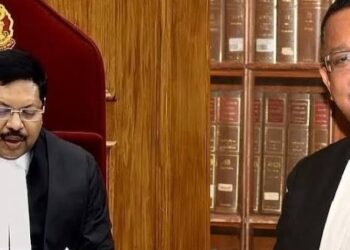
Earlier that day, a special Supreme Court bench comprising Justices Joymalya Bagchi and V. Mohana issued directions in proceedings concerning restrictions on protests and alleged unlawful detentions.
The Court addressed the detention of peaceful protesters, freedom of movement, the review of barricades and the normal functioning of public transport, subject to lawful restrictions. It also underscored that journalists, lawyers and other professionals must not be obstructed in carrying out their duties.
The alleged treatment of Brittas has therefore raised serious questions about police conduct during the protests and compliance with the Court’s directions. Whether the specific incident violated the orders or attracted any further legal consequences would depend on the precise terms of the directions and the facts established through an investigation.
MP John Brittas alleges four CRPF personnel pinned him down inside a vehicle until he struggled to breathe, and released him only after the DCP threatened suspension. He says the person with him was also assaulted. Watch.. https://t.co/0KB9RhHasH
— Firoz….. (@Firoze_) October 11, 2026
Brittas Seeks Investigation and Accountability
In his communication to constitutional authorities, Brittas invoked fundamental rights relating to freedom of speech and expression, peaceful assembly, and life and personal liberty under Articles 19 and 21 of the Constitution.
He argued that the use of force by law-enforcement personnel must have a lawful basis and be necessary and proportionate to the circumstances. He also raised the question of parliamentary privilege under Article 105, arguing that the alleged physical treatment of a sitting MP while he was engaging with the media warranted institutional scrutiny.
His argument was not that parliamentary membership places an MP above the law, but that law-enforcement agencies must remain accountable for any unlawful assault, restraint or abuse of authority.
“A uniform cannot confer immunity for assault, unlawful detention or abuse of authority,” Brittas wrote, according to reports on his letter.
He has sought a comprehensive report from the Union Government and the Delhi government, an independent and impartial investigation, and the identification of all personnel involved, including supervisory officers.
He has also called for the immediate preservation of evidence, including unedited video footage, vehicle movement records, duty rosters, deployment orders, wireless communications, control-room logs and records relating to his detention and release. He has sought safeguards against retaliation against witnesses.
The requests are intended to establish what happened inside the police vehicle, who ordered the action and why an elected representative was allegedly subjected to physical force while speaking to journalists.
A Test of Accountability
The incident has intensified concerns over the policing of protests in the capital, particularly when demonstrators and journalists are attempting to exercise constitutionally protected freedoms.
The right to peaceful assembly is not absolute, and police may enforce lawful restrictions. But any use of force or detention must be justified by law and remain proportionate. A journalist’s presence or an elected representative’s identity does not, by itself, settle every question of legality; equally, neither should be a reason for intimidation or arbitrary treatment.
The allegations made by Brittas warrant a transparent examination of the evidence, including available recordings, medical findings and the accounts of witnesses. The police response to the specific allegations had not been detailed in the reports cited.
The central question is whether the personnel involved acted within the law and whether their superiors exercised appropriate oversight. The answer must emerge from a credible investigation, not from competing political claims.
In a democracy, the handling of dissent is a measure of the state’s commitment to constitutional freedoms. The allegations surrounding Brittas’s detention now place that commitment under renewed scrutiny.