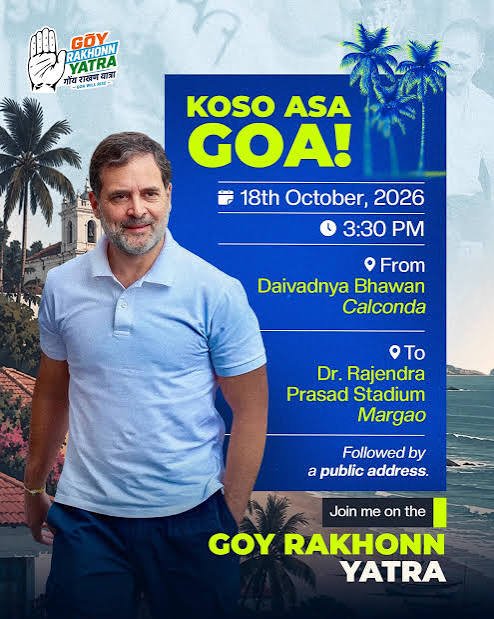
Rahul Gandhi accused Prime Minister Narendra Modi, Amit Shah and Chief Election Commissioner Gyanesh Kumar of involvement in alleged “vote chori” during the concluding leg of Congress’s 27-day Goy Rakhon Yatra in Margao, Goa. He vowed that the three would face accountability.
BY PC Bureau
October 18: Congress leader and Leader of the Opposition in the Lok Sabha Rahul Gandhi on Sunday launched a sweeping attack on Prime Minister Narendra Modi, Union Home Minister Amit Shah and Chief Election Commissioner Gyanesh Kumar, accusing them of electoral malpractice and declaring that they would eventually face accountability.
Turning the concluding leg of the Congress’s 27-day Goy Rakhon Yatra into a political offensive ahead of the 2027 Goa Assembly elections, Gandhi also accused the BJP government in Goa of presiding over corruption, land-related irregularities and the erosion of the state’s identity.
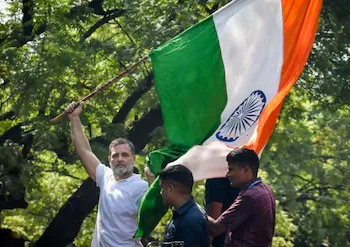
Walking nearly two kilometres alongside Congress workers and senior leaders in Margao before addressing a public meeting, Gandhi linked the party’s campaign to protect Goa’s land and heritage with its national confrontation with the BJP and the Election Commission over alleged “vote chori”.
“Gyanesh Kumar implements the theft of votes, Amit Shah operationalizes it, and Narendra Modi orchestrates the entire plan from behind the scenes,” Gandhi said, according to The Times of India. These were allegations made by the Congress leader, not established findings of electoral wrongdoing against the three men.
He went on to promise that the Congress would pursue accountability.
“Let me assure all Congress workers: PM Narendra Modi, Amit Shah and Gyanesh Kumar will face justice and will pay the price for what they have done,” Gandhi said.
He also questioned why no defamation case had been filed specifically over his allegations of vote theft, despite what he said were more than 45 defamation cases against him.
“I am facing over 45 defamation cases—cases filed by Amit Shah, by Narendra Modi, and so on. Despite these 45 cases, I continue to state at every opportunity that Narendra Modi steals votes. Yet, no case has been filed against me specifically for this claim,” he said.
‘Where has the 56-inch chest gone?’
Gandhi sharpened his attack on Modi with a jibe aimed at the Prime Minister’s long-standing political image of strength and decisiveness.
LIVE: Goy Rakhonn Yatra | Calconda to Margao, Goa https://t.co/zqu1ZewmjM
— Rahul Gandhi (@RahulGandhi) October 18, 2026
“Where has his 56-inch chest gone? Perhaps you haven’t noticed, but have you seen Modi ji’s face lately? Where has his 56-inch chest gone? These days, Modi ji cannot even stand before us,” he said.
“He and Amit Shah know that the Congress party has taken them on and cornered them,” Gandhi added.
He also predicted that the BJP’s political dominance was approaching its end, describing the party’s “expiry date” as near. The remarks were part of the Congress’s effort to make the 2027 Goa Assembly election a referendum on the BJP’s record in the state as well as on the party’s conduct at the national level.
Gandhi presented the Congress as a defender of constitutional values and electoral integrity, arguing that the alleged manipulation of votes struck at the foundations of democratic representation.
“Gyanesh Kumar knows that these people cannot escape accountability at the hands of the Congress party because we are the guardians and protectors of the Constitution. Safeguarding the Constitution is our duty,” he said.
The remarks came amid the Congress-led Opposition’s continuing campaign against alleged irregularities in electoral rolls and its demand for accountability from the Election Commission. Gandhi’s accusations against the BJP leadership and the Chief Election Commissioner remain contested political claims.
‘Goa is not for sale’: Land, jobs and corruption at the centre of campaign
While the national political attack dominated parts of Gandhi’s address, the Goy Rakhon Yatra was built around concerns specific to Goa: land conversion, alleged land grabbing, unemployment, corruption, public safety and the preservation of the state’s environment and cultural heritage.
In a message ahead of his participation in the yatra, Gandhi had accused the BJP government of “15 years of misrule and loot”, using the phrase “land chori”, “paisa chori”, “jobs chori”, “MLA chori” and, above all, “vote chori”.
“Together, let’s tell the BJP: Goa is not for sale. Goa belongs to its people,” he had said while announcing his participation in the campaign.
The slogan sought to bring together several grievances under a single political message: that Goa’s land, livelihoods, political representation and distinctive identity must not be sacrificed to the interests of powerful groups.
Addressing the public meeting, Gandhi alleged that the state had become a model for corruption and accused the government of allowing residents to suffer humiliation while their land was taken away or sold off.
“The injustices you are suffering, the humiliation you face every day, and the way your land is being taken away from you and sold off — if you want to put a stop to all this, you must give the Congress party a full majority,” he said.
The demand for a full majority was significant. Goa has a 40-member Assembly, and the BJP won 20 seats in the 2022 election, emerging as the single largest party but falling one short of an outright majority. The Congress won 11 seats. The next Assembly election is expected before March 2027.
Gandhi’s appeal was therefore not limited to a protest against the ruling party. It was an explicit pitch for a decisive Congress mandate, with the party seeking to convert concerns over land, employment and governance into electoral support.
The BJP has not been shown to have accepted Gandhi’s characterisation of its record, and his allegations of corruption and land-related wrongdoing should be understood as political charges rather than adjudicated findings.
Student protests and the cost of education
Gandhi also connected the Goa campaign to the treatment of young people protesting in Delhi, arguing that the government’s response to student grievances raised broader questions about democratic freedoms and the cost of education.
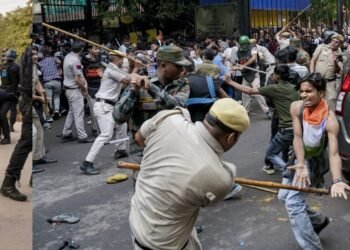
“Look at what is happening in Delhi today. Pellet guns are being fired at students because they are raising concerns about vote theft, employment and the rising cost of education,” he said.
The reference was to the wider controversy over police action against student protesters in Delhi. Gandhi has repeatedly questioned the use of force against demonstrators and demanded accountability from the Union Home Ministry.
By raising the issue in Goa, he sought to connect local concerns about unemployment and economic insecurity with the national debate over the right to protest. His argument was that young people asking questions about jobs, education and their future should not face violence or intimidation.
The issue also gave the Congress an opportunity to appeal to younger voters, an important constituency as political parties prepare for the 2027 Assembly election.
READ: ‘No Kings’ Protests Sweep Across the US Ahead of Midterm Polls
A 27-day campaign across all 40 Goa constituencies
The Goy Rakhon Yatra began on September 22 and concluded on Sunday after covering all 40 Assembly constituencies in Goa. Led by Goa Leader of the Opposition Yuri Alemao and Goa Pradesh Congress Committee president Girish Chodankar, the campaign was designed to strengthen the party’s grassroots organisation and take its message into constituencies held by both the Congress and the ruling BJP.
Gandhi arrived at Dabolim airport on Sunday afternoon and joined the procession in Margao. He walked alongside senior Congress leaders, including AICC Goa desk in-charge Manikrao Thakare, co-in-charge Dr Anjali Nimbalkar, Alemao and Chodankar, interacting with party workers and local residents along the route.
The Congress presented the yatra as a public movement to protect Goa’s land, identity, environment and heritage. The campaign also highlighted unemployment, public safety, corruption and the consequences of development decisions for local communities.
The party’s official campaign website described the exercise as a 27-day effort spanning all 40 constituencies, with a stated target of reaching more than 15 lakh voters. That figure is the campaign’s own stated reach, not an independently verified count of people who participated in its events.
The yatra’s conclusion provided the Congress with a platform to bring a state-level campaign into the national political spotlight. Gandhi’s presence also gave the event a sharper electoral dimension, making clear that the party intends to contest the BJP’s record in Goa while continuing its wider campaign over electoral integrity.
Congress seeks to turn outreach into electoral momentum
The immediate challenge for the Congress is to translate the campaign’s public meetings and constituency-level outreach into sustained political organisation before the 2027 election.
The yatra has allowed the party to foreground issues that may resonate beyond traditional party loyalties: access to land, employment opportunities, public safety, corruption and concerns about the pace and character of development in Goa. Gandhi’s address sought to place those grievances within a larger narrative about constitutional accountability and the alleged misuse of political power.
His demand for a full majority also indicated that the Congress intends to present itself as a viable governing alternative rather than merely an opposition voice.
Whether the campaign can consolidate support across Goa’s diverse constituencies will depend on the party’s ability to maintain its grassroots engagement, develop credible responses to local concerns and present a clear programme for government.
For now, the Goy Rakhon Yatra has concluded with Gandhi delivering a message that joined two strands of the Congress’s political strategy: protecting Goa’s land and identity, and challenging the BJP and the Election Commission over allegations of electoral wrongdoing.
“Goa is not for sale. Goa belongs to its people,” Gandhi said in his campaign message. At the close of the yatra, that slogan became the Congress’s central appeal to voters ahead of a contest in which the party hopes to turn public discontent into an electoral mandate.