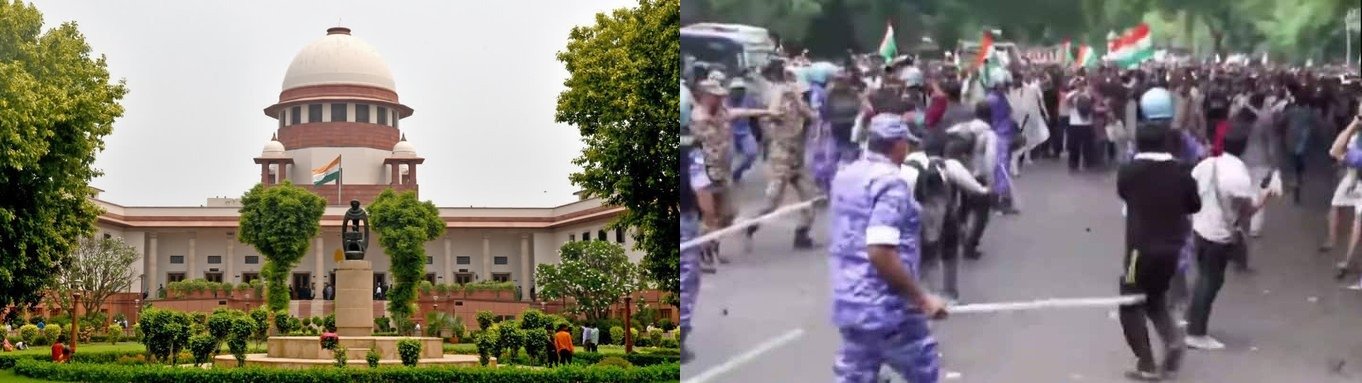
Defending its handling of the protests, Delhi Police said more than 30,000 people gathered across three kilometres, with over 240 police personnel and around 200 protesters injured in clashes.
BY PC Bureau
August 18, 2926: Delhi Police has told the Supreme Court that the force used during recent student protests was a necessary response to a situation that had escalated beyond peaceful demonstrations, with sections of the crowd allegedly breaching barricades and attacking police personnel.
In a detailed counter-affidavit filed by Deputy Commissioner of Police Sachin Sharma, the force said officers resorted to graded measures only after protesters attempted to advance towards Parliament without permission. The affidavit has been filed as a common response to four petitions seeking a court-monitored inquiry into alleged police excesses.
According to the police, around 5,000 personnel were deployed to manage a crowd of more than 30,000 people spread across nearly three kilometres. The situation, it said, eventually led to clashes in which more than 240 police personnel and about 200 protesters were injured.
The police maintained that allegations of excessive force must be assessed against the scale and circumstances of the gathering. It alleged that anti-social elements and history-sheeters had infiltrated the protest.
Since permission had not been granted for a march to Parliament, the police described the gathering as unlawful and the attempt to proceed towards the complex as an illegal act. It also argued that the petitions were based on selective photographs, incomplete video footage and unverified media and social-media reports, which, according to the force, failed to present the full sequence of events.
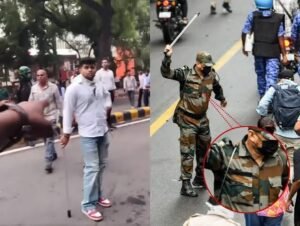
Responding to allegations that police used nail-fitted lathis, the affidavit said videos showed only one instance involving such an object and claimed it was in the hands of a protester, not a police officer. The object was described as a stick bearing the National Flag rather than a conventional police lathi.
READ: Mahto Ends Fast After Jharkhand Cancels JSSC-CGL Exam
The police said lathis were permissible equipment and were used only after sections of the crowd allegedly launched attacks on officers. It maintained that the measures adopted were consistent with established crowd-control practices.
On footage showing personnel in plain clothes carrying lathis, the police said they were “spotters” drawn from the Special Branch, Special Cell, Crime Branch and local police units. They had entered the crowd because of the rapidly deteriorating situation, the affidavit said, adding that such deployment was neither illegal nor unusual and was routinely used during major public events.
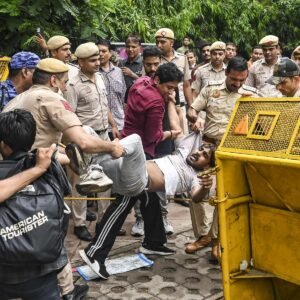
The police further claimed that videos showed groups of protesters attacking isolated officers, removing their protective equipment, dragging them and pushing them onto stone pavements. It told the court that 2,873 people present at the protest had previous criminal cases registered against them, including cases involving murder, attempt to murder, dacoity, rape and offences under the POCSO Act.
The Delhi Police said a Special Investigation Team constituted by the police commissioner would examine the criminal antecedents and related issues.
At the same time, the force said it would cooperate with any independent committee the Supreme Court might constitute to examine whether the force used during the protests was excessive.
On the deployment of facial-recognition technology, Delhi Police defended the measure as proportionate, saying the system was not used to indiscriminately identify everyone attending the protest. According to the affidavit, the technology was used to identify people with previous records involving serious offences, while minor violations such as traffic offences were excluded.
The police further said a facial-recognition match alone did not trigger any action. Officers were required to conduct field verification to establish whether the identified individual was actually present at the protest site.