• Naga bodies have called for immediate arrests, stronger security along NH-202, and an impartial inquiry into the killing of two Tangkhul Naga civilians.
BY PC Bureau
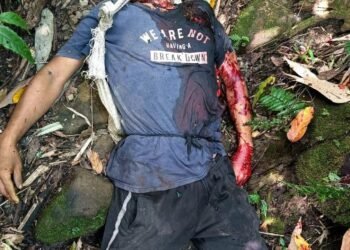
April 18, 2026 — An ex-serviceman from the Indian Army’s Naga Regiment and another civilian were killed, while at least two others were critically injured, when unidentified armed militants ambushed a convoy of civilian vehicles on the Imphal–Ukhrul road (NH-202) near T.M. Kasom village in Ukhrul district on Saturday afternoon.
The attack took place around 2:30–2:35 p.m. between Litan and T.M. Kasom under Litan Police Station limits. Police said the victims were travelling in a convoy of four civilian vehicles heading from Imphal towards Ukhrul and Kamjong districts when gunmen opened fire.
The deceased have been identified as SW Chinaoshang (also referred to as Chinaoshang Shokwungnao), a resident of Tashar village and a retired member of the Naga Regiment, and Yaruingam Vashum (42), from Kharasom CV village, who later succumbed to injuries at Ukhrul District Hospital. Two other passengers remain in critical condition.
According to preliminary police accounts, the convoy had a security escort up to Litan but continued without protection beyond that point. The attackers fled immediately after the assault. Security forces have launched a search operation in the area.
@manipur_police* can you tell us what really went down?
Stop blaming someone else b4 establishing the facts*UKHRUL firing – Updated with Evidence*
_self inflicting failed plot leading to loss of two innocent tangkhul lives by Tangkhuls own bullet_
.
A gunfight between NSCN-IM… pic.twitter.com/RjR648jPUe— HRH Lenn X | Unfiltered Truth (@HRHlenn) April 18, 2026
Strong Indications of Internecine Naga Factional Fighting
While initial unverified reports and some social media posts alleged involvement of Kuki militants, multiple local sources, eyewitness accounts, and community statements strongly suggest the incident stems from ongoing rivalry between factions of the National Socialist Council of Nagalim (NSCN) — specifically the NSCN (Isak-Muivah) and the NSCN (Eastern Flank).
This theory gains weight from the location: T.M. Kasom and surrounding areas lie deep within Tangkhul Naga territory, a well-established stronghold of the Tangkhul community in Ukhrul district. It is highly improbable for Kuki militants to successfully stage an ambush in such a location without significant local support or detection, given the terrain, community vigilance, and prevailing ethnic sensitivities.
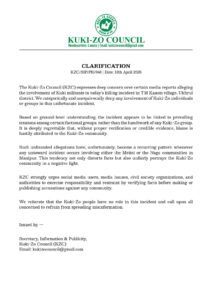
Civil society bodies have explicitly rejected any Kuki role:
The Kuki-Zo Council (KZC) issued a formal clarification on April 18, categorically denying involvement of any Kuki-Zo individuals or groups. The statement expressed concern over hasty blame being attributed to the Kuki community without evidence, calling it a recurring pattern that unfairly portrays them negatively. It urged media, social media users, and authorities to verify facts before publishing accusations.
The Kuki CSO Working Committee, Ukhrul, issued a separate condemnation of “reckless violence and blame game.” It stated that preliminary evidence points to an internal conflict involving NSCN (Eastern Flank) and NSCN-IM, describing the ambush as a “planned” operation, with visuals suggesting attempts to implicate Kukis. The committee announced it would pursue legal action against media houses spreading unverified, defamatory reports against the Kuki community.
Recent Background Fueling Suspicion of Factional Revenge
Tensions within Naga insurgent groups have simmered for weeks. In late March 2026, four cadres of the NSCN (Eastern Flank) were killed in an alleged ambush by suspected NSCN-IM elements in the Hongbei area of neighbouring Kamjong district. The victims were reportedly returning from monitoring activities along the India-Myanmar border.
The killings triggered outrage among Tangkhul Nagas in Ukhrul. An angry mob torched the Wung Tangkhul Region office of NSCN-IM in Ukhrul town and later targeted the residences of senior NSCN-IM leaders. These events highlighted deep factional rifts, often linked to control over resources, taxation, and influence in the Naga-inhabited hills.
The April 18 ambush appears to fit a pattern of retaliatory or mistaken-identity violence between these factions, with civilians unfortunately caught in the crossfire. Some local reports even suggested the firing may have involved NSCN-Eastern Flank cadres targeting what they perceived to be rival-linked vehicles.
READ: Iran Closes Hormuz Again, Blames Ongoing US Naval Blockade
Broader Context of Violence in Ukhrul and Manipur
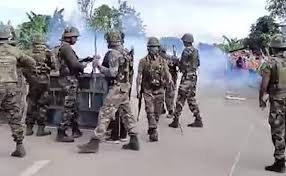
The incident comes amid heightened tensions in Ukhrul district. On Friday (April 17), gunfire erupted in nearby Sinakeithei village between suspected armed Kuki village volunteers and Tangkhul Naga village volunteers. A Kuki individual sustained minor injuries during subsequent action by security forces. Hostilities reportedly resumed later that night involving security personnel from the Manipur Rifles, BSF, and Mahar Regiment.
Manipur has been grappling with ethnic violence since May 3, 2023, primarily between the valley-based Meitei and hill-based Kuki-Zo communities, resulting in over 260 deaths and the displacement of more than 60,000 people. While the core conflict remains Meitei-Kuki, sporadic Naga-Kuki frictions and internal Naga factionalism have added dangerous layers of complexity in the hill districts.
The ambush occurred just a day after Chief Minister Yumnam Khemchand Singh visited Ukhrul as part of his “Journey for Peace” initiative, during which he engaged with local residents, including those from Kuki villages, in an effort to de-escalate tensions.
Authorities have appealed for calm and urged communities not to spread unverified information that could inflame the situation further. Security has been stepped up, but the fragile peace in the hills remains under strain.
As investigations continue, the emerging narrative underscores how internal rivalries within long-standing insurgent groups can spill over into civilian tragedies, often with blame quickly — and sometimes inaccurately — shifted to rival ethnic communities. Verification of facts and restraint from all sides will be critical to prevent further escalation.