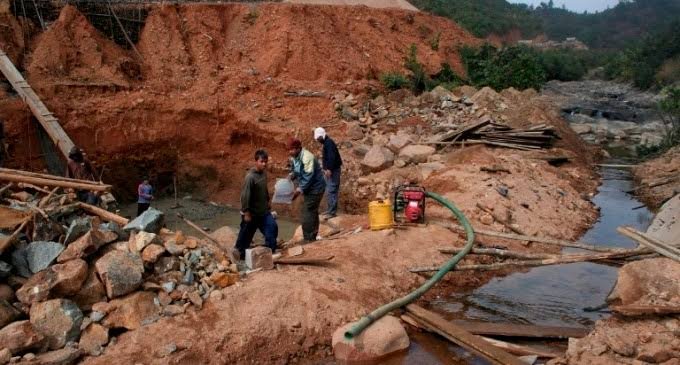
Fresh allegations of land purchases in the uranium-rich Domiasiat region have revived a decades-old controversy, with the Khasi Students’ Union demanding stronger legal safeguards against any future mining.
BY Navin Upadhyay
July 18: Meghalaya Chief Minister Conrad K. Sangma has once again made it clear that uranium mining has no place in the state. Responding to fresh concerns raised by the Khasi Students’ Union (KSU) over alleged land purchases in the uranium-rich Domiasiat region of South West Khasi Hills and reports of visits by officials of the Atomic Minerals Directorate (AMD), Sangma reiterated that his government has never approved uranium mining and has consistently communicated its opposition to both the Centre and the people of Meghalaya.
His remarks have revived one of Meghalaya’s most contentious public policy debates—a conflict that goes far beyond mining. It touches on environmental protection, indigenous land rights, constitutional federalism, national security, and electoral politics.
Chief Minister Shri Conrad K. Sangma has reaffirmed the Government of Meghalaya’s clear and consistent stand against uranium mining in the State.
Responding to recent speculation and media reports, the Chief Minister announced that the Meghalaya Government will move a formal… pic.twitter.com/C0ZTEfNMAN
— National People’s Party (NPP) (@nppmeghalaya) July 16, 2026
A Long-Running Controversy
Meghalaya’s uranium deposits, particularly in the Domiasiat-Kylleng-Pyndengsohiong-Mawthabah (KPM) belt, were identified by the Atomic Minerals Directorate during the 1980s and 1990s. Geological surveys estimate that the KPM deposit alone contains around 9,500 tonnes of uranium oxide (U₃O₈), while total identified reserves across Domiasiat, Wahkyn, Tyrnai, Lostoin and nearby locations range between 16,000 and 23,000 tonnes, making Meghalaya one of India’s largest uranium-bearing states after Jharkhand and Andhra Pradesh.
Given India’s growing nuclear energy programme, these deposits have long attracted the interest of the Department of Atomic Energy (DAE) and Uranium Corporation of India Ltd. (UCIL). However, virtually every attempt to initiate exploration or mining has run into fierce resistance from local communities.
The issue resurfaced in 2026 after allegations that influential individuals were purchasing land in Domiasiat, fuelling fears that uranium extraction could be revived without public consent. The controversy intensified after a Central government Office Memorandum exempted certain atomic mineral projects from mandatory public hearings on national security grounds, prompting renewed protests from civil society organisations.
The Khasi Students’ Union has since demanded that both the Meghalaya Legislative Assembly and the Autonomous District Councils (ADCs) pass resolutions formally prohibiting uranium mining and preventing the transfer of land in uranium-bearing areas.
READ: Amid Sinking Health, Police Shift Sonam Wangchuk to Hospital
READ: Did Aamir Khan Really Not Know Wangchuk Before 3 Idiots?
Why Meghalaya Is Opposed:
Unlike conventional mining disputes driven primarily by compensation or employment concerns, Meghalaya’s opposition is rooted in a broad combination of environmental, health, cultural and constitutional issues.
A) Environmental Risks
Environmental groups argue that uranium extraction could permanently alter Meghalaya’s fragile ecology.
Much of the identified ore lies close enough to the surface to make open-cast mining economically viable, raising concerns about large-scale deforestation, destruction of hill ecosystems and contamination of rivers and groundwater.
These fears are amplified by Meghalaya’s experience with unregulated coal mining, particularly in Jaintia Hills, where acid mine drainage has severely polluted rivers and damaged ecosystems.
Given the state’s exceptionally high rainfall, activists warn that radioactive waste and mine tailings could spread more rapidly through water systems than in drier mining regions.
B) Public Health Concerns
Opponents frequently cite experiences from uranium mining areas such as Jaduguda in Jharkhand, where community groups and several studies have alleged increased incidences of cancers, congenital disorders and other health problems linked to radioactive exposure.
While scientific opinion remains divided over the extent of these impacts, public perception in Meghalaya remains overwhelmingly cautious.
Concerns extend beyond mining itself to the long-term management of radioactive waste, which requires monitoring for decades after extraction ends.
C) Indigenous Land Rights
Perhaps the strongest argument against uranium mining concerns tribal ownership of land.
Unlike many other Indian states, most land in Meghalaya is not owned by the government. Under the Sixth Schedule of the Constitution, land belongs to indigenous communities, clans and traditional institutions.
Mining therefore raises fears of displacement, erosion of customary rights and loss of community control over natural resources.
Civil society organisations argue that any mining proposal must satisfy the principle of Free, Prior and Informed Consent, ensuring that affected communities—not merely governments—have the final say.
Can the Centre Override Meghalaya?
Legally, the answer is complicated.
Atomic minerals, including uranium, fall under the Atomic Energy Act, 1962, placing them firmly within the Union government’s strategic jurisdiction.
However, mining cannot proceed through central authority alone.
Land acquisition, environmental clearances, local permissions and access to tribal lands require cooperation from the state government and institutions established under the Sixth Schedule.
Autonomous District Councils exercise substantial authority over tribal land, while the state government controls several regulatory approvals essential for any mining project.
This creates a situation where the Centre may possess constitutional authority over uranium, but implementation remains heavily dependent on state cooperation.
In practical terms, Meghalaya enjoys a powerful de facto veto.
Successive state governments have previously withdrawn permissions for pre-mining activities, demonstrating that political opposition can effectively halt projects despite central interest.
Political Calculations
Conrad Sangma’s latest statement is consistent with the National People’s Party’s broader political strategy of emphasising regional identity and consensus-building.
The NPP has consistently projected itself as a defender of indigenous interests and environmental protection, positions that resonate strongly across Khasi, Jaintia and Garo communities.
Ignoring organisations like the Khasi Students’ Union would carry significant political costs, given their influence over public opinion.
The timing is also politically significant.
Although Meghalaya’s next Assembly elections are expected only in early 2028, reaffirming opposition now strengthens the government’s credibility among tribal voters while preventing the issue from becoming an electoral liability.
The BJP, which shares power with the NPP in the Meghalaya Democratic Alliance, has indicated it may contest future elections independently, making regional positioning even more important for Sangma’s party.
Interestingly, the same government has been actively seeking greater powers from the Centre to facilitate scientific coal mining.
This contrast illustrates that Meghalaya is not opposed to mining per se; rather, uranium is viewed as a uniquely sensitive resource because of its radioactive nature, environmental implications and history of public opposition.
Strategic Importance vs Local Consent
Supporters of uranium mining argue that India needs domestic uranium resources to strengthen its nuclear energy programme, reduce dependence on imports and enhance long-term energy security.
Nuclear power is also considered an important low-carbon energy source as India seeks to reduce greenhouse gas emissions.
Advocates contend that modern mining technologies, strict environmental safeguards, rehabilitation measures and revenue-sharing mechanisms could minimise risks while creating employment and infrastructure in underdeveloped areas.
Yet these arguments have failed to gain traction in Meghalaya.
Years of distrust arising from environmental degradation caused by illegal coal mining have left many communities sceptical about assurances of effective regulation.
For most residents, the perceived ecological and health risks continue to outweigh the promised economic benefits.
Conrad Sangma’s latest reaffirmation signals continuity rather than a policy shift.
Whether or not the Assembly eventually adopts a formal resolution banning uranium mining, the government’s political position remains unequivocal.
The larger challenge now is developmental.
Communities in uranium-bearing regions continue to seek better roads, healthcare, education and employment opportunities. Unless these needs are addressed through sustainable alternatives, the uranium debate will continue to symbolise a broader struggle between resource extraction and local aspirations.
Ultimately, Meghalaya’s uranium controversy represents more than a dispute over mining. It encapsulates the delicate balance between India’s strategic interests, constitutional federalism, tribal autonomy and environmental stewardship. While the Centre possesses significant legal authority over atomic minerals, Meghalaya’s unique constitutional protections, strong community institutions and overwhelming public opposition mean that any attempt to proceed without local consent would face formidable legal, political and social resistance.