BY PC Bureau
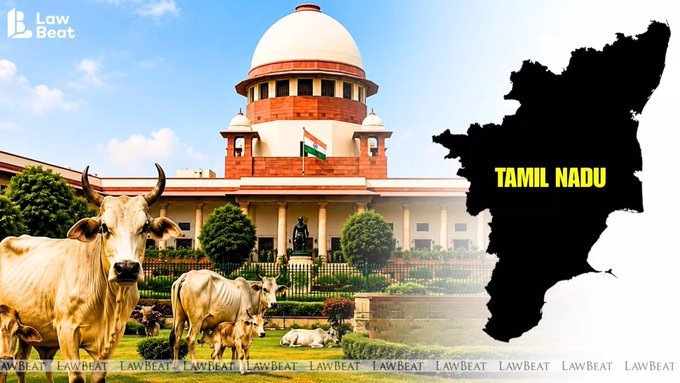
New Delhi, July 13: The Supreme Court on Monday stayed a Madras High Court order directing the Tamil Nadu government to prohibit the slaughter of cows and calves across the state, holding in abeyance a ruling that had effectively sought to enforce a decades-old government notification.
A Bench of the apex court granted interim relief after the Tamil Nadu government, led by Chief Minister Vijay, approached it with a Special Leave Petition challenging the Madras High Court’s May 27 judgment.
The High Court had directed the state to ensure that no cow or calf is slaughtered in Tamil Nadu, either on the eve of Bakrid or on any other day, by implementing a 1976 government order issued to protect cattle and promote milk production.
State Challenges High Court Ruling
Before the Supreme Court, the Tamil Nadu government argued that the High Court’s direction was legally unsustainable because it conflicted with the existing statutory framework governing cattle slaughter in the state.
The government contended that Tamil Nadu’s laws permit the slaughter of certain categories of cattle under specified conditions and in authorised slaughterhouses. It maintained that a judicial direction based solely on an executive notification could not override provisions enacted by the legislature.
Accepting the state’s plea for interim relief, the Supreme Court stayed the operation of the High Court’s directive pending further hearing of the matter.
What the Madras High Court Had Said
The order under challenge was passed by a Division Bench of the Madras High Court comprising Justices G.R. Swaminathan and V. Lakshminarayanan.
The Bench directed the state government to strictly implement a 1976 government notification that prohibited the slaughter of cows and calves, observing that the policy was intended to safeguard milk production, improve the rural economy and preserve cattle wealth.
Writing the judgment, Justice G.R. Swaminathan placed reliance on Article 48 of the Constitution, one of the Directive Principles of State Policy, which directs the State to organise agriculture and animal husbandry on modern lines and to take steps for preserving and improving breeds while prohibiting the slaughter of cows, calves and other milch and draught cattle.
The judge also referred to the Constituent Assembly debates, observing that the cow has occupied a special place in India’s civilisational and cultural traditions for centuries.
READ: Middle East on Edge: Iran Strikes US Bases, Oil Prices Jump
Constitutional and Legal Questions
The case raises significant constitutional questions regarding the relationship between the Directive Principles of State Policy and statutory law.
While Article 48 urges states to take measures to prohibit the slaughter of cows and other milch and draught cattle, the Directive Principles are not directly enforceable by courts. The Tamil Nadu government has argued that any restriction on cattle slaughter must operate within the framework of existing legislation enacted by the state legislature.
The Supreme Court’s interim order means that the Madras High Court’s directions will remain suspended until the apex court finally decides the legality of the ruling.
The matter is expected to have wider implications for cattle slaughter regulations, executive powers and the interpretation of Directive Principles in relation to state legislation.
Article 48 of the Constitution (at a glance):
- It is part of the Directive Principles of State Policy (Part IV of the Constitution).
- It directs the State to organise agriculture and animal husbandry on modern and scientific lines.
- It specifically calls for preserving and improving breeds and prohibiting the slaughter of cows, calves and other milch and draught cattle.
- Unlike Fundamental Rights, Directive Principles are not enforceable in courts, but they guide government policy and legislation.