The CJP movement was more than a protest over NEET—it exposed deeper structural flaws in India’s education system, from paper leaks and coaching culture to the neglect of student mental health.
BY Annpurna Nautiyal
A large and powerful movement lasting thirty-six days was staged by the Cockroach Janta Party (CJP), formed by Abhijeet Dipke on May 16, 2026, in response to a remark by the Chief Justice of India about “cockroaches” and “parasites” during a Supreme Court hearing. This led to a Gen Z movement seeking the resignation of Union Education Minister Dharmendra Pradhan over his accountability and failure to stop the paper leak in the National Eligibility cum Entrance Test (NEET-UG).
Paper leaks have, in one form or another, occurred since the inception of the centralised examination for medical courses. However, this year’s paper leak affected almost twenty lakh students. Dharmendra Pradhan, while taking moral responsibility for the paper leak, ordered a retest on June 21, 2026. But the delayed results, allegedly caused by faulty evaluations, transformed students’ unrest into a mass movement at Delhi’s Jantar Mantar.
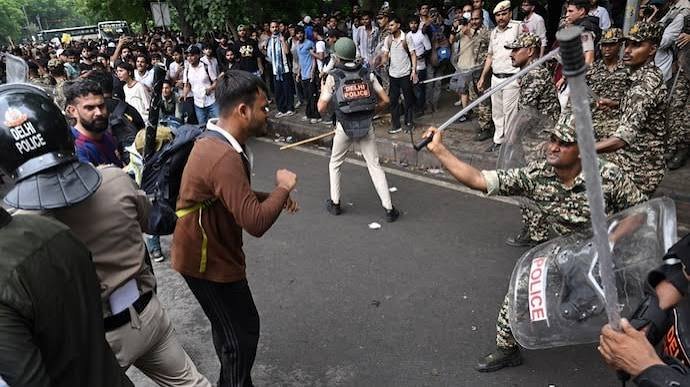
The use of force by the police and the intensity of the movement against what protesters described as a damaged system ultimately forced Education Minister Dharmendra Pradhan to resign. It also led to the sacking of 47 officials of the National Testing Agency (NTA), while Prahlad Joshi was given additional charge of the Ministry of Education following the transfer of the Education Secretary.
Although the CJP has terminated its movement, it has also threatened to relaunch its agitation if its two remaining demands—the withdrawal of FIRs against all protesters and compensation for the families of students who died by suicide—are not met within the stipulated timeframe.
The Supreme Court has also directed all states to release minor students with no criminal records. Meanwhile, the government has appointed a six-member high-powered committee chaired by technology entrepreneur Nandan Nilekani to recommend measures for ensuring seamless examinations in the future.
READ: The State of TV News: Falling Revenues, the ‘Godi Media’ Tag and Crisis of Trust (Part 1)
Unfortunately, the committee does not include any representative from the university system with practical experience in conducting examinations. The inclusion of such a member could help address implementation challenges while providing practical solutions and resources for the effective decentralisation of examinations conducted in the Computer-Based Test (CBT) mode.
The answer to why the NTA could not implement the Radhakrishnan Committee’s 2024 recommendation to conduct NEET through CBT also lies here, as many examination centres still lack the required infrastructure.
Though NEET is an important examination, the paper leak is not merely a consequence of the wrong practices of the National Testing Agency. It also reflects deeper flaws in the education system, which continues to push an overwhelming number of students towards a handful of competitive examinations.
In the absence of proper guidance and counselling regarding alternative career options, a huge imbalance has emerged between the number of candidates appearing for the examination and the limited seats available in central and state-run medical colleges. This has fuelled the mushrooming of coaching centres across the country.
Since seats are limited, a nexus often develops between some coaching centres and paper leak rackets, reducing the chances of genuinely deserving candidates who prepare honestly for these examinations. Coaching hubs in cities such as Kota and Pune have become educational factories. While they cater to students’ aspirations, they also consume the hard-earned savings of parents.
Those who benefit from paper leaks make enormous profits, while many students who fail despite years of preparation are pushed into depression and, in some tragic cases, suicide.
Although both the Lok Sabha and the Rajya Sabha passed the stringent Public Examination (Prevention of Unfair Means) Amendment Bill, 2026, by voice vote on July 29, 2026, the CJP movement has provided an opportunity for introspection among educationists across both school and higher education.
What is fundamentally wrong with the education system? How can it be made more accountable? Why do so many students, regardless of aptitude, continue to pursue only medicine or engineering? Why has diversification of career choices remained so limited? Are educational institutions truly fulfilling the responsibilities entrusted to them?
The National Education Policy, implemented since 2022, offers some answers, but its challenges remain enormous. It seeks to bridge the gap between school and higher education by integrating the two. Unfortunately, widespread ignorance among teachers and students regarding its provisions, coupled with a lax approach towards implementation, remains a matter of concern.
Since education falls under the Concurrent List, the lack of uniformity in implementation between central and state institutions has also become worrisome. Excessive centralisation creates additional difficulties because the necessary resources are not uniformly available across the country.
In the light of the problems facing the higher education system, an eye-opening judgment was delivered on January 15, 2026, by Justices J.B. Pardiwala and R. Mahadevan of the Supreme Court of India. The Bench was considering an interim report submitted by a National Task Force (NTF), constituted in March 2025, to examine the alarming rise in student suicides across the country.
The NTF made several observations about the functioning of Higher Educational Institutions (HEIs) and regulatory bodies. The Court noted that while many problems stem from broader societal issues, factors affecting students’ mental health within higher education fall directly under the control of educational authorities. However, the tendency to “shift the blame” and individualise each incident leaves little room for introspection into institutionally normalised stressors.
The Court observed that HEIs cannot evade their fundamental duty to provide equitable, inclusive, and supportive learning environments for all students. It accepted the NTF’s findings identifying multiple factors contributing to student suicides in higher educational institutions, including the rapid expansion of the higher education system, structural and social inequalities, the persistence of ragging despite regulatory prohibitions, academic pressure, inadequate redressal of mental health concerns, and financial stress.
The Court also highlighted the ineffective functioning of Equal Opportunity Cells, Internal Complaints Committees, and grievance redressal mechanisms, signalling negligence and a lack of accountability on the part of HEIs. It expressed dissatisfaction with the indifferent responses of many institutions to the NTF’s nationwide survey.
While acknowledging the existence of multiple statutory regulations and policy initiatives, including the UGC Regulations, the National Education Policy (NEP) 2020, the National Suicide Prevention Strategy, and the Mental Healthcare Act, 2017, the Court observed that these measures remain scattered across several documents. As a result, implementation suffers and accountability for non-compliance often slips through the cracks.
The Bench further noted that although a policy roadmap exists, strict compliance remains absent because accountability has not been effectively fixed on HEIs. It called for closing these gaps with the assistance of the NTF and the Union Government and warned all higher educational institutions that non-compliance would carry serious consequences.
The Court also directed that a centralised database on student suicides be prepared to provide accurate national statistics. It ruled that no student should face penalties—such as being barred from examinations, eviction from hostels, or withholding of marksheets or degrees—because of delays in scholarship disbursement. It further directed that clear timelines for scholarship payments must be ensured.
Every residential HEI, the Court said, must provide access to qualified medical assistance round the clock, either on campus or within a one-kilometre radius, to ensure timely emergency response. It also directed all HEIs to comply strictly with binding UGC regulations.
The Bench observed that persistent faculty shortages and prolonged vacancies in institutional leadership contribute to declining academic standards, inadequate mentorship, neglect of student well-being, and rising student distress. Accordingly, it ordered a time-bound process for filling vacancies in both public and private higher educational institutions. Teaching positions must be filled within four months, while key administrative posts—including Vice-Chancellors, Registrars, Finance Officers, and Controllers of Examinations—must be filled within one month of falling vacant.
READ: The State of TV News: Falling Revenues, the ‘Godi Media’ Tag and Crisis of Trust (Part 1)
Both judges observed that retirement dates of faculty members and institutional heads are known well in advance. Therefore, vacancies in leadership and teaching positions should never be allowed to continue indefinitely, as they adversely affect both academic standards and the overall well-being of students. Unfortunately, despite this judgment, the positions of institutional heads continue to remain vacant for periods ranging from one to two years, affecting the growth and functioning of institutions.
Bringing together students from diverse regions and backgrounds, with varying levels of knowledge, exposure, and understanding, is a Herculean task. It requires extensive groundwork, careful preparation, sensitivity to regional realities, and an understanding of the expectations of both students and employees. Ad hoc approaches inevitably lead to institutional decline. Recognising this, the Court issued comprehensive guidelines to improve the discharge of responsibilities by HEIs and strengthen institutional accountability.
To diversify students’ career choices, skills in areas such as artificial intelligence, machine learning, chip and semiconductor manufacturing, digital and multilingual communication, agroecological products, organic farming, disaster management, climate change mitigation, cutting-edge innovation, and research must be promoted. Equally important is the integration of STEM disciplines with the humanities and social sciences, alongside embedding ethics and philosophy to cultivate a deeper understanding of India’s knowledge systems.
Vocational courses such as plumbing, electrical work, carpentry, cooking, nursing, physiotherapy, and interpretation should also be promoted in schools with adequate infrastructure, as every student is not destined for higher education.
In an age driven by speed, skill, and scale, collaboration with national and international institutions can expand opportunities for exposure, learning, and the adoption of global best practices. Since education ultimately seeks to promote research, innovation, and excellence in teaching and learning for human welfare, comprehensive reforms across the entire educational ecosystem—from schools to universities—are essential. Such reforms would also fulfil the integration mandate envisioned under the National Education Policy 2020.
(The Author is a former Vice Chancellor and former Professor of Political Science, HNB Garhwal University, Srinagar, Garhwal, Uttarakhand.)