


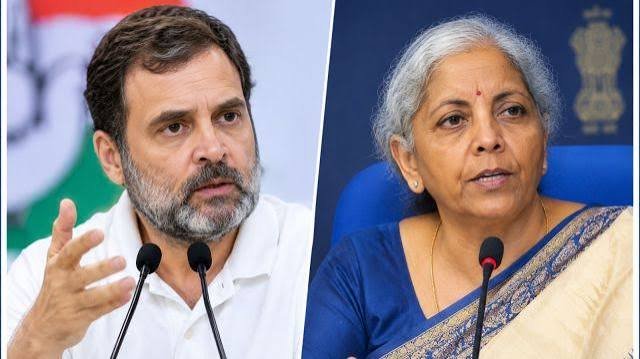
Finance Minister Nirmala Sitharaman has hit back at Rahul Gandhi over his criticism of the proposed IDBI Bank sale, accusing Congress governments of political interference in public sector banking and favouring business groups with political connections.
BY PC Bureau
October 30: Finance Minister Nirmala Sitharaman has hit back at Leader of Opposition Rahul Gandhi over his criticism of the proposed sale of IDBI Bank, accusing successive Congress governments of treating public sector banks as personal fiefdoms and pressuring officials to sanction loans to politically connected businesses.n a strongly worded response, Sitharaman cited several historical instances to allege political interference in banking decisions, dating back to the 1950s.
She referred to the 1957 Mundhra scandal, in which LIC invested heavily in shares of companies owned by businessman Haridas Mundhra, allegedly under political pressure. She also recalled the removal of State Bank of India chairman R.K. Talwar in 1976 after he reportedly resisted pressure to relax lending conditions for a company linked to Sanjay Gandhi’s circle.
Sitharaman further alleged that Sanjay Gandhi exerted pressure on the Central Bank of India over loans for Maruti and that B. Janardhana Poojary, Minister of State for Finance under Indira Gandhi and Rajiv Gandhi, routinely pressured bank officials to extend loans during the 1980s.
She also cited allegations of ministerial interference during the UPA government, referring to former minister Pawan Kumar Bansal and loans sought by businesses linked to his family.
Turning specifically to IDBI Bank, the Finance Minister said the institution was handed over to the NDA government in a severely weakened financial condition after extending large loans to business groups, including Videocon, Winsome, ABG Shipyard and Kingfisher. These exposures subsequently turned into non-performing assets, resulting in substantial losses.
READ: Rahul Gandhi Backs IDBI Bank Staff, Slams Sale to Canadian Firm
We all know how @INCIndia has used Banks and financial institutions as personal entities and pressured bank employees to extend loans at their whim, bypassing prudent lending norms.
Let me list a few instances.
– In 1957, Haridas Mundra got money from LIC due to influence by the Congress leaders.
– In 1976, Indira Gandhi’s government removed SBI Chairman R.K. Talwar after he refused political pressure to relax lending conditions for a company linked to Sanjay Gandhi’s circle.
– Sanjay Gandhi pressured the Central Bank of India over loans to Maruti.
– B. Janardhana Poojary, MoS Finance under Indira Gandhi and Rajiv Gandhi — pressured bank employees to issue loans in the 1980s.
– Pawan Kumar Bansal, as a minister in the UPA, pressured Canara Bank to give loans to his family-linked businesses.
The IDBI Bank was handed over to us in poor shape, as IDBI itself was forced to lend to large business groups with close connections to @INCIndia leaders such as Videocon, Winsome, ABG Shipyard, Kingfisher, etc. These turned into bad loans, causing huge losses for IDBI Bank, which we recognised.
The NDA govt led by Hon’ble PM Shri @narendramodi revived the IDBI bank through professionalism, prudence and recapitalisation of more than Rs 25,000 crores. The IDBI Bank is now poised for its next phase of growth.
All due process has been followed in the IDBI Bank strategic restructuring, and we have already clarified this yesterday.
Check this: https://t.co/EjAOziADyf
Many more instances of blatant scams and economic mismanagement have been covered in the White Paper on the Indian Economy released in February 2024. It remains relevant even now.
Read here: https://t.co/MojSe36Zb2
Your lies with respect to Rafale had failed and were exposed. You had to apologise. The same will happen here.
Congress-era banking had a phonebook for the powerful and a rulebook for the common citizens.
The era of ‘connection and setting banking’ is over.Common people now have easy access to loans, and employees are not under pressure to extend loans over the phone calls.
— Nirmala Sitharaman (@nsitharaman) October 30, 2026
She credited the Modi government with reviving the bank through professional management, tighter lending practices and recapitalisation exceeding ₹25,000 crore.
Defending the proposed strategic sale, Sitharaman maintained that all prescribed procedures had been followed and referred to the government’s clarification issued through the Press Information Bureau.
She also invoked the White Paper on the Indian Economy, released in February 2024, arguing that it documented instances of financial mismanagement and irregularities during Congress-led governments.
Taking a direct swipe at Rahul Gandhi, she recalled his allegations over the Rafale deal and the subsequent apology in a contempt-related case, asserting that his latest claims would also be exposed.
“Under Congress, banking operated with a phonebook for the powerful and a rulebook for ordinary citizens,” Sitharaman said, arguing that the Modi government had ended the culture of political recommendations and pressure on bank officials.
She maintained that ordinary citizens now had easier access to credit and that bank employees were no longer subjected to telephone calls from powerful individuals seeking preferential loan approvals.