



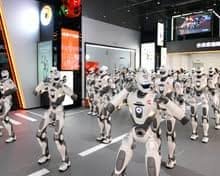
From humanoid robots performing choreographed routines to machines serving ice cream, Shenzhen offered a glimpse of China’s technology push. The spectacle also raised questions about India’s preparedness for the next phase of industrial competition.
BY PC Bureau
November 19: More than 100 humanoid robots performing synchronised dances, machines demonstrating martial arts, robots playing football and automated systems serving ice cream and drinks. Shenzhen offered an unusual spectacle as China hosted some of the world’s most powerful leaders for the Asia-Pacific Economic Cooperation (APEC) summit.
But the display was about much more than entertainment. As US President Donald Trump, Russian President Vladimir Putin and Chinese President Xi Jinping gathered for an unprecedented trilateral meeting, Beijing used its technology hub to project an image of industrial strength, innovation and growing geopolitical influence.
The juxtaposition was striking. While the three leaders prepared to discuss nuclear arms control, the conflicts in Ukraine and Iran, and the changing global order, China’s southern technology hub was demonstrating how robotics and artificial intelligence were moving from laboratories and industrial facilities into public spaces.
For Beijing, the message was clear: China wants to be seen not merely as a diplomatic heavyweight but also as a leading force in the technologies that will shape the global economy.
Robots take centre stage
On November 17, more than 100 humanoid robots performed a synchronised dance in a central Shenzhen square, attracting large crowds of residents and visitors who recorded the spectacle on their mobile phones.
Other machines demonstrated fighting and martial arts movements inside metal cages, while robots played football and served ice cream and beverages. The demonstrations were part of a wider technology showcase organised as the city prepared to receive international leaders and delegates.
The choice of Shenzhen was significant. Once a relatively small settlement, the city has developed into one of China’s most important manufacturing and technology centres. It is home to a large ecosystem of electronics manufacturers, robotics companies and artificial intelligence developers.
Its industrial landscape also includes autonomous taxis, delivery drones and increasingly sophisticated automated services.
The robot demonstrations offered a carefully curated glimpse of China’s technological ambitions. They were not simply a ceremonial welcome for Trump and Putin but part of a broader effort to showcase the country’s progress in robotics, automation and artificial intelligence.
The distinction matters. The performances did not, by themselves, establish that humanoid robots were ready for widespread commercial deployment. But they demonstrated the scale of China’s research, manufacturing ecosystem and ability to turn technological development into a public spectacle.
China surprised super powers.
Xi Jinping welcomes President PresidentTrump and Putin by 100 of humanoid dancing robots in Shenzhen.
Should we Indian introspect where are heading? https://t.co/T1D1GKUwt7
— Clear Nama (@Clear_Nama) November 19, 2026
Xi’s extraordinary welcome for Trump
The diplomatic choreography was almost as carefully arranged as the technology display.
Xi Jinping personally received Trump at Shenzhen Bao’an International Airport on November 18, breaking with the usual protocol followed by Chinese presidents when welcoming visiting foreign leaders.
The American president received a red-carpet reception, an honour guard, military flypast, national anthems and a welcome from children carrying flowers. Xi and Trump briefly embraced on the tarmac.
The gesture was particularly significant because Trump had personally welcomed Xi during the Chinese president’s visit to the United States in September 2026. Beijing presented Xi’s airport appearance as a reciprocal gesture.
Putin, by contrast, received a more conventional welcome from Cai Qi, a senior Chinese Communist Party official and member of its Politburo Standing Committee.
The difference in protocol was noteworthy. Xi’s personal reception of Trump underscored the importance Beijing attaches to its relationship with Washington, despite continuing disagreements over trade, technology and strategic competition.
Later on Wednesday, Trump and Putin shook hands and exchanged greetings in Xi’s presence before the APEC welcome banquet and group photograph. It was their first face-to-face encounter since their meeting in Alaska in August 2025.
𝐀𝐏𝐄𝐂 :– China welcomed world leaders in Shenzhen by showing its advanced technology. Humanoid robots danced, did staged fights in a metal cage, and served ice cream during the APEC summit. https://t.co/GoyV2s5Sob
— 𝐌𝐨𝐧𝐨𝐣𝐢𝐭 𝐒𝐢𝐧𝐡𝐚 (@MonojitSinha11) November 19, 2026
A historic meeting of three global powers
The three leaders held their first formal trilateral summit on November 19 on the sidelines of the APEC gathering.
The discussions brought together three countries with enormous military, economic and geopolitical influence but sharply differing interests.
Nuclear arms control was among the central issues. The expiry of the New START treaty in February 2026 had removed the last remaining major bilateral limits on the strategic nuclear arsenals of the United States and Russia.
Trump has expressed interest in a broader arrangement that would also involve China. Beijing, however, has been reluctant to accept restrictions on its nuclear arsenal while it remains considerably smaller than those of Washington and Moscow.
The conflicts involving Ukraine and Iran also formed part of the wider geopolitical backdrop to the meeting.
The summit was significant even without an expectation of immediate breakthroughs. Bringing the leaders of the world’s three major powers together for direct discussions on nuclear security and international stability was itself an important diplomatic development.
However, the meeting also raised questions about the extent to which major powers could shape the international order through negotiations that might affect countries not represented at the table.
READ: Who Killed Jeffrey Epstein? Brother Seeks Independent Probe
The message from Shenzhen
The combination of diplomatic theatre and technological spectacle was not accidental.
China was simultaneously projecting two forms of power: its ability to engage with the world’s most influential leaders and its ambition to lead the next generation of industrial and technological development.
The personal reception for Trump, the carefully calibrated treatment of Putin and the public display of humanoid robots all contributed to the image Beijing wanted to present.
Technology has increasingly become an instrument of geopolitical influence. Countries are no longer competing only through military strength, trade and diplomatic alliances. Their ability to manufacture advanced semiconductors, develop artificial intelligence, build sophisticated robots and control critical supply chains is becoming equally important.
Shenzhen provided a vivid illustration of this changing landscape.
Should India introspect?
The developments in Shenzhen offer an important opportunity for India to examine its own technological and industrial ambitions.
India was not a member of APEC and therefore had no formal seat at the leaders’ meeting where regional economic cooperation, trade and supply-chain issues were discussed. APEC has 21 member economies, and India is not among them.
Yet India maintains significant relationships with all three powers. Its strategic partnership with the United States, longstanding defence and energy ties with Russia, and complicated economic and security relationship with China make developments involving Washington, Moscow and Beijing particularly relevant to New Delhi.
There are at least three lessons India should draw from the Shenzhen spectacle.
1. Software strength must be matched by manufacturing capability.
India has established itself as a major player in information technology, software services, digital payments and space research. Its digital public infrastructure has attracted international attention.
But China has developed a much deeper manufacturing ecosystem, linking electronics production, component suppliers, research institutions and industrial automation.
The Shenzhen demonstrations underline the importance of moving beyond software excellence. India needs sustained investment in robotics research, semiconductor manufacturing, electronics production, advanced materials and technical education.
The challenge is not simply to develop sophisticated machines but to build the industrial capacity to manufacture, improve and deploy them competitively.
2. Technology is becoming a measure of geopolitical power.
The Trump-Xi-Putin meeting demonstrates how a handful of powerful countries can influence discussions on nuclear security, global conflicts, trade and the future of international relations.
India’s strategic autonomy remains an important asset, but it must be supported by technological and industrial capabilities.
New Delhi has pursued technology partnerships with the United States, participated in the Quad and promoted domestic manufacturing through initiatives such as Make in India. The critical test is whether these initiatives translate into greater technological self-reliance and a stronger position in global supply chains.
India cannot afford to remain primarily a consumer of technologies developed elsewhere.
3. Technology is also an instrument of soft power.
China’s robot performances were not merely demonstrations of engineering. They were carefully staged displays intended to create an impression of technological sophistication among visiting leaders, delegates, journalists and the wider public.
India, too, has achievements worth showcasing. Its digital public infrastructure, space programme, renewable energy initiatives and growing defence technology sector offer considerable opportunities to project its capabilities internationally.
But such projections need to be backed by measurable progress in research, manufacturing and commercial deployment.
Beyond the spectacle
India should neither underestimate China’s technological advances nor assume that its own development model must replicate the Chinese experience.
The two countries have different political systems, economic structures and development priorities. India’s strengths lie in its entrepreneurial ecosystem, skilled workforce, software industry, scientific institutions and democratic framework.
But these advantages cannot compensate indefinitely for weaknesses in manufacturing depth, research investment and technological innovation.
The real benchmarks should be concrete: the domestic value addition in high-technology manufacturing, the number of globally competitive robotics companies, semiconductor production capacity, research and development spending, and the ability to retain skilled scientific and engineering talent.
Shenzhen was not simply a city entertaining visiting dignitaries with dancing machines. It was presenting a vision of China’s industrial future.
The lesson for India is not to be impressed by robots performing choreographed routines. It is to examine the factories, research facilities, supply chains, skilled workforce and investment that make such demonstrations possible.
In the emerging global order, technological capability will increasingly determine economic competitiveness and geopolitical influence. India must ensure that it is not merely watching this transformation unfold but actively shaping it.







Comments 3