

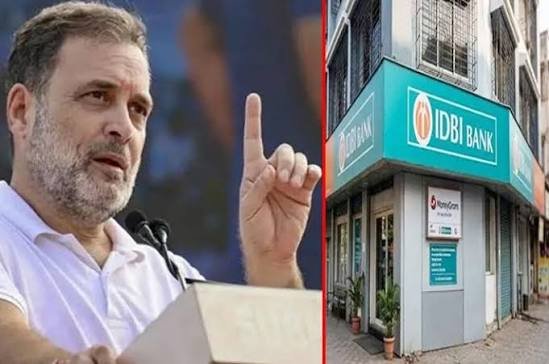
Leader of Opposition Rahul Gandhi has accused the Modi government of selling public assets after employees helped turn IDBI Bank around financially. He recalled a parliamentary assurance that the government would retain at least 51 per cent ownership and questioned its decision to dilute its stake.
BY PC Bureau
New Delhi, October 29, 2026: Leader of Opposition Rahul Gandhi has thrown his weight behind IDBI Bank employees opposing the proposed sale of a controlling stake in the public sector lender to Canada-based Fairfax Financial Holdings, accusing the Modi government of selling a profitable institution built with public resources.
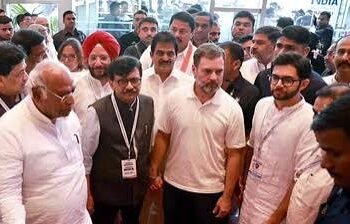
In a message addressed to “Members of the IDBI Bank family” on Thursday, Gandhi recalled meeting a group of bank employees at Parliament House in March last year. They had questioned why the government was selling a bank that they had worked hard to make profitable.
Gandhi said he subsequently raised the issue in the Lok Sabha, questioning the proposed sale of a profitable public bank and seeking assurances on the protection of employees and depositors. However, he claimed, the government did not provide a satisfactory response.
“Now it has decided to sell IDBI Bank to Fairfax, a Canadian company,” he wrote.
Highlighting the bank’s financial turnaround, Gandhi said IDBI had been a pioneering development financial institution before facing difficulties after transitioning into a commercial bank.
READ: Gandhi Grandson Wins 30-Acre Virginia Land Battle
कांग्रेस के समय में IDBI बना – देश का उद्योग खड़ा करने के लिए।
मोदी के समय में पहले बोली देखी गई, फिर दाम तय हुआ।
कांग्रेस के time पे बैंक बनते थे। मोदी के time में बिकते हैं।
मैं IDBI बैंक के कर्मचारियों के साथ खड़ा हूँ। https://t.co/uLT7mWTYyr
— Rahul Gandhi (@RahulGandhi) October 30, 2026
“Seven years ago, IDBI was losing money. Last year, it earned a profit of over nine thousand crore rupees. That turnaround is your work,” he said, crediting employees for the recovery.
Rahul Gandhi also questioned the government’s decision to dilute its ownership despite the bank’s improved financial performance. The Centre and Life Insurance Corporation of India (LIC) currently hold a combined 95 per cent stake in IDBI Bank. Following the proposed transaction, their combined holding will fall to 34 per cent.
Rahul Gandhi Invokes 2003 Parliament Assurance
Gandhi invoked a 2003 assurance given to Parliament that the government would retain at least 51 per cent ownership of IDBI.
“That promise may not be written into law, but a promise made to Parliament is a promise made to the people of India,” Rahul said.
The Congress leader also warned that privatisation could have implications for employment safeguards and social justice policies. He argued that reservation provisions for Scheduled Castes, Scheduled Tribes and Other Backward Classes would cease to apply following the bank’s privatisation, while employees could lose existing protections relating to their service conditions.
“The Congress has always believed in a strong public sector working alongside the private sector. Public banks are not assets to be sold off, they are tools to build the nation,” Rahul said.
Assuring the employees of his support, Gandhi wrote: “You asked me to stand with you. I stand with you in your fight today, and fully support all your legitimate demands. Stay together. Stay determined. Jai Hind.”
His message followed an earlier post on X in which he contrasted the Congress government’s role in establishing IDBI and building public financial institutions with what he described as the Modi government’s approach of selling public sector banks.
The Union Cabinet, on October 14, approved the strategic sale of a 60.72 per cent stake in IDBI Bank to a subsidiary of Fairfax Financial Holdings for ₹52,878 crore. The proposed transaction involves the government selling 30.48 per cent and LIC divesting 30.24 per cent of their respective holdings.
After the transaction, the government’s stake will fall to 15 per cent, while LIC will retain 19 per cent.
The government has described the transaction as the largest foreign direct investment in India’s financial sector. The sale represents a major shift in ownership of a bank in which the government and LIC have collectively held a dominant position.
There was no immediate response from the government to Gandhi’s criticism.