

Defending his longtime friend, Musk says Huang’s technical expertise, industry relationships and loyalty among employees make him virtually impossible to replace. He has also backed an online petition seeking Huang’s reinstatement.
BY PC Bureau
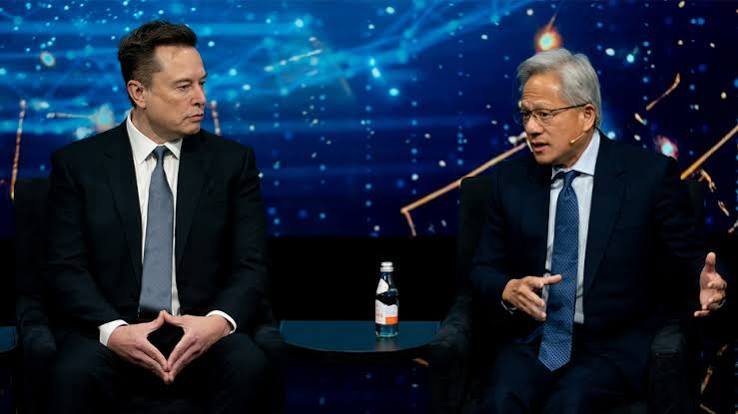
November 19: Elon Musk has criticised Nvidia’s decision to part ways with former chief executive Jensen Huang, arguing that the chipmaker may have lost an irreplaceable leader. Comparing Huang’s departure to removing basketball legend Michael Jordan from a team on a winning streak, the Tesla and SpaceX chief warned that the move could ultimately hurt Nvidia and its shareholders.
Speaking via video conference at The New York Times DealBook Summit on Wednesday, Musk said Huang’s contribution to Nvidia extended well beyond his formal responsibilities as chief executive.
“There’s no one that can really replace Jensen. He performs the roles of several people,” Musk said.
Drawing an analogy with professional basketball, he added: “I think it’s like kicking Michael Jordan off your team when you’re on a winning streak. And it just doesn’t seem like a good thing for shareholders.”
Musk also explained why he believed finding a successor with Huang’s combination of technical expertise, industry relationships and organisational influence would be particularly difficult.
He pointed to Huang’s longstanding relationships with key suppliers in South Korea and Taiwan, recalling instances when he had seen the Nvidia chief sharing street food with business partners. Such interactions, Musk suggested, reflected the personal relationships Huang had cultivated over several decades.
“He has long-term relationships that have been built up over decades. He understands technology incredibly well. His team loves him, loves him,” Musk said.
He also highlighted the loyalty Huang enjoyed among Nvidia employees, claiming that some had rejected more lucrative offers from other companies because of their personal commitment to him.
“Many of them are there because of him and have had higher offers to go elsewhere and have turned them down because of personal loyalty to Jensen,” he said.
READ: Anthropic’s IPO set to shatter all records, raising over $81 billion
Musk questions Nvidia’s decision
While acknowledging that Huang had made mistakes, Musk questioned whether they justified his departure from the company he helped build.
He said he did not believe Huang had been “disloyal to the United States” and argued that Nvidia needed to consider his overall contribution rather than focus exclusively on his personal failings.
“You have to balance the good that someone does and brings relative to the bad,” Musk said, reiterating his view that Nvidia had made the wrong decision.
Huang’s departure followed reports concerning his alleged relationships with a Chinese businesswoman suspected of having links to Chinese intelligence and two Nvidia employees. The allegations have attracted considerable attention, although claims about the businesswoman’s intelligence connections should not be treated as established facts.
🚨 JUST IN: Elon Musk says he’d LOVE to hire Jensen Huang and he’s SPOKEN TO HIM
“Who WOULDN’T? He’s incredibly talented. He’s one of the most talented entrepreneurial CEOs in HISTORY.”
“Now, Jensen’s not looking for a job.”
“I don’t know what happens next. The decision is up to the Nvidia board.”
“The current board would either need to change their mind or shareholders would need to vote the board out at the shareholder’s meeting, which is, that’s pretty rare.”
Nvidia’s board rejected Huang’s offer to return as CEO.
A petition to bring him back has nearly 200,000 signatures, with more than 10,000 current Nvidia employees!
The pressure on this board is only GROWING but they may not budge!
— Eric Daugherty (@EricLDaugh) November 18, 2026
Musk’s public campaign to bring Huang back
Musk’s intervention is part of a series of public expressions of support for Huang, with whom he shares a longstanding friendship.
Earlier this month, Musk defended the former Nvidia chief on X after Huang acknowledged having an extramarital affair. Musk endorsed a social media post arguing that although Huang had made an extremely poor personal decision, it did not necessarily indicate malicious intentions. His response was brief: “I agree”.
He subsequently backed an online campaign seeking Huang’s reinstatement at Nvidia.
“A petition is underway to reinstate Jensen and I’m signing it too,” Musk wrote on X on Friday.
Musk had also previously indicated that hiring Huang would be an honour, signalling his willingness to bring the former Nvidia chief into his own business empire.
Nvidia board rules out Huang’s return
Despite Musk’s intervention and calls from other technology industry figures for Huang’s return, Nvidia’s board has shown no inclination to reverse its decision.
Nvidia chairman Harvey Jones made the company’s position clear during a conference call with investors on Tuesday, hours after Huang indicated that he would consider returning if invited by the board.
“Jensen Huang voluntarily resigned his positions as president, CEO and board member. The Nvidia board unanimously accepted his resignation and does not intend to reinstate him as CEO,” Jones said.
The company is proceeding with its leadership transition, with chief financial officer Colette Kress overseeing operations as the board considers its next steps.
The end of an era at Nvidia
Huang co-founded Nvidia in 1993 and spent more than three decades transforming it from a graphics-chip manufacturer into one of the world’s most influential technology companies.
Its graphics processing units (GPUs) have become indispensable to the development of artificial intelligence, powering data centres and advanced computing systems used by technology companies around the world.
Nvidia’s central role in the AI revolution helped propel it into the ranks of the world’s most valuable companies, making Huang one of the most influential executives in the global technology industry.
His departure has therefore raised questions not only about the circumstances surrounding his exit but also about Nvidia’s ability to maintain its technological leadership and corporate momentum without the executive who shaped its rise.
Musk’s comparison with Michael Jordan captures the central argument made by Huang’s supporters: that removing a leader whose experience, relationships and influence are deeply embedded in an organisation could carry consequences extending well beyond a change at the top.