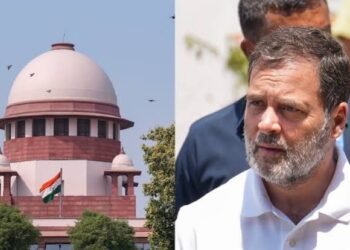
While granting interim bail to two co-accused in the Delhi riots conspiracy case, the Supreme Court raised fresh questions over the interpretation of stringent UAPA bail provisions.
BY PC Bureau
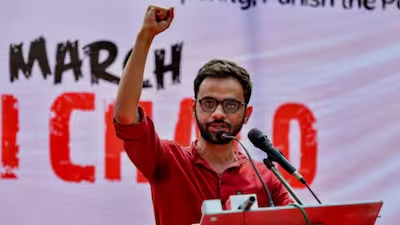
May 22, 2026: In a development that could have far-reaching consequences for bail jurisprudence under anti-terror laws, the Supreme Court on Friday referred to a larger bench the question of whether its earlier refusal to grant bail to Umar Khalid under the Unlawful Activities (Prevention) Act (UAPA) was legally sustainable.
The reference was made by a bench comprising Justices Aravind Kumar and P B Varale while granting six months’ interim bail to co-accused Tasleem Ahmed and Khalid Saifi.
The development came on the same day that the Delhi High Court granted Umar Khalid a three-day interim bail to allow him to meet his ailing mother, who is undergoing surgery.
Earlier this week, on May 19, a Delhi court had rejected Khalid’s plea for interim bail even for a period of two weeks. But in a separate matter heard a day earlier, a Supreme Court bench of Justices B V Nagarathna and Ujjal Bhuyan remarked that under the UAPA, “bail is the rule and jail is the exception.”
That bench had also cast doubt on the correctness of the earlier order denying Khalid bail and relied on the 2021 ruling in Union of India vs KA Najeeb, where a three-judge bench held that constitutional courts retain the power to grant bail in cases of prolonged incarceration despite the restrictive framework of the UAPA.
Umar Khalid’s prolonged legal battle
Umar Khalid has remained incarcerated in Tihar Jail since his arrest in September 2020 in connection with the Delhi riots conspiracy case under the UAPA. Even as the trial has progressed slowly, his repeated attempts to obtain regular bail have been unsuccessful.
A Delhi trial court first denied him bail, and on October 18, 2022, the Delhi High Court rejected his appeal, observing that he was in “constant touch” with co-accused persons and that the allegations against him were “prima facie true,” disclosing, at first glance, the commission of a “terrorist act.”
Khalid approached the Supreme Court in 2023, but the matter saw repeated adjournments and the recusal of one judge from the proceedings. In February 2024, he withdrew the petition citing changed circumstances and chose to renew his plea before the trial court.
READ: 19M Cockroaches Swarm Insta, Govt Hits Them on X
Over the years, Khalid has received only limited interim relief. He was temporarily released in 2022 and again in 2024 to attend family events, and once more in December 2025, each time under strict conditions that included restrictions on speaking to the media. On every occasion, he surrendered within the stipulated period.
On January 5 this year, another Supreme Court bench comprising Justices Aravind Kumar and N V Anjaria again refused him regular bail, holding that the statutory embargo under Section 43D(5) of the UAPA applied in view of allegations relating to the “planning, mobilisation and strategic direction” of the riots.
The same bench, however, granted bail to five co-accused persons, including Gulfisha Fatima, while allowing Khalid the liberty to revive his bail plea after one year.
The Section 43D(5) debate
At the centre of the legal controversy is Section 43D(5) of the UAPA, which imposes some of the toughest bail restrictions in Indian criminal law.
Unlike ordinary criminal proceedings — where bail is generally treated as the norm — the UAPA provision directs courts to deny bail if the accusations appear “prima facie true” on the basis of the chargesheet and case diary, thereby placing a heavy burden on the accused even before the trial begins.
The provision has been interpreted differently in two major Supreme Court rulings.
In NIA vs Zahoor Ahmed Shah Watali, the court adopted a stringent approach, holding that judges should broadly accept the prosecution’s material at face value during bail hearings without closely scrutinising its evidentiary value. The judgment sharply narrowed the possibility of securing bail under the UAPA.
However, in the later KA Najeeb ruling, the Supreme Court carved out a constitutional exception, holding that prolonged incarceration and delays in trial could independently justify bail under Article 21 of the Constitution, even in cases where Section 43D(5) applies.
The court underscored that statutory restrictions cannot override the constitutional guarantees of personal liberty and a speedy trial.