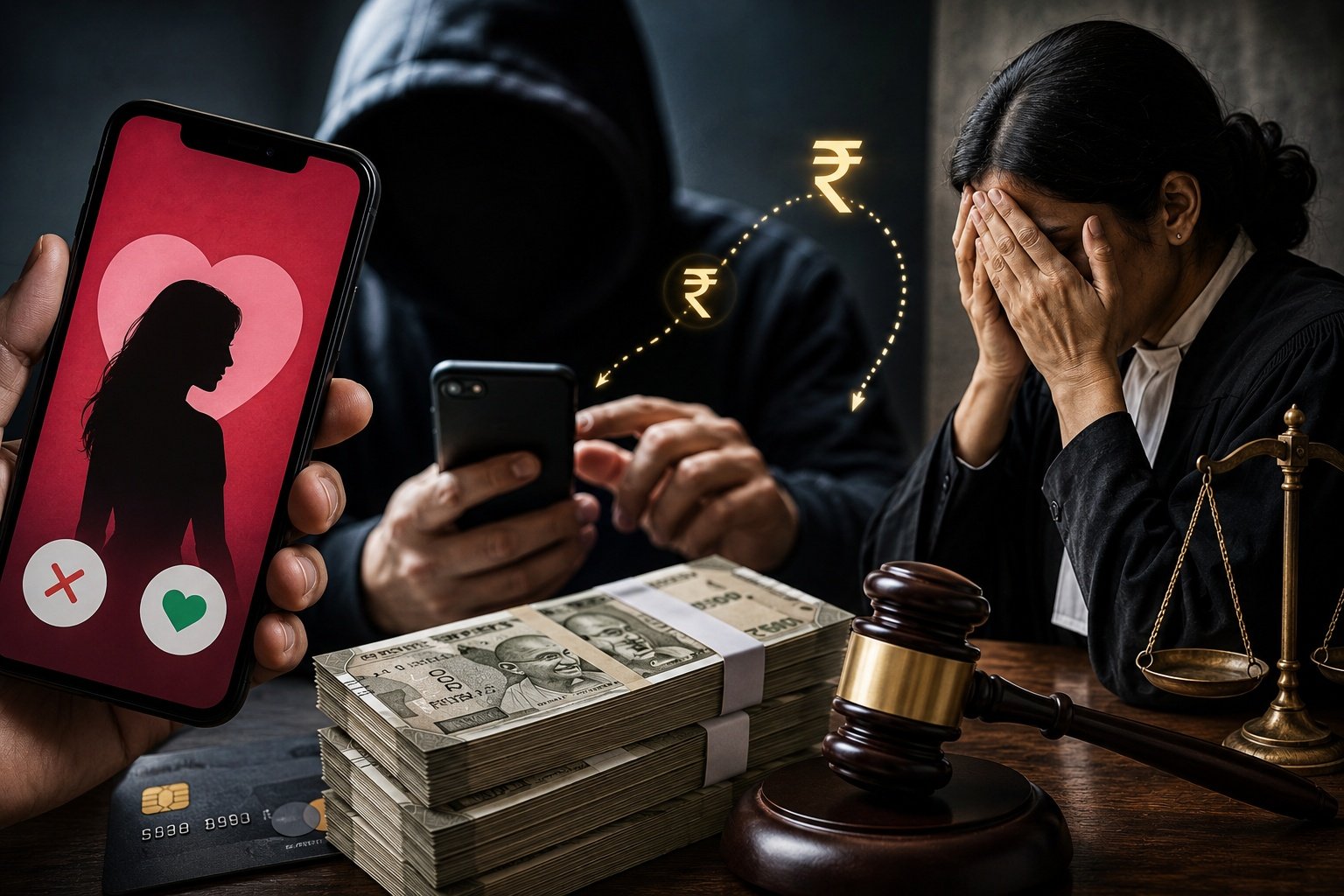
A Haryana judicial officer was allegedly duped of ₹52.81 lakh by a man she met on Tinder, with a Delhi court denying bail to the accused and questioning gaps in the police investigation.
BY PC Bureau
New Delhi, June 12: In a case that has sent ripples through legal circles, a Haryana judicial officer was allegedly duped of more than ₹52.81 lakh by a man she met on the dating app Tinder, with a Delhi court refusing to grant bail to the accused while flagging serious lapses in the police investigation.
The accused, Deepak Vats, allegedly posed as “Abhimanyu Vashishth”, claiming to be an officer in a secret government department. According to the prosecution, he developed a personal relationship with the judicial officer over several months before persuading her to invest money on the promise of lucrative returns.
Romance Turns Into Alleged Fraud
Investigators told the court that the two first connected on Tinder in November 2025. Presenting himself as a government official working in a sensitive role, the accused allegedly gained the judge’s trust and convinced her to transfer funds to accounts linked to him.
Believing his assurances of substantial profits, the judicial officer allegedly transferred more than ₹52.81 lakh from her bank accounts. The alleged fraud came to light after the promised returns failed to materialise and communication between the two deteriorated.
The case took an unusual turn when it emerged that the First Information Report (FIR) was not lodged by the judicial officer herself but in the name of her domestic worker, Diksha Devi, who claimed she had been cheated through an online dating platform.
During the bail hearing, Additional Sessions Judge Saurabh Partap Singh Laler of the Patiala House Courts observed that nearly all the disputed transactions—except for a cash deposit of ₹5 lakh—originated from the Haryana judicial officer’s bank accounts.
The court noted that the domestic worker “did not initiate or make a single digital payment”, making it evident that the judicial officer was the “actual and real victim” in the case.
The judge further remarked that approaching the criminal justice system indirectly raised serious questions about transparency.
READ: Can Oil Transform The Northeast’s Economic Future?
Court Pulls Up Investigators
While rejecting the accused’s bail plea, the court highlighted several shortcomings in the investigation conducted by the Delhi Police Special Cell.
Among the lapses noted were:
- Failure to obtain Tinder chat records through which the two allegedly connected;
- Failure to secure the complete WhatsApp conversations between the complainant and the accused;
- Non-collection of Call Detail Records (CDRs);
- Delay in conducting forensic analysis of the accused’s mobile phone.
The court also criticised the accused for allegedly attempting to conceal evidence.
According to the order, Vats selectively produced messages purportedly sent by the judicial officer while withholding his own replies and declined to provide unrestricted access to his mobile device.
Additional Sessions Judge Laler acknowledged that victims of romance scams may hesitate to come forward due to embarrassment or fear of social stigma. However, he stressed that such concerns could not justify incomplete disclosure or impede a comprehensive investigation.
The court directed investigators to promptly collect all relevant digital evidence, verify the physical meetings between the parties, trace the money trail and expedite the forensic examination.
Deepak Vats was arrested by the Delhi Police Special Cell in February 2026. After a lower court rejected his plea for bail, he approached the sessions court, which dismissed his application during proceedings held on June 9 and 10. He continues to remain in judicial custody.
The case adds to a growing list of romance scams and honeytrap frauds reported across India, where fraudsters exploit dating platforms and social media to build trust before siphoning off large sums of money.
It also underscores a sobering reality: professional standing and legal expertise do not necessarily shield individuals from sophisticated forms of emotional manipulation and online deception.
As the investigation proceeds, the Delhi court has made it clear that a full, fair and transparent probe is non-negotiable—regardless of the stature of those involved.