As China asserts itself as an equal to the US in matters ranging from tariffs to Taiwan and the Strait of Hormuz, India faces mounting pressure to recalibrate its foreign policy priorities.
By Annpurna Nautiyal
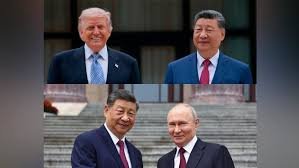
BY May 22, 2026: The rapidly shifting global order is increasingly placing China at the centre of international diplomacy, economic influence, and strategic negotiations. The back-to-back visits of US President Donald Trump and Russian President Vladimir Putin to China underline not only the growing stature of Chinese President Xi Jinping but also Beijing’s expanding ability to shape global conversations and offer strategic alternatives during crises.
From the conflict in West Asia to debates over trade, energy security, artificial intelligence, and multipolarity, China is increasingly positioning itself as an indispensable power. Its technological advancement, dominance in critical supply chains, and expanding influence across the Global South have strengthened Beijing’s leverage at a time when traditional power equations are under strain. In this evolving geopolitical landscape, India faces the challenge of safeguarding its interests while exploring new diplomatic and strategic opportunities.
READ: 19M Cockroaches Swarm Insta, Govt Hits Them on X
The visitas by Trump and Putin reflect a rapidly changing geopolitical scenario in which China often needs to do little overtly, yet its posturing alone shapes international movements and expectations. Before Trump’s visit, amid diplomatic efforts by Pakistan and several other countries to halt the US-Israel war and uphold the fragile ceasefire, Iran’s Foreign Minister Abbas Araghchi also visited China to discuss Tehran’s strategies and seek support against future attacks.
Due to the geopolitical interests of both China and Russia in West Asia, the US has suspected them of assisting Iran in navigating its arsenal during the US-Israel conflict — allegations both countries have denied. China itself has also been undergoing an internal purging process within its armed forces and facing economic vulnerabilities linked to the Strait of Hormuz blockade and Iranian control of shipping routes. Yet Beijing’s influence in global affairs continues to rise because of its technological excellence, manufacturing dominance in semiconductors, computer chips, EV batteries, and control over critical rare earth materials. Its expanding influence in Global South countries and Iran through aid, loans, and infrastructure development has further enhanced its strategic standing.
Ever since Trump spoke about the role of a “G-2” relationship with China for addressing global challenges during the APEC Economic Leaders’ Meeting in Busan, South Korea, in October 2025, China has increasingly begun to see itself not as subordinate to the US, but as an equal power. Beijing now negotiates from a position of parity and strategic confidence.
This was evident in China’s response to threats of triple-digit tariffs from the US. China neither stopped purchasing Russian oil nor succumbed to American pressure. Instead, it constrained rare earth exports, contributing to a slowdown in the global economy. The tariff war not only emboldened China to act as an equal to the US, but also signalled to Trump the risks of confrontation between a rising and an established power if American “red lines” over Taiwan and the South China Sea were crossed.
As China considers Taiwan an internal matter, continued US arms supplies to Taipei remained unacceptable to Beijing. China therefore advocated “constructive strategic stability and cooperation,” limited competition, and controllable differences to avoid conflict and identify opportunities for peace and cooperation. Discussions also reportedly included artificial intelligence regulations and ensuring the reopening of the Strait of Hormuz for smooth maritime traffic, a route critical to China’s trade, energy supplies, and economic growth.
China subtly projected the US as a declining power and argued that, at a stage when Chinese economic expansion ultimately aims to surpass the US, disruptions must be avoided. Beijing had earlier proposed a “new model of great power relations” during President Barack Obama’s tenure to push the US toward changing its policies on Taiwan and the South China Sea, though the proposal was rejected then.
Trump, however, appeared more receptive to China’s concept of strategic stability. Following the summit, he reportedly kept nearly $14 billion worth of weapons supplies to Taiwan on hold as leverage for reciprocal dealings with Beijing. Echoing Chinese strategic arguments, Trump even questioned whether the US could realistically defend Taiwan after travelling 9,500 miles to fight a war.
China appeared to hold the upper hand, as the framing and strategic direction of the discussions largely reflected Beijing’s priorities. Trump likely hoped that Chinese assistance could help the US emerge relatively unscathed from what had become a destructive, unpopular, and costly conflict with Iran. According to estimates, the US lost more than forty fighter jets and spent nearly $29 billion without tangible gains. China, meanwhile, limited itself to stating that the war should never have occurred and that the Strait of Hormuz should remain open, while offering no concrete assurance regarding Iran.
Iran’s control over the Strait of Hormuz badly affected global oil and gas trade. Tehran’s retaliatory strategy against pro-American Gulf countries and its response to Israeli attacks on energy installations contributed to sharp increases in oil prices.
Trump’s delegation managed to conclude agreements involving the purchase of two hundred Boeing aircraft, annual Chinese agricultural imports worth $17 billion, and the establishment of a bilateral Board of Trade and Investment. Yet despite these developments, the ceasefire in West Asia remained fragile after April 8, 2026. Trump repeatedly threatened to resume military operations through “Project Freedom,” though these plans were reportedly paused again following requests from Saudi Arabia, the UAE, and Qatar to allow continued negotiations with Iran. Meanwhile, the US Senate recently introduced — though failed to pass — a measure directing Trump to end the war and withdraw US forces from Iran.
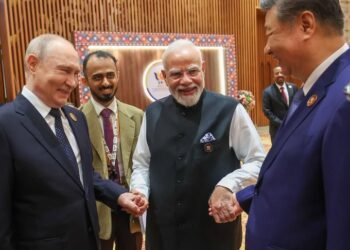
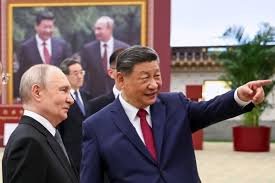
Russian President Vladimir Putin also visited China during May 19–20, 2026, amid considerable ceremony, though from a weakened position due to the prolonged Ukraine war, which severely strained Russia’s already declining economy. Russia imports significantly more from China than it exports and accounts for only around 4 percent of China’s international trade.
While China has long viewed itself as economically superior because of its booming growth, Russia’s posture during the visit also signalled that Moscow would not accept the role of a junior partner, given its vast nuclear arsenal. The West Asia conflict proved advantageous for Russian oil exports, allowing Moscow to project itself as a reliable energy supplier while deepening ties with Beijing.
Putin’s visit served as a powerful symbolic display of Russia as China’s most dependable all-weather strategic partner, contrasting itself with the unpredictability of the US. The forty agreements signed between the two countries further reflected Beijing’s calculated support for Moscow and its broader signalling of resistance to American influence.
The visit also reinforced China’s desire to be seen as a crucial global power without which peace and prosperity cannot be guaranteed. Russia managed to secure Chinese support in principle for the proposed “Power of Siberia 2” gas pipeline, intended to transport up to 50 billion cubic metres of natural gas annually from Russia’s Yamal Peninsula to China via Mongolia.
The project sits at the intersection of geopolitics, energy security, and Eurasian logistics. However, despite a “general understanding” on the route, several crucial issues — including pricing, financing, timelines, and contractual terms — remained unresolved. Both Putin and Xi reiterated support for a multipolar world order through platforms such as the United Nations, the Shanghai Cooperation Organisation, BRICS, and other multilateral institutions to address pressing global and regional issues.
India’s options under these evolving circumstances remain limited, as New Delhi lacks decisive leverage over either China or the US. Nevertheless, India continues searching for opportunities to play a larger international role. Prime Minister Narendra Modi’s visit from May 15–20, 2026, to the UAE and four European countries — the Netherlands, Sweden, Norway, and Italy — aimed at consolidating strategic partnerships in areas such as petroleum reserves, LPG supplies, investment, defence cooperation, trade, water management, agriculture, healthcare, green technology, artificial intelligence, and semiconductors.
The timing of Modi’s visit coincided with Trump’s China visit from May 13–15, 2026. According to officials from India’s Ministry of External Affairs, the trip followed the finalisation of the India-EU Free Trade Agreement and the India-EFTA Trade and Economic Partnership Agreement signed in 2025.
While India received assurances from the UAE regarding energy reserves, the UAE in turn received assurances of India’s willingness to support peace efforts in West Asia. Modi also participated in the 3rd India-Nordic Summit. Joint declarations, press briefings, and collaborative op-eds with the leaders of Sweden and Italy followed each visit. Interestingly, no similar joint declaration or detailed briefing emerged after the Xi-Trump meeting, possibly indicating underlying tensions in US-China relations.
Modi’s diplomatic outreach occurred amid Russia’s continuing war in Ukraine, Trump’s tariff measures, the US-Israel conflict with Iran, and growing global concerns over energy security. India’s need to diversify and deepen its international partnerships further shaped the visit. India reportedly sought investments worth nearly $42 billion during the tour.
However, despite Trump’s China visit and mediation efforts by Pakistan and several other countries, no substantial breakthrough emerged on Iran. This evolving global situation may ultimately require India to play a more constructive role in crisis management, particularly given the goodwill and strategic credibility it enjoys across multiple regions.
( The author is Former Vice Chancellor and Professor of Political Science, HNB Garhwal (Central) University, Srinagar, Garhwal, Uttarakhand)