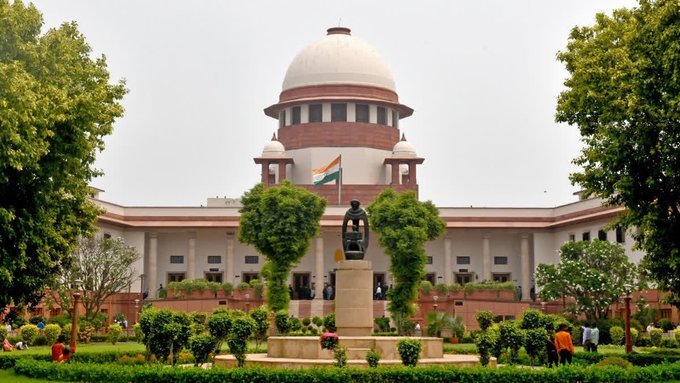
New Delhi/ July 30, 2026: : The Supreme Court on Thursday sought an explanation from the Bihar government over the continuation of Panchayati Raj Minister Deepak Prakash, who has remained in office for more than six months in aggregate without being elected to either House of the state legislature.
A Bench headed by Chief Justice of India Surya Kant described the matter as involving “a pure question of law” and directed the state government to clarify the constitutional basis for the minister’s appointment. The case has been listed for urgent hearing on August 4, with the Court expected to decide whether the Constitution permits a minister to continue in office through staggered terms without securing membership of the legislature.
Constitutional Question Before the Court
The petition challenges Prakash’s reappointment and continued tenure in the Council of Ministers, arguing that it violates Article 164(4) of the Constitution, which limits the period for which a non-legislator can serve as a minister.
The case centres on an important constitutional question: Can a person who has already served as a minister without being elected be reappointed after a brief break and claim a fresh six-month period, or does the Constitution require the total period of service to be counted together?
Calling it a matter of constitutional interpretation, the Bench indicated that the ruling could have implications extending well beyond Bihar.
Why the Appointment Is Under Challenge
Deepak Prakash first served as Bihar’s Panchayati Raj Minister in the Nitish Kumar government for four months and 26 days without becoming a member of either the Legislative Assembly or the Legislative Council.
His tenure ended on April 15, 2026, when Nitish Kumar resigned as Chief Minister. After remaining out of office for 22 days, Prakash was sworn in again on May 7, 2026, when Samrat Choudhary formed a new government.
Despite being reappointed as a Cabinet minister, Prakash has still not been elected to the state legislature.
The petition, filed on May 30, contends that allowing him to continue in office after cumulatively serving for more than six months amounts to “a fraud upon the Constitution” and defeats the purpose of Article 164(4).
READ: Kangana’s ‘Generation Gutter’ Remark Triggers Massive Backlash
What Article 164(4) Says
The dispute revolves around Article 164(4) of the Constitution, which provides:
“A Minister who for any period of six consecutive months is not a member of the Legislature of the State shall at the expiration of that period cease to be a Minister.”
The provision permits a Chief Minister to induct a person who is not a legislator into the Council of Ministers, but only on the condition that the individual secures election to the legislature within six months.
In practice, governments usually ensure compliance by having such ministers contest a by-election or enter the Legislative Council before the constitutional deadline expires.
A Constitutional Grey Area
The Bihar case presents an unusual legal issue because Prakash did not serve six consecutive months in a single tenure.
Instead, he completed nearly five months in office, remained out of the Cabinet for just over three weeks following the change of government, and was then reappointed.
The key question before the Supreme Court is whether this brief interruption effectively resets the constitutional clock or whether the total period of service without legislative membership should be counted together.
The petitioner argues that permitting repeated reappointments after short breaks would allow governments to bypass the constitutional safeguard indefinitely, undermining the principle that ministers must remain accountable to the legislature.
Established Constitutional Practice
Indian constitutional practice has seen several ministers and chief ministers assume office before becoming members of the legislature.
Former Maharashtra Chief Minister Uddhav Thackeray entered the Legislative Council within the prescribed six-month period after taking office in 2019.
Former Uttarakhand Chief Minister Tirath Singh Rawat resigned in 2021 before the deadline after it became difficult to hold a by-election during the COVID-19 pandemic.
Similarly, former Prime Minister H.D. Deve Gowda entered Parliament after assuming office.
In each of these cases, however, the constitutional six-month limit remained intact. The Bihar matter is the first to squarely raise the issue of whether successive appointments separated by a brief interval can effectively extend that period.
Wider Implications
The Supreme Court’s ruling is expected to set an important precedent on the interpretation of Article 164(4), particularly at a time when coalition governments and changes in political alignments frequently lead to Cabinet reshuffles.
Constitutional experts say the six-month provision is intended to provide flexibility by allowing distinguished individuals from outside the legislature to join the executive temporarily. However, they caution that it is not designed to become a mechanism for indefinitely retaining unelected ministers in office.
The Court’s decision could therefore have implications for ministerial appointments across the country, reinforcing the balance between executive discretion and the constitutional requirement that those exercising executive power remain accountable to the elected legislature.
With the matter scheduled for hearing on August 4, the judgment is expected to clarify whether the six-month rule is a strict constitutional limit or whether a fresh appointment following a change in government creates a new period of eligibility.